Showing posts with label Science. Show all posts

Wednesday, January 2, 2008

Theologian John Haught explains why science and God are not at odds, etc


By Steve Paulson, salon.com

The atheist delusion
Theologian John Haught explains why science and God are not at odds, why Mike Huckabee worries him, and why Richard Dawkins and other "new atheists" are ignorant about religion.

By Steve Paulson

Dec. 19, 2007 | Evolution remains the thorniest issue in the ongoing debate over science and religion. But for all the yelling between creationists and scientists, there's one perspective that's largely absent from public discussions about evolution. We rarely hear from religious believers who accept the standard Darwinian account of evolution. It's a shame because there's an important question at stake: How can a person of faith reconcile the apparently random, meaningless process of evolution with belief in God?

The simplest response is to say that science and religion have nothing to do with each other -- to claim, as Stephen Jay Gould famously did, that they are "non-overlapping magisteria." But perhaps that response seems too easy, a politically expedient ploy to pacify both scientists and mainstream Christians. Maybe evolutionary theory, along with modern physics, does pose a serious challenge to religious belief. To put it another way, how can an intellectually responsible person of faith justify that faith -- and even belief in a personal God -- after Darwin and Einstein?

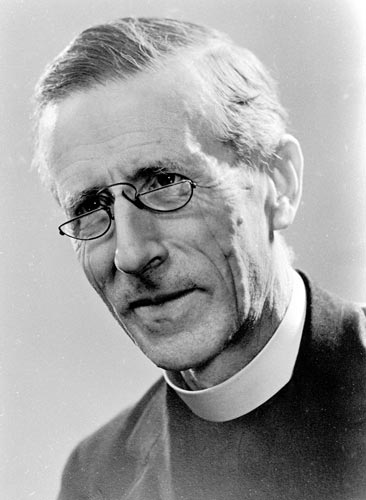
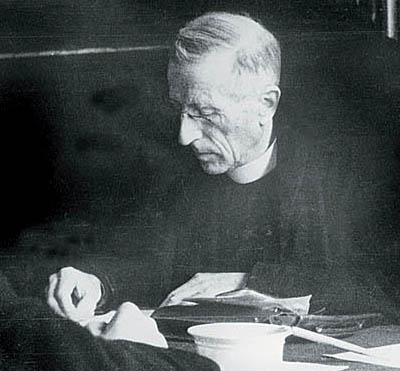
That's the question John Haught has set out to answer by proposing a "theology of evolution." Haught is a Roman Catholic theologian at Georgetown University and a prolific author. His books include "God After Darwin," "Is Nature Enough?" and the forthcoming "God and the New Atheism." He's steeped in evolutionary theory as well as Christian theology. Haught believes Darwin is "a gift to theology." He says evolutionary biology has forced modern theologians to clarify their thinking by rejecting outdated arguments about God as an intrusive designer. Haught reclaims the theology of his intellectual hero, Jesuit priest and paleontologist Pierre Teilhard de Chardin, who died more than half a century ago. Teilhard believed that we live in a universe evolving toward ever greater complexity and, ultimately, to consciousness.

Haught is an intriguing figure in the debate over evolution. He was the only theologian to testify as an expert witness in the landmark 2005 Dover trial that ruled against teaching intelligent design in public schools. Haught testified against intelligent design, arguing that it's both phony science and bad theology. But Haught is also a fierce critic of hardcore atheists like Richard Dawkins and Daniel Dennett, who claim that evolution leads logically to atheism. He says both sides place too much faith in science. "Ironically," Haught writes, "ID advocates share with their ideological enemies, the evolutionary materialists, the assumption that science itself can provide ultimate explanations."

I talked with Haught about the new atheists, Albert Camus, and how evolutionary biology can be a complement to faith. We spoke about why Christian candidates like Mike Huckabee worry him and why science is ultimately not equipped to answer questions about love, consciousness and the Resurrection.

CONTINUE...

Monday, November 19, 2007

Kitzmiller v. Dover Area School District


Kitzmiller v. Dover Area School District
Trial transcript: Day 5 ((September 30), PM Session, Part 1
John F.Haught, PH.D., called as a witness, having been duly sworn or affirmed, testified as follows:

Continue

Thursday, November 1, 2007

Great new book: "The Divine Milieu Explained: A Spirituality for the 21st Century"

67/68. Who was this guy called Pierre Teilhard de Chardin? Why is he Famous in the Scientific Community?

From Are Jesuits Catholic?

Pierre Teilhard de Chardin was a visionary French Jesuit, paleontologist, biologist, and philosopher, who spent the bulk of his life trying to integrate religious experience with natural science, most specifically Christian theology with theories of evolution. In this endeavor he became absolutely enthralled with the possibilities for humankind, which he saw as heading for an exciting convergence of systems, an "Omega point" where the coalescence of consciousness will lead us to a new state of peace and planetary unity. Long before ecology was fashionable, he saw this unity he saw as being based intrinsically upon the spirit of the Earth:

"The Age of Nations is past. The task before us now, if we would not perish, is to build the Earth." Teilhard de Chardin passed away a full ten years before James Lovelock ever proposed the "Gaia Hypothesis" which suggests that the Earth is actually a living being, a collosal biological super-system. Yet Chardin's writings clearly reflect the sense of the Earth as having its own autonomous personality, and being the prime center and director of our future -- a strange attractor, if you will -- that will be the guiding force for the synthesis of humankind.

"The phrase 'Sense of the Earth' should be understood to mean the passionate concern for our common destiny which draws the thinking part of life ever further onward. The only truly natural and real human unity is the spirit of the Earth. . . .The sense of Earth is the irresistable pressure which will come at the right moment to unite them (humankind) in a common passion.

"We have reached a crossroads in human evolution where the only road which leads forward is towards a common passion. . . To continue to place our hopes in a social order achieved by external violence would simply amount to our giving up all hope of carrying the Spirit of the Earth to its limits."

To this end, he suggested that the Earth in its evolutionary unfolding, was growing a new organ of consciousness, called the noosphere. The noosphere is analogous on a planetary level to the evolution of the cerebral cortex in humans. The noosphere is a "planetary thinking network" -- an interlinked system of consciousness and information, a global net of self-awareness, instantaneous feedback, and planetary communication. At the time of his writing, computers of any merit were the size of a city block, and the Internet was, if anything, an element of speculative science fiction. Yet this evolution is indeed coming to pass, and with a rapidity, that in Gaia time, is but a mere passage of seconds. In these precious moments, the planet is developing her cerebral cortex, and emerging into self-conscious awakening. We are indeed approaching the Omega point that Teilhard de Chardin was so excited about.

This convergence however, though it was predicted to occur through a global information network, was not a convergence of merely minds or bodies -- but of heart, a point that he made most fervently.

"It is not our heads or our bodies which we must bring together, but our hearts. . . . Humanity. . . is building its composite brain beneath our eyes. May it not be that tomorrow, through the logical and biological deepening of the movement drawing it together, it will find its heart, without which the ultimate wholeness of its power of unification can never be achieved?"

In his productive lifetime, Teilhard de Chardin wrote many books, which include the following: LET ME EXPLAIN
THE APPEARANCE OF MAN
THE DIVINE MILIEU
THE FUTURE OF MAN
HOW I BELIEVE
HYMN OF THE UNIVERSE
LETTERS FROM A TRAVELLER
LETTERS TO LEONTINE ZANTA
THE MAKING OF A MIND
MAN'S PLACE IN NATURE
THE PHENOMENON OF MAN
SCIENCE AND CHRIST
THE VISION OF THE PAST
WRITINGS IN TIME OF WAR
BUILDING THE EARTH

Most of these quotes were taken from Building the Earth, and The Phenomenon of Man, but as I no longer have a copy, but only old notes, I can't quote exact page numbers.

by Anodea Judith, Dec. 96.

from: http://www.gaiamind.com/Teilhard.html
more on Teilhard de Chardin: http://en.wikipedia.org/wiki/Pierre_Teilhard_de_Chardin
posted by sonoftheprodigal at 8:43 PM 3 comments

Sunday, August 12, 2007

Designing Life

By John F. Kavanaugh

The Case Against Perfection
By Michael J. Sandel
Belknap Press. 176p $18.95 (hardcover)

A t first I did not want to review this rather slight treatment of such a weighty topic. But as it turns out, Michael Sandel’s dive into the sea of genetic engineering provides a great tasty gulp of contemporary ethical controversy. Quickly read, The Case Against Perfection is nonetheless dense with challenging quandaries, loaded with moral puzzles and filled with facts. An inveterate highlighter, I underlined half the book.

In his first essay, “The Ethics of Enhancement,” Sandel, professor of government at Harvard University, raises the question whether “curing” is different from “improving.” Do plastic surgery and Botox injections heal us or improve us? And if there is little difference, why do they seem acceptable, while muscle enhancement through steroids or blood doping is not? If growth hormones are permitted for children whose projected height is under 5 feet, why are they not acceptable for a possible 6-footer who wants to be a power forward? If reproductive autonomy is so important, why should it be prohibited for parents who want sex selection? He applies these questions more specifically to athletic enhancement, both low-tech assistance by better shoes and golf clubs, through Lasik surgery on to blood transfusions and hormone injections.

While discussing athletes, Sandel surfaces the theme that will mark his later discussion of “designer children” and his final chapter, called “Mastery and Gift.”

To acknowledge the giftedness of life is to recognize that our talents and powers are not wholly our own doing, nor even fully ours…. It is also to recognize that not everything in the world is open to any use we may desire or devise. An appreciation of the giftedness of life constrains the Promethean project and conduces to a certain humility.
Thus, in discussing children, Sandel warns that they must be appreciated and accepted as gifts, not as objects to be manipulated for utilitarian or egoistic goals. He suggests that there is the danger of radical pride in trying to design or control. Concurring with William May, he holds that the “transforming love” of guiding, forming and enhancing a child must be balanced with “accepting love” that embraces children for their own intrinsic, not performative, goodness. While Sandel offers no hard and fast line of difference between (a) specialized training and the best schools, (b) growth hormones and orthodontics and (c) eugenics (a “presumably bad thing”), the drive to mastery and control could extinguish our appreciation of life as a gift.

The dangers of reproductive mastery are horrifically sketched in the book’s best chapter, a treatment of the “old” eugenics and the “new.” The old eugenics of forced sterilization in the United States and racial cleansing in the Third Reich, having been replaced by a seemingly more benign combination of market-based and liberal eugenics, still haunts our contemporary consciousness. Insistence on atomistic autonomy in reproduction and fixation on desired traits are a flight from the contingency and connectedness of our common humanity and a refusal to accept our existence as a gift. These are Sandel’s ideas most worthy of development and elaboration, perhaps in concert with his interlocutors, William May, Leon Kass, Charles Taylor and Jurgen Habermas.

As for myself, I would want to engage Sandel over his epilogue, the longest section of the book, titled “Embryo Ethics: The Stem Cell Debate.” This serious and insightful attempt to prove that an individual human life, and surely human personhood, is incorrectly attributed to early stage embryos, should be read by anyone who holds the conception criterion for the beginning of an individual human being. His arguments, while not being the traditional ones that are made concerning undifferentiated cells, twinning and the high number of spontaneous abortions, are telling. Our collecting of “spare” embryos, our apparent acceptance of in vitro fertilization, our lack of mourning for all the supposed tiny persons lost, President Bush’s eager willingness to say he is not banning the use of private funds for embryonic stem cell research all indicate that we really do not believe we are dealing with persons. This is indeed a powerful critique of the present confusion. But it does not address what exactly a human being is. Surely, as Sandel says, an acorn is not a full-blown oak. Neither is it a sapling. The acorn, however, is the start of a tree’s existence. An embryo, similarly, is neither a grandmother nor a toddler; but every piece of genetic evidence we have reveals that at conception we have the beginning of a unique human career (or two, if it is so programmed from the beginning to twin).

As you read this book, you might imagine yourself sitting in on one of Sandel’s classes of a thousand Harvard students. It is said that he can be mesmerizing with his probing questions and tricky sample cases. Another thing you might imagine is sitting with him at a meeting of the President’s Council on Bioethics, engaging the likes of William Hurlbut and Leon Kass—both strongly disagreeing with him at times, but hearing what he has to say and being honestly heard in return.

The Case Against Perfection, consequently, is open to a very wide audience indeed. It will introduce the novice to some of the knotty problems in genetic therapy and enhancement. It will propose thoughtful challenges to the college undergraduate. As for scholars, it will unsettle those who may have too easily or ideologically arrived at unwarranted conclusions. And it will challenge those of us who disagree with him on the status of the human embryo to provide our most cogent and well-evidenced arguments.


Monday, June 25, 2007

Einstein on God and Religion

Einstein on God and Religion

Try and penetrate with our limited means the secrets of nature and you will find that, behind all the discernible laws and connections, there remains something subtle, intangible, and inexplicable. Veneration for this force beyond anything we can comprehend is my religion. To that extent I am, in fact, religious.

I am not an atheist. I don´t think I can call myself a pantheist. The problem involved is too vast for our limited minds. We are in the position of a little child entering a huge library filled books in many languages. The child knows someone must have written those books. It does not know how. It does not understand the languages in which they are written. The child dimly suspects a mysterious order in the arrangement of the books but does not know what it is. That, it seems to me, is the attitude of even the most intelligent human being towards God. We see the universe marvelously arranged and obeying certain laws, but only dimly understand these laws.

The most beautiful emotion we can experience is the mysterious. It is the fundamental emotion that stands at the cradle of all true art and science. He to whom this emotion is a stranger, who can no longer wonder or stand rapt in awe, is as good as dead, a snuffed out candle. To sense that behind anything that can be experienced there is something that our minds cannot grasp, whose beauty and sublimity reaches us only indirectly : this is religiousness. In this sense, and in this sense only, I am a devoutly religious man.