Showing posts with label Emergent/Ecumenical. Show all posts

Monday, March 24, 2008

The unexpected monks


Some evangelicals turn to monasticism, suggesting unease with megachurch religion - and the stirrings of rapprochement with the Roman Catholic Church.

By Molly Worthen | February 3, 2008

S.G. PRESTON IS a Knight of Prayer. Each morning at his Vancouver, Wash., home, he wakes up and prays one of the 50-odd psalms he has committed to memory, sometimes donning a Kelly green monk's habit. In Durham, N.C., Jonathan Wilson-Hartgrove and fellow members of Rutba House gather for common meals as well as morning and evening prayer based on the Benedictine divine office. Zach Roberts, founder of the Dogwood Abbey in Winston-Salem, meets regularly with a Trappist monk to talk about how to contemplate God. Roman Catholic monastic traditions loom large in their daily routines - yet all three men are evangelical Protestants.

The image of the Catholic monk - devoted to a cloistered life of fasting and prayer, his tonsured scalp hidden by a woolen cowl - has long provoked the disdain of Protestants. Their theological forefathers denounced the monastic life: True Christians, the 16th-century Reformers said, lived wholly in the world, spent their time reading the Bible rather than chanting in Latin, and accepted that God saved them by his grace alone, not as reward for prayers, fasting, or good works. Martin Luther called monks and wandering friars "lice placed by the devil on God Almighty's fur coat." Of all Protestants, American evangelicals in particular - activist, family-oriented, and far more concerned with evangelism than solitary study or meditative prayer - have historically viewed monks as an alien species, and a vaguely demonic one at that.

Yet some evangelicals are starting to wonder if Luther's judgment was too hasty. There is now a growing movement to revive evangelicalism by reclaiming parts of Roman Catholic tradition - including monasticism. Some 100 groups that describe themselves as both evangelical and monastic have sprung up in North America, according to Rutba House's Wilson-Hartgrove. Many have appeared within the past five years. Increasing numbers of evangelical congregations have struck up friendships with Catholic monasteries, sending church members to join the monks for spiritual retreats. St. John's Abbey, a Benedictine monastery in Minnesota, now makes a point of including interested evangelicals in its summer Monastic Institute.

"I grew up in a tradition that believes Catholics are pagans," said Roberts, who was raised Southern Baptist and serves as a pastor in a Baptist church. "I never really understood that. Now I'd argue against that wholeheartedly."

In an era in which televangelists and megachurches dominate the face of American evangelicalism, offering a version of Christianity inflected by populist aesthetics and the gospel of prosperity, the rise of the New Monastics suggests that mainstream worship is leaving some people cold. Already, they are transforming evangelical religious life in surprising ways. They are post-Protestants, breaking old liturgical and theological taboos by borrowing liberally from Catholic traditions of monastic prayer, looking to St. Francis instead of Jerry Falwell for their social values, and stocking their bookshelves with the writings of medieval mystics rather than the latest from televangelist Joel Osteen.

The New Monastics come from a variety of religious backgrounds, from Presbyterian to Pentecostal. All share a common frustration with what they see as the overcommercialized and socially apathetic culture of mainstream evangelicalism. They perceive a "spiritual flabbiness in the broader church and a tendency to assimilate into a corrupt, power-hungry world," writes New Monastic author Scott Bessenecker in his recent book "The New Friars."

New Monasticism is part of a broader movement stirring at the margins of American evangelicalism: Evangelicals disillusioned with a church they view as captive to consumerism, sectarian theological debates, and social conservatism. Calling themselves the "emerging church" or "post-evangelicals," these Christians represent only a small proportion of the approximate 60 million evangelical Americans. Yet their criticisms may resonate with more mainstream believers. A recent study by Willow Creek Community Church in Illinois - one of the most influential megachurches in the nation - discovered that many churchgoers felt stalled in their faith, alienated by slick, program-driven pastors who focus more on niche marketing than cultivating contemplation. The study suggested that megachurch members know how to belt out jazzy pop hymns from their stadium seats, but they don't always know how to talk to God alone.

Many New Monastics live and worship together, and their practices sometimes resemble the communes and house churches associated with the Jesus Movement of the 1970s. Like the hippies who were "high on Jesus," New Monastics tend to favor simple living, left-leaning politics, and social activism. However, they are quick to cite the intellectual seriousness and monastic forms of prayer and study that set them apart. "I doubt most of the Jesus Movement people were reading the philosophers of their day in the way I have friends reading Zizek and Derrida," said Mark Van Steenwyk, founder of Missio Dei, a New Monastic community in Minneapolis. Van Steenwyk's group has also compiled its own breviary, a book of scriptural texts that guides the group's abbreviated version of the divine office sung in monasteries.

"The real radicals aren't quoting Che Guevara or listening to Rage Against the Machine on their iPods," writes Wilson-Hartgrove in a forthcoming book, "New Monasticism: What It Has to Say to Today's Church." "The true revolutionaries are learning to pray."

I their countercultural orientation, the New Monastics are true to the oldest monastic precedent. The founding father of monasticism, fourth-century Egyptian St. Anthony, gave away his worldly possessions and fled the temptations of the Roman Empire for desert solitude. Monasticism's subsequent history is a complicated story of both extreme asceticism and descent into decadence, of the Vatican's alternate promotion and suppression of charismatic holy men and women who criticized and compromised with the church hierarchy. Though by the 16th century there was much truth in the Reformers' charges of monastic depravity and corruption, the religious orders made up a diverse culture still home to rebels and critics: Martin Luther himself was an Augustinian friar.

Though New Monasticism is not entirely a product of the evangelical left - the Knights of Prayer, for example, are not interested in liberalizing movements within the church - most New Monastics are trying to create an alternative to conservative mainstream evangelicalism. They embrace ecumenism over doctrinal debate, encourage female leadership, and care far more about social justice and the environment than about the culture wars. Shane Claiborne, founder of one of the best-known New Monastic communities, the Simple Way of Philadelphia, asks that churches that invite him to speak offset the carbon emissions produced by his visit by "fasting" from fuel.

More fundamentally, New Monastics consider themselves "monks in the world." They are not interested in extreme isolation or asceticism (though there are stories about the occasional Protestant "hermit" living in the Mountain West). Nearly all have regular jobs and social lives. From the traditionalist perspective, many break the most essential monastic rule: they are married. Most groups support those who choose a celibate lifestyle, and a few have a member or two who do so, but it happens rarely.

Five centuries of Protestant heritage have alienated most New Monastics from the notion of religiously motivated celibacy. More importantly, these groups do not aim to separate themselves from society - on the contrary, they see New Monasticism as a means to better integrate core Christian values into their lives as average citizens. This is the fundamental difference between old monks and the new. New Monastics often quote one of their heroes, Lutheran theologian Dietrich Bonhoeffer, who captured the ambitions - and the ecumenical limits - of the movement when he wrote in 1935, "the restoration of the church will surely come only from a new kind of monasticism which will have nothing in common with the old but a life of uncompromising adherence to the Sermon on the Mount in imitation of Christ."

Missio Dei is one of many groups that have deliberately made their homes in struggling urban neighborhoods. In addition to their routine of prayer and worship, they serve vegan meals to people on the street and offer hospitality to those who need it. Van Steenwyk sees hypocrisy in churches that preach social justice from the pulpit, but ignore their struggling neighbors for the rest of the week. "You can be involved with your church, but never really experience brokenness in another human being. Jesus lived with other people," he said. "So we ask, what are the resources throughout church history that can equip us to live life that way?"

Serving the poor is not a new impulse among evangelicals, but serious contemplation is. American culture has never placed a high priority on solitude, and historically, self-denial has gone hand in hand with bustling capitalist productivity, not contemplation (though the Puritans did balance their active lives with a heavy dose of journaling and soul-searching). America has produced a few geniuses of contemplative life - Henry Thoreau and Emily Dickinson come to mind - but we have no indigenous contemplative tradition comparable to that of Catholic Europe or Buddhist Japan. Yet contemplation is the heart of what it means to be a monk: the root of the word, monos, means "alone" in Greek.

Evangelicals have been tentatively exploring that side of Christian tradition since at least the 1978 publication of "Celebration of Discipline" by Richard Foster, a Quaker theologian who recast fasting and meditative prayer for an evangelical audience. His book sold nearly 2.5 million copies and launched a cottage industry of evangelical contemplative literature - a phrase that, 30 years ago, was a contradiction in terms. Some evangelicals made pilgrimages to the handful of older ecumenical monastic communities abroad, such as the Taizé Community (founded in Burgundy, France, in 1940), and the Iona Community, founded in 1938 at St. Columba's landing place in the Inner Hebrides. They brought back what they learned, and have tried to make it their own.

N

ot all of their co-religionists, however, are pleased with these new spiritual ventures. Van Steenwyk received e-mails from friends concerned about his "fringe activities," including accusations that he'd "gotten into bed with the apostate Catholic Church." Deborah Dombrowski, along with her husband, David, founded Lighthouse Trails Publishing and Research Project in 2002 to counteract the "infiltration" of evangelicalism by "mystical spirituality." She fears that New Monastics' contemplative prayer is no different from Eastern meditation, and their openness to Roman Catholicism is only the beginning: "where it's going is an interspiritual, interfaith, one-world religion, where it all blends together."

Though many Roman Catholics have mixed feelings about evangelicals who adopt a hodgepodge of watered-down monastic practices and call themselves "monks," some are supportive of New Monasticism. They view the movement as part of a wider rapprochement between Protestant evangelicals and Rome. A half-century of theological shifts on both sides of the divide - Vatican II's liberalizing impact on the Catholic Church, and the waning of Protestant fundamentalism - as well as the decline of traditional ethnic resentments and an emerging pattern of political cooperation have all prepared the way. Father Jay Scott Newman, a priest in South Carolina, said that the New Monastic movement suggests a profound shift in evangelical identity.

"Until very recently, an evangelical of whatever stripe included in his self-definition not just opposition to, but violent rejection of everything Catholic," he said. "That's no longer true{hellip}that's dramatic, revolutionary, and, I think, lasting."

To some Catholic observers, it is no shock that evangelicals have begun to feel the lack of organized contemplative life and yearn for a bond with religious tradition - they're only surprised that it took them so long. "Monasticism has been such a powerful thing in the West and the East for so long that it would be very peculiar if it didn't, at one point or another, erupt in evangelical circles," said William Shea, director of the Center for Religion, Ethics, and Culture at the College of the Holy Cross.

"It's just too long, too deep, too creative a tradition{hellip}You could call this movement ersatz monasticism, but I would hold back and ask, where might this lead?"

Molly Worthen, a New Haven-based writer, is working on a book about evangelical intellectual life.

Wednesday, January 30, 2008

Great review of what seems like an interesting book...


"I'm lost in admiration for Lamin Sanneh's magnificent study of world Christianity, for the work's geographical scope and historical sweep, and for the breadth of the author's learning. Throughout, Sanneh asks the critical question: how can we reconceive Christianity in a way that frees it from its European and imperial contexts, permitting the faith to adapt to the kaleidoscopic realities of different societies around the globe. This is a splendid achievement." --Philip Jenkins, author of The Next Christendom and The New Faces of Christianity


By Matt K. "happy reader" (Michigan, USA)

A spate of recent works on "world (or global) Christianity," including Philip Jenkins' widely read "The Next Christendom" (New York: Oxford Univ. Press, 2007), have drawn needed attention to one of the most striking developments of the past century: the rise of a "Post-Western Christianity" which is now firmly rooted and growing dramatically in parts of Africa, Asia, and Latin America.

In his recent book, "Disciples of All Nations: Pillars of World Christianity," Lamin Sanneh sets out to describe some of the "pillars" or roots of this worldwide Christian awakening, which he calls the "Third Awakening" (p. 274). It is a wide-ranging study that chronicles the fascinating, if somewhat messy, story of Christianity's naturalization (or "inculturation") and growth among various peoples throughout its history. It is the story of Christianity becoming "the most diverse and pluralist religion in the world." To tell the story, Sanneh focuses on certain themes ("pillars") that define "world Christianity," and then illustrates them in multiple ways, drawing out interesting implications along the way.

It is an eye-opening study that contains fascinating, and sometimes myth-busting insights about our understanding of the nature of the Christian religion, our understanding of Western missions, and the role of local agency and native resources in the spread of Christianity. Anyone interested in the worldwide Christian movement or current events would greatly benefit from Professor Sanneh's thorough study.

Let me offer one small warning: someone reading "Disciples of All Nations" without a decent background in the history of Christian missions may well find this book overwhelming. Sanneh has such a remarkable breadth of knowledge and draws his examples from such a variety of contexts that I sometimes struggled to stay with him. At times, Sanneh rather abruptly turns to particular historical examples that feel more like extended rabbit trails than helpful contributions to the flow of his argument. The book would have been much strengthened by clearer organization. Still, in spite of this, I warmly recommend the book.

One of Sanneh's dominant themes that emerges again and again is that Christianity has a "peculiar temper"(p. 12) acquired through its long encounter with a dizzying diversity of cultural, political and social contexts. "The characteristic pattern of Christianity's engagement with the languages and cultures of the world has God at the center of the universe of cultures, implying equality among cultures and the...relative status of cultures vis a vis the truth of God. No culture is so advanced or so superior that it can claim exclusive access or advantage to the truth of God, and none so marginal...that it can be excluded. All have merit, none is indispensable" (p. 25).

As such, Christianity both absorbs and transforms the cultures it encounters. It spreads by making local appropriations and adaptations with local cultural resources, while investing those preexisting materials with new meaning and purpose. All that is to say, one reason for Christianity's appeal as a world religion is that it is a "translated and translating" religion, a religion with an "amazing power of adaptation" which enables it to speak to the heart of human beings in exceedingly diverse historical and cultural situations.

If this "peculiar temper" of Christianity is one of the faith's greatest strengths, it has too often been hindered by notions of cultural superiority, and connections to political power. Sanneh shows, again through a multitude of examples, the "heavy price" that has often been paid when Christianity's "intrinsic character as a worldwide religion... was framed in the uniform tenets of Christendom," and thus used to justify exploitation and domination (p. 54).

In the West, this is an often-told story: the story of missionary complicity in colonial imperialism. Sanneh is not shy to point out many examples of this. But, he is quick to add, though western scholarship and popular opinion would have us believe otherwise, that is not the whole story.

Sanneh writes, "I am urging a revisionist history without claiming that missions and colonialism were not in cahoots." So while acknowledging the colonial connections and mindset of many missions, Sanneh contends that "the frontier experience... ultimately transformed missions' agenda and modus operandi," so that many missionaries repudiated their ties to the colonial powers and worked for local empowerment in the cause of Christ. There were many shining examples of this throughout missions history. Missions saw increasingly that though the Gospel was a universal message meant to flourish in any and every cultural milieu, the "crushing burden" of "Europeandom" had muted the Gospel and robbed it of its power.

Moreover, wether consciously or unconsciously, missionaries who translated the Bible into local vernacular languages, and who preached the essentials of Christianity, often sowed the seeds of local empowerment that contributed to the undermining of colonial domination.

Bible translation, it turned out, was a great act of cultural affirmation and empowerment. Bible translation work also produced grammars and lexicons for languages that otherwise might have disappeared.

Though Sanneh devotes a great deal of attention to foreign missions, that is not his ultimate focus; to focus on Western missions would be to misread Sanneh. Throughout "Disciples of All Nations," he explicitly shifts the focus from expatriate initiative to local reception, from foreign control to native direction. This is another crucial and convincing aspect of Sanneh's argument.

Sanneh claims that scholarship related to the growth of Christianity in Africa and the colonial era often makes the same mistake the colonial powers made: they ignore the vital, creative, energetic response and involvement of local people themselves.

However, Sanneh contends that this one-sided picture of native passivity in the face of missionary hegemony is far wide of the mark. It soon became clear that while foreigners may have been the initial bearers of Christian teaching to parts of Africa, Africans had taken the ball for themselves and run with it.

In the last chapter of the book, Sanneh points out a similar Chinese appropriation of Christianity which took place in very different circumstances. In its paranoid repression of Christianity as a "foreign religion," the communist revolution in China (itself the bearer of a foreign ideology - Marxism) ironically cleared the decks for the thoroughly Chinese Christian awakening that is currently underway in China (ch. 8).

Returning to Africa, it became clear that Africans wanted Jesus, they wanted the Bible, they wanted healing and miracles and power over evil in the spirit realm (things they found ample evidence for in the Bible), but not the European civilization that was supposed to accompany Christianity (something the Bible seemed to oppose at many points). Sanneh provides a cogent summary: "It is remarkable the extent to which colonial co-option weakened Christianity by presenting it as a freshly minted European creed. Africans rejected that view by circulating the religion as local currency" (p. 161).

On the one hand, then, African Christians brilliantly separated the Christian kernel from the colonial husk, and made Christianity their own. In so doing, they often recaptured the spirit of primal apostolic Christianity against its secularized European counterpart. On the other hand, this story illustrates that Christianity itself, with its "peculiar temper" refused to be domesticated. It is almost as if Christianity itself was just waiting to shake off its colonial baggage and break out in fresh ways in these new contexts.

In the end, by putting the Christian movement into the broader context which I have attempted to summarize above, Lamin Sanneh has convincingly shown that the present growth of world Christianity, while unprecedented in its scale, is not at all out of character. By carefully demonstrating the "peculiar temper" of Christianity, the two-sided process of Christian expansion (missionary outreach and local appropriation), and the "serial nature" of Christian history, Sanneh has helped us to see again that Christianity is a dynamic world religion, a religion able to flourish and be "at home" in a wide variety of cultural, linguistic, social and political contexts.

This may be surprising in certain quarters, for example, where the Western pedigree of Christianity has been long assumed, or where the supernaturalism of Christianity has been long assumed discredited. But this surprise may well say more about the cultural or ideological captivity of these quarters than it does about the true nature of the faith.

Friday, January 18, 2008

Jesus for President - Politics for Ordinary Radicals


Chapter/Section Summaries

Section 1
A good Creation of love and beauty takes a turn for the worse, landing it in a murderous chaos. What to do? Flood it and start fresh? Build a tower that reaches heaven? Appoint an adventurous elderly couple to lead the people out of the nations to the Promised Land? Something has to save humanity from themselves …

Section 2
The construction of a set-apart people into a living temple of blessing is going so-so. The solution: God puts skin on to show the world what love looks like. But here’s the catch: the Prince of Peace is born as a refugee in the middle of a genocide and is rescued from the trash bin of imperial executions to stand at the pinnacle of this peculiar people. A strange way to start a revolution …

Section 3
Flags on altars, images of the gods on money … Caesar is colonizing our imaginations. What has happened to the slaughtered Lamb, the Prince of Peace? There seems to be another gospel spreading across the empire, and two Kingdoms are colliding. What is a Jesus-follower to do when the empire gets baptized?

Section 4
Snapshots of political imagination … the question is not are we political, but how are we political. Not are we relevant, but are we peculiar? The answer lies in how we embody what we believe. Our greatest challenge is to maintain the distinctiveness of our faith in a world gone mad. And all of creation waits, groans, for a people who live God’s dream with fresh imagination.

Thursday, December 13, 2007

Book worth checking out - How (Not) to Speak of God, by Pete Rollins

"The emerging [Christian] thought is a self-acknowledged form of heresy insomuch as it is aware of its failure to describe that of which it speaks. This recognition acts as an effective theological response to fundamentalism, as it unsettles the dark heart of its self-certain power. Very briefly, fundamentalism can be understood as a particular way of believing one's beliefs rather than referring to the actual content of one's beliefs.

"It can be described as holding a belief system is such a way that it mutually excludes all other systems, rejecting other views in direct proportion to how much they differ from one's own. In contrast, the a/theistic approach can be seen as a form of disbelieving what one believes, or rather, believing IN God while remaining dubious concerning what one believes ABOUT God (a distinction that fundamentalism is unable to maintain). This does not actually contradict the idea of orthodoxy but rather allow us to understand it in a new light...

"This a/theism is not then some temporary place of uncertainty on the way to spiritual maturity, bur rather is something that operates within faith as a type of heat-inducing friction that prevents our liquid images of the divine from cooling and solidying into idolatrous form."

Thursday, November 15, 2007

Mindblowing..."Globalization, Spirituality, and Justice: Navigating the Path to Peace"


Globalization, Spirituality, and Justice: Navigating the Path to Peace (Theology in Global Perspective) (Paperback)

By Mary J. Miller (Iowa and Indiana, USA) - See all my reviews
(REAL NAME)

"This book may take our breath away." So states the cover blurb from Walter Brueggemann on "Globalization, Spirituality, and Justice: Navigating the Path to Peace," released on April 17, 2007 by Daniel G. Groody. The basic premise is, metaphorically, that the global family has booked passage and is now aboard the ship of globalization and there is no turning back to the shore. The question we must ask ourselves, as passengers on this ship, is, "who is at the helm and where are we going?" As Gustavo Gutierrez quips, "Being against globalization is like being against electricity." We can't stop the ship, and one would question the wisdom of wanting to, but the issues of who's driving and where will we end up are legitimate.

The book begins by offering an overview of the dual nature of globalization--its inherent propensity for good, such as the triumphs of technology, and for ill, such as the tragedy of poverty. Perhaps more importantly, chapter one details where we have sailed on this ship so far. This chapter seeks to give a realistic picture of the world today and paints that picture by using the most current statistics available. These statistics were gathered from sources such as the World Bank, the United Nations annual Human Development and World Development reports, and the World Institute for Development Economic Research. It is staggering to learn that 19 percent of the global population lives on less than $1 per day, 48 percent live on less than $2 per day, 75 percent live on less than $10 per day, and, according to the World Bank, two-thirds of the population of the planet lives in poverty. The weight of these income disparities is compounded when one looks at the unequal distribution of wealth and our disordered spending patterns. According to an article in the December 2006 issue of "The Economist," half of all wealth is held by only 2 percent of the world's adults. The world spends almost as much money on toys and games as the poorest 20 percent of the population earns in a year, and four times as much on alcohol as on international development aid. The troubling area of military spending is also addressed.

The world picture, from the perspective of poverty and need is indeed bleak, but Professor Groody does not leave us in the grip of its reality with no hope. He is convinced that, while fully aware of the abuses committed in the name of religion throughout history, the gift theology can bring to the process of globalization is a navigation system that has the potential to guide us to a place of solidarity and peace, where if globalization is left to itself or to those leaders who are only motivated by profit we may run aground on the icebergs of greed. As Groody notes, we are doing theological reflection all the time, but he argues that to find a place of human solidarity we must undergo a conversion from "money-theism" to monotheism. The remaining eight chapters of the book deal with how the various sub-disciplines of theology inform the process of globalization.

* Chapter two details the core narratives of the Bible--the Narrative of the Empire, the Narrative of the Poor, the Narrative of Yahweh, the Narrative of Idolatry, and the Narrative of the Gospel, integrating them all with the Narrative of the Passover.
* Chapter three challenges idolatry and excessive wealth through the words of the early church writers.
* Chapter four lays out an overview of Catholic social teaching with an acronym ("A God of Life") that provides a framework on which to hang the basic tenets. There are also several very useful charts that detail the documents of the universal and regional churches by categories of year, author, context, and key concept.
* Chapter five consists of a short section (five or six pages) on the basic social teachings of each of the major, non-Judeo-Christian, world religions--Islam, Hinduism, Buddhism, Bahai Faith, and African Indigenous religions. Here we see that social justice is not unique to Christianity.
* In chapter six the lives of five contemporary models of justice are briefly chronicled: Gandhi, Martin Luther King, Jr., Dorothy Day, Mother Teresa, and Oscar Romero. Attention is paid especially to their foundational experiences, the major metaphor of their life, their operative theology, and their core contribution to justice.
* Chapter seven reflects on God through the perspective of the poor by looking at liberation theology and the preferential option for the poor. This chapter is an especially helpful read for anyone who wishes to understand what is meant by these two terms and the position of the Vatican on liberation theology. The global perspective is readily apparent again in this chapter as attention is paid to Black, Hispanic, Feminist, and Asian liberation theology.
* Chapter eight concerns the rite of the liturgy, and justice as living in right relationships with God, self, others, and the environment. This chapter also has several nice charts that are helpful in linking the sacraments to social teaching by way core issue.
* The final chapter on spirituality and transformation beautifully sums up the book by looking to the spiritual disciplines which can strengthen us for doing the work of justice in the world: fasting, prayer, community, solidarity, nature, simplicity, recollection, and Sabbath.

Each chapter begins with a relevant story, and ends with a set of questions that would be helpful for personal reflection, group discussion, or classroom use, and a detailed bibliography for further reading and study.

I recommend Globalization, Spirituality, and Justice for upper level undergrads and graduate students in theology, peace studies, political science, ethics and justice, and economics and business, as well as justice groups, and the general reader interested in this vital and timely topic. Groody has managed to research and write a compelling treatise on global injustice without conveying a bleak and hopeless message. At its core, this book seeks to respond to the deeper issues of the human heart that globalization has largely left unexplored--questions related to belonging and loneliness, good and evil, peace and division, healing and suffering, meaning and meaninglessness, hope and despair, love and apathy, justice and injustice, freedom and slavery, and ultimately life and death. He is not interested in overwhelming readers with guilt, but rather with guiding readers to examine our personal and corporate lives and motivations, all the while encouraging us to think beyond ourselves to the needs of our brothers and sisters in the global family. The book is clear and well documented, exquisitely written, and sings a wonderful melody of the gratuitousness of God that is both a gift to and a demand on our lives.

Thursday, November 1, 2007

Great new book: "The Divine Milieu Explained: A Spirituality for the 21st Century"

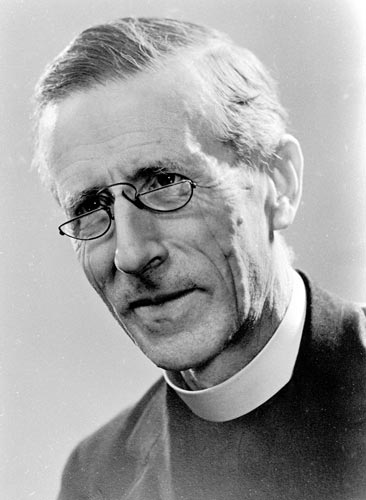
67/68. Who was this guy called Pierre Teilhard de Chardin? Why is he Famous in the Scientific Community?

From Are Jesuits Catholic?

Pierre Teilhard de Chardin was a visionary French Jesuit, paleontologist, biologist, and philosopher, who spent the bulk of his life trying to integrate religious experience with natural science, most specifically Christian theology with theories of evolution. In this endeavor he became absolutely enthralled with the possibilities for humankind, which he saw as heading for an exciting convergence of systems, an "Omega point" where the coalescence of consciousness will lead us to a new state of peace and planetary unity. Long before ecology was fashionable, he saw this unity he saw as being based intrinsically upon the spirit of the Earth:

"The Age of Nations is past. The task before us now, if we would not perish, is to build the Earth." Teilhard de Chardin passed away a full ten years before James Lovelock ever proposed the "Gaia Hypothesis" which suggests that the Earth is actually a living being, a collosal biological super-system. Yet Chardin's writings clearly reflect the sense of the Earth as having its own autonomous personality, and being the prime center and director of our future -- a strange attractor, if you will -- that will be the guiding force for the synthesis of humankind.

"The phrase 'Sense of the Earth' should be understood to mean the passionate concern for our common destiny which draws the thinking part of life ever further onward. The only truly natural and real human unity is the spirit of the Earth. . . .The sense of Earth is the irresistable pressure which will come at the right moment to unite them (humankind) in a common passion.

"We have reached a crossroads in human evolution where the only road which leads forward is towards a common passion. . . To continue to place our hopes in a social order achieved by external violence would simply amount to our giving up all hope of carrying the Spirit of the Earth to its limits."

To this end, he suggested that the Earth in its evolutionary unfolding, was growing a new organ of consciousness, called the noosphere. The noosphere is analogous on a planetary level to the evolution of the cerebral cortex in humans. The noosphere is a "planetary thinking network" -- an interlinked system of consciousness and information, a global net of self-awareness, instantaneous feedback, and planetary communication. At the time of his writing, computers of any merit were the size of a city block, and the Internet was, if anything, an element of speculative science fiction. Yet this evolution is indeed coming to pass, and with a rapidity, that in Gaia time, is but a mere passage of seconds. In these precious moments, the planet is developing her cerebral cortex, and emerging into self-conscious awakening. We are indeed approaching the Omega point that Teilhard de Chardin was so excited about.

This convergence however, though it was predicted to occur through a global information network, was not a convergence of merely minds or bodies -- but of heart, a point that he made most fervently.

"It is not our heads or our bodies which we must bring together, but our hearts. . . . Humanity. . . is building its composite brain beneath our eyes. May it not be that tomorrow, through the logical and biological deepening of the movement drawing it together, it will find its heart, without which the ultimate wholeness of its power of unification can never be achieved?"

In his productive lifetime, Teilhard de Chardin wrote many books, which include the following: LET ME EXPLAIN
THE APPEARANCE OF MAN
THE DIVINE MILIEU
THE FUTURE OF MAN
HOW I BELIEVE
HYMN OF THE UNIVERSE
LETTERS FROM A TRAVELLER
LETTERS TO LEONTINE ZANTA
THE MAKING OF A MIND
MAN'S PLACE IN NATURE
THE PHENOMENON OF MAN
SCIENCE AND CHRIST
THE VISION OF THE PAST
WRITINGS IN TIME OF WAR
BUILDING THE EARTH

Most of these quotes were taken from Building the Earth, and The Phenomenon of Man, but as I no longer have a copy, but only old notes, I can't quote exact page numbers.

by Anodea Judith, Dec. 96.

from: http://www.gaiamind.com/Teilhard.html
more on Teilhard de Chardin: http://en.wikipedia.org/wiki/Pierre_Teilhard_de_Chardin
posted by sonoftheprodigal at 8:43 PM 3 comments

Tuesday, September 18, 2007

"How (Not) To Speak of God," by Peter Rollins


"The emerging [Christian] thought is a self-acknowledged form of heresy insomuch as it is aware of its failure to describe that of which it speaks. This recognition acts as an effective theological response to fundamentalism, as it unsettles the dark heart of its self-certain power. Very briefly, fundamentalism can be understood as a particular way of believing one's beliefs rather than referring to the actual content of one's beliefs.

"It can be described as holding a belief system is such a way that it mutually excludes all other systems, rejecting other views in direct proportion to how much they differ from one's own. In contrast, the a/theistic approach can be seen as a form of disbelieving what one believes, or rather, believing IN God while remaining dubious concerning what one believes ABOUT God (a distinction that fundamentalism is unable to maintain). This does not actually contradict the idea of orthodoxy but rather allow us to understand it in a new light...

"This a/theism is not then some temporary place of uncertainty on the way to spiritual maturity, bur rather is something that operates within faith as a type of heat-inducing friction that prevents our liquid images of the divine from cooling and solidying into idolatrous form."

Monday, June 18, 2007

6 Songs from NPR's 'The New Monastics' show

Jes Karper, Psalters, John Mallinen, Derek Webb, Mewithoutyou..

some good tunes, with heart, soul and spirit