H/T: inhabitatiodei
58 MINUTES, YOUTUBE
Showing posts with label Saints. Show all posts
Showing posts with label Saints. Show all posts
Thursday, February 28, 2008

Monday, February 11, 2008
Lourdes: 150 Years Ago Today

Lourdes: 150 Years Ago Today
Posted at: 2008-02-11 12:15:00.0
Author: James Martin, S.J.
Today marks the 150th Anniversary of the appearances of Our Lady to St. Bernadette Soubirous in the Grotto of Lourdes, the small town in Southern France that has become one of the church's main sites of pilgrimage.
It has become fashionable in recent years, especially after Vatican II, to downplay the miraculous, the supernatural or the otherworldly aspects of our Catholic faith--at least among a few Catholics. And so Lourdes can be a difficult thing for some Catholics to grasp. Apparitions? Voices? Miracles? Are these things, people ask me, consistent with a mature faith?
I've never had that problem. Or those questions. I consider myself a rational person, and a fairly well educated Catholic, who is also not a literalist in any way when it comes to things like, say, Scripture. But, in my theological worldview, I've always believed that we need to be exceedingly careful about saying what God can and cannot do, and how God does and does not act. Or, worse, how God should act or not act.
That's one of the things that landed the scribes and the Pharisees in so much trouble.
For me the story of the apparitions of Mary to St. Bernadette are easy to believe. If God can create the world and raise his son from the dead, then something like Lourdes is rather simple by comparison, I would think. And having visited Lourdes several times, I'm even more convinced.
If that type of logic doesn't appeal to you, then consider the sworn testimonies of the doctors who attest to the 67 miraculous cures of the pilgrims who have been travelling there since 1858. (Quite a few of these doctors are not Catholic, by the way.) Or read the story of Bernadette Soubirous, the unlettered girl who was chosen for these visions. (Franz Werfel's "The Song of Bernadette" is a good place to start. Father Rene Laurentin's biographies and collections of her letters are even better.) Wholly uninterested during her life in fame or even fortune (quite a feat for someone so poor), she simply told what she had seen in the Grotto. And she was forced to do so over and over, even after she entered the convent.
Or, better yet, go to Lourdes. See the pilgrims. Listen to their prayers. Plunge yourself into the cold clear spring water that still flows from the fountain that Bernadette uncovered, at the behest of "the beautiful lady."
And then see if you can convince yourself that something miraculous did not happen there.
[Comments] Comments (0) | 152 Views
Comments
Add Comments
Thursday, January 24, 2008
Audio and transcript of Martin Luther King, Jr.'s speech "Beyond Vietnam -- A Time to Break Silence"
delivered 4 April 1967 at a meeting of Clergy and Laity Concerned at Riverside Church in New York City
Tuesday, January 22, 2008

Sunday, January 13, 2008


Monday, January 7, 2008
John Stephenson R.I.P.

[Life has changed, not ended]
"I believe that our friends among the dead really mind us and look out for us. Often there might be a big boulder of misery over our path about to fall on you, but your friends among the dead hold it back until you have passed by." John O'Donohue, Anam Cara [John O'Donohue made the hike to heaven on January 3, 2008, a day after Big John Stephenson set off for the same destination]
Revelation 21:1-6
"Then I saw a new heaven and a new earth; for the first heaven and the first earth had passed away, and the sea was no more. 2 And I saw the holy city, the new Jerusalem, coming down out of heaven from God, prepared as a bride adorned for her husband. 3 And I heard a loud voice from the throne saying,
‘See, the home of God is among mortals.
He will dwell with them;
they will be his peoples,
and God himself will be with them;
4 he will wipe every tear from their eyes.
Death will be no more;
mourning and crying and pain will be no more,
for the first things have passed away.’
5 And the one who was seated on the throne said, ‘See, I am making all things new.’ Also he said, ‘Write this, for these words are trustworthy and true.’ 6 Then he said to me, ‘It is done! I am the Alpha and the Omega, the beginning and the end. To the thirsty I will give water as a gift from the spring of the water of life."
Thursday, December 13, 2007
Advent, Week II: Love - Dorothy Day

From Levellers
“If I have achieved anything in my life, it is because I have not been embarrassed to talk about God.” Dorothy Day.
Thursday, November 1, 2007

67/68. Who was this guy called Pierre Teilhard de Chardin? Why is he Famous in the Scientific Community?
From Are Jesuits Catholic?
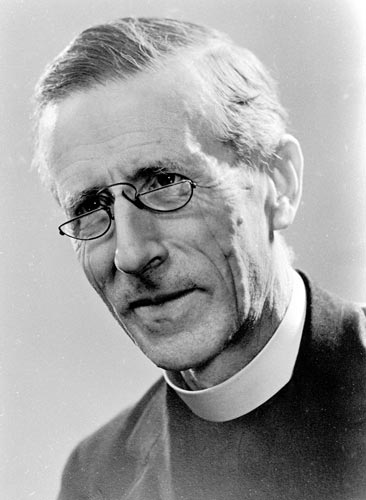 Pierre Teilhard de Chardin was a visionary French Jesuit, paleontologist, biologist, and philosopher, who spent the bulk of his life trying to integrate religious experience with natural science, most specifically Christian theology with theories of evolution. In this endeavor he became absolutely enthralled with the possibilities for humankind, which he saw as heading for an exciting convergence of systems, an "Omega point" where the coalescence of consciousness will lead us to a new state of peace and planetary unity. Long before ecology was fashionable, he saw this unity he saw as being based intrinsically upon the spirit of the Earth:
"The Age of Nations is past. The task before us now, if we would not perish, is to build the Earth." Teilhard de Chardin passed away a full ten years before James Lovelock ever proposed the "Gaia Hypothesis" which suggests that the Earth is actually a living being, a collosal biological super-system. Yet Chardin's writings clearly reflect the sense of the Earth as having its own autonomous personality, and being the prime center and director of our future -- a strange attractor, if you will -- that will be the guiding force for the synthesis of humankind.
"The phrase 'Sense of the Earth' should be understood to mean the passionate concern for our common destiny which draws the thinking part of life ever further onward. The only truly natural and real human unity is the spirit of the Earth. . . .The sense of Earth is the irresistable pressure which will come at the right moment to unite them (humankind) in a common passion.
"We have reached a crossroads in human evolution where the only road which leads forward is towards a common passion. . . To continue to place our hopes in a social order achieved by external violence would simply amount to our giving up all hope of carrying the Spirit of the Earth to its limits."
To this end, he suggested that the Earth in its evolutionary unfolding, was growing a new organ of consciousness, called the noosphere. The noosphere is analogous on a planetary level to the evolution of the cerebral cortex in humans. The noosphere is a "planetary thinking network" -- an interlinked system of consciousness and information, a global net of self-awareness, instantaneous feedback, and planetary communication. At the time of his writing, computers of any merit were the size of a city block, and the Internet was, if anything, an element of speculative science fiction. Yet this evolution is indeed coming to pass, and with a rapidity, that in Gaia time, is but a mere passage of seconds. In these precious moments, the planet is developing her cerebral cortex, and emerging into self-conscious awakening. We are indeed approaching the Omega point that Teilhard de Chardin was so excited about.
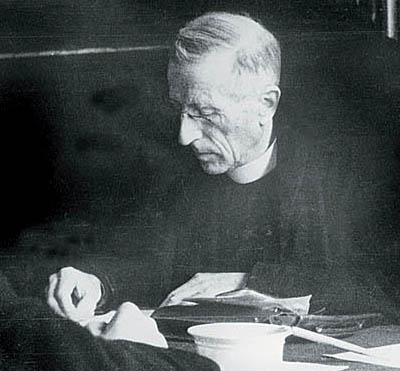 This convergence however, though it was predicted to occur through a global information network, was not a convergence of merely minds or bodies -- but of heart, a point that he made most fervently.
"It is not our heads or our bodies which we must bring together, but our hearts. . . . Humanity. . . is building its composite brain beneath our eyes. May it not be that tomorrow, through the logical and biological deepening of the movement drawing it together, it will find its heart, without which the ultimate wholeness of its power of unification can never be achieved?"
In his productive lifetime, Teilhard de Chardin wrote many books, which include the following:
Most of these quotes were taken from Building the Earth, and The Phenomenon of Man, but as I no longer have a copy, but only old notes, I can't quote exact page numbers.
by Anodea Judith, Dec. 96.
from: http://www.gaiamind.com/Teilhard.html
more on Teilhard de Chardin: http://en.wikipedia.org/wiki/Pierre_Teilhard_de_Chardin
Saturday, September 15, 2007
Wednesday, September 12, 2007
The Message of Blessed Teresa of Calcutta to Atheists

From "TheWesternConfucian"
Capuchin Father Raniero Cantalamessa, preacher to the papal household, asks, "She became poor to serve the materially poor — did she similarly share the sufferings of the spiritually poor?"─The ‘Atheism’ of Mother Teresa. An excerpt:
The world of today knows a new category of people: the atheists in good faith, those who live painfully the situation of the silence of God, who do not believe in God but do not boast about it; rather they experience the existential anguish and the lack of meaning of everything: They too, in their own way, live in the dark night of the spirit.Albert Camus called them “the saints without God.” The mystics exist above all for them; they are their travel and table companions. Like Jesus, they “sat down at the table of sinners and ate with them” (see Luke 15:2).This explains the passion in which certain atheists, once converted, pore over the writings of the mystics: Claudel, Bernanos, the two Maritains, L. Bloy, the writer J.K. Huysmans and so many others over the writings of Angela of Foligno; T.S. Eliot on those of Julian of Norwich.There they find again the same scenery that they had left, but this time illuminated by the sun. Few know that Samuel Beckett, the author of Waiting for Godot, the most representative drama of the theater of the absurd, in his free time read St. John of the Cross.
The word “atheist” can have an active and a passive meaning. It can indicate someone who rejects God, but also one who — at least so it seems to him — is rejected by God. In the first case, it is a blameworthy atheism (when it is not in good faith), in the second an atheism of sorrow or of expiation. In the latter sense, we can say that the mystics, in the night of the spirit, are “a-theist,” that Jesus himself on the cross was an “a-theist”, without-God. Mother Teresa has words that no one would have suspected of her: “They say people in hell suffer eternal pain because of the loss of God. ... In my soul I feel just this terrible pain of loss, of God not wanting me, of God not being God, of God not really existing. Jesus please forgive the blasphemy.”But one is aware of the different nature, of solidarity and of expiation, of this “atheism” of hers: “I wish to live in this world that is so far from God, which has turned so much from the light of Jesus, to help them — to take upon myself something of their suffering.”
The clearest sign that this is an atheism of a completely different nature is the unbearable suffering that it causes to the mystics. Normal atheists don’t torment themselves because of the absence of God. The mystics arrived within a step of the world of those who live without God; they have experienced the dizziness of throwing themselves down. Again, Mother Teresa who writes to her spiritual father: “I have been on the verge of saying — No. ... I feel as if something will break in me one day. ... Pray for me that I may not refuse God in this hour — I don’t want to do it, but I am afraid I may do it.”Because of this the mystics are the ideal evangelizers in the post-modern world, where one lives etsi Deus non daretur (as if God did not exist). They remind the honest atheists that they are not “far from the Kingdom of God”; that it would be enough for them to jump to find themselves on the side of the mystics, passing from nothingness to the All. [link via The New Beginning]
Wednesday, August 15, 2007
Wednesday, 15 August 2007, Assumption of the Virgin Mary into Heaven

Woman of the magnificat, servant-singer, lowly and lovely Lady, coming in haste with the compassion of God surging beneath your flesh, gather us under your cloak. Remind us that there is room for all of us and there is welcome abundance of Mercy. Let us rejoice with you, tell of the deeds of God again and again and cry out with you of the honour of God, the care of the poor and the coming of justice. You, Mary are the music of God. Your presence moves on all the roads and you step first over the thresholds of the homes of the poor. In your dark countenance and strong hands God's flesh is exposed and we know we are loved, saved and embraced by God in the light that dawns upon us in your great "Yes." In imitation of your stance before God, may we stand open hearted with arms extended towards one another. May we who are born of grace be the beloved children of God and your children who walk to every corner of the earth. We ask this in the name of the Trinity, the Father, the Son and the gracious Spirit.
Amen Amen Alleluia.
Megan McKenna
-------------
Mary's Magnificat:
My soul proclaims the greatness of the Lord, and my spirit rejoices in God my Saviour.
For he has looked with favour on his lowly servant, and from this day all generations will call me blessed. Yes, the Almighty has done great things for me and holy is his name.
He has mercy on those who honour him, from generation to generation.
He has shown strength with his arm and has scattered the proud in their conceit,
He has cast down the mighty from their thrones and lifted up the lowly.
He has filled the hungry with good things and sent the rich away empty.
Gospel of Luke, Chapter 1
Thursday, July 26, 2007
The Way of Ignatius

A five-day programme of prayer to lead you a little deeper into Ignatian spirituality.
Tuesday 31st July is the Feast of St Ignatius of Loyola, who founded the Society of Jesus (the Jesuits)
Saturday, June 16, 2007
6/16/06: Memorial of the Immaculate Heart of Mary

Most Holy Mother of God, pray for us in this hour of our need, that we may turn away from the path of destruction and be filled with the Spirit of your Son to build up the New Creation of Justice, Peace and Love
Friday, March 30, 2007
Pope recalls anniversary of 1980 slaying of popular archbishop in El Salvador

VATICAN CITY: Pope Benedict XVI on Sunday recalled the 1980 slaying of El Salvador archbishop and human rights activist Oscar Romero, and praised those who lost their lives in carrying out their mission for the Roman Catholic Church.
Benedict reminded pilgrims in St. Peter's Square that Saturday [March 25th] had been the anniversary of Romero's killing, and that the church had dedicated the day to prayer and fasting for missionary martyrs.
He described they martyrs as "bishops, priests, other men and women clergy and lay people cut down in carrying out their mission of evangelization and human promotion."
Benedict said martyrs represent hope for the world "because they testify that the love of Christ is stronger than violence and hate."
With song and prayer on Saturday, hundreds of Salvadorans in the capital, San Salvador, mark the 27th anniversary of Romero's slaying.
The day before Romero was gunned down in a chapel, he had called on the military to halt its repressive tactics. During El Salvador's 12-year civil war, the [*U.S. backed and financed] military was blamed for death squads that killed thousands of suspected guerrillas and leftist opponents of the military-led government.
The Vatican is considering Romero for possible sainthood.
*my note
Monday, March 19, 2007
St. Joseph, pray for us...

Holy St. Joseph, pray that we may follow your example of bravery, faithfulness and love, and that we may nourish and protect our families and communities and work toward building the new creation.
Mt 1,16.18-21.24.
The birth of Jesus took place like this. His mother, Mary, was engaged to be married to Joseph. Before they came to the marriage bed, Joseph discovered she was pregnant. (It was by the Holy Spirit, but he didn't know that.) Joseph, chagrined but noble, determined to take care of things quietly so Mary would not be disgraced.
While he was trying to figure a way out, he had a dream. God's angel spoke in the dream: "Joseph, son of David, don't hesitate to get married. Mary's pregnancy is Spirit-conceived. God's Holy Spirit has made her pregnant. She will bring a son to birth, and when she does, you, Joseph, will name him Jesus—'God saves'—because he will save his people from their sins." This would bring the prophet's embryonic sermon to full term:
Watch for this—a virgin will get pregnant and bear a son;
They will name him Immanuel (Hebrew for "God is with us").
Then Joseph woke up. He did exactly what God's angel commanded in the dream...
Friday, March 9, 2007
Alfred Delp. S.J

"Whoever doesn't have the courage to make history is doomed to become its object. We have to take action" Alfred Delp. S.J
"If there was a little more light and truth in the world through one human being, his life has had meaning." Alfred Delp. S.J
Just started reading an amazing book by Alfred Delp. S.J. [see link in sidebar], which includes a long and [of course] insightful introduction by Thomas Merton. Delp was executed by the Nazis for standing up to their tyranny. Although written over 60 years ago, his writing is prophetically relevant to our contemporary situation. I left the book in the car and it's gone for now, but I'll try to type some excerpts in when i get it back.
Wednesday, March 7, 2007
St. Maximilian- I will not serve as a soldier of this world, for I am a soldier of Christ.

St. Maximilian, a 3rd century conscientious objector and martyr in North Africa, was killed for refusing conscription to the Roman army. He was 21 when he was brought before the Roman court. Click here to read an actual translated account of Maximilian’s trial.
In Peace,
the CPF Staff
Subscribe to:
Posts (Atom)