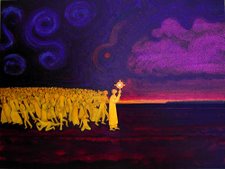
H/T: inhabitatiodei
58 MINUTES, YOUTUBE
Showing posts with label NewCreation. Show all posts
Showing posts with label NewCreation. Show all posts
Thursday, February 28, 2008

Tuesday, February 12, 2008
Christians Wrong About Heaven, Says Bishop [NTWright]

"...And in almost all cases, when I've explained this to people, there's a sense of excitement and a sense of, "Why haven't we been told this before?"
Monday, February 11, 2008
Lourdes: 150 Years Ago Today

Lourdes: 150 Years Ago Today
Posted at: 2008-02-11 12:15:00.0
Author: James Martin, S.J.
Today marks the 150th Anniversary of the appearances of Our Lady to St. Bernadette Soubirous in the Grotto of Lourdes, the small town in Southern France that has become one of the church's main sites of pilgrimage.
It has become fashionable in recent years, especially after Vatican II, to downplay the miraculous, the supernatural or the otherworldly aspects of our Catholic faith--at least among a few Catholics. And so Lourdes can be a difficult thing for some Catholics to grasp. Apparitions? Voices? Miracles? Are these things, people ask me, consistent with a mature faith?
I've never had that problem. Or those questions. I consider myself a rational person, and a fairly well educated Catholic, who is also not a literalist in any way when it comes to things like, say, Scripture. But, in my theological worldview, I've always believed that we need to be exceedingly careful about saying what God can and cannot do, and how God does and does not act. Or, worse, how God should act or not act.
That's one of the things that landed the scribes and the Pharisees in so much trouble.
For me the story of the apparitions of Mary to St. Bernadette are easy to believe. If God can create the world and raise his son from the dead, then something like Lourdes is rather simple by comparison, I would think. And having visited Lourdes several times, I'm even more convinced.
If that type of logic doesn't appeal to you, then consider the sworn testimonies of the doctors who attest to the 67 miraculous cures of the pilgrims who have been travelling there since 1858. (Quite a few of these doctors are not Catholic, by the way.) Or read the story of Bernadette Soubirous, the unlettered girl who was chosen for these visions. (Franz Werfel's "The Song of Bernadette" is a good place to start. Father Rene Laurentin's biographies and collections of her letters are even better.) Wholly uninterested during her life in fame or even fortune (quite a feat for someone so poor), she simply told what she had seen in the Grotto. And she was forced to do so over and over, even after she entered the convent.
Or, better yet, go to Lourdes. See the pilgrims. Listen to their prayers. Plunge yourself into the cold clear spring water that still flows from the fountain that Bernadette uncovered, at the behest of "the beautiful lady."
And then see if you can convince yourself that something miraculous did not happen there.
[Comments] Comments (0) | 152 Views
Comments
Add Comments
Tuesday, January 22, 2008
Friday, January 18, 2008
Jesus for President - Politics for Ordinary Radicals

Chapter/Section Summaries
Section 1
A good Creation of love and beauty takes a turn for the worse, landing it in a murderous chaos. What to do? Flood it and start fresh? Build a tower that reaches heaven? Appoint an adventurous elderly couple to lead the people out of the nations to the Promised Land? Something has to save humanity from themselves …
Section 2
The construction of a set-apart people into a living temple of blessing is going so-so. The solution: God puts skin on to show the world what love looks like. But here’s the catch: the Prince of Peace is born as a refugee in the middle of a genocide and is rescued from the trash bin of imperial executions to stand at the pinnacle of this peculiar people. A strange way to start a revolution …
Section 3
Flags on altars, images of the gods on money … Caesar is colonizing our imaginations. What has happened to the slaughtered Lamb, the Prince of Peace? There seems to be another gospel spreading across the empire, and two Kingdoms are colliding. What is a Jesus-follower to do when the empire gets baptized?
Section 4
Snapshots of political imagination … the question is not are we political, but how are we political. Not are we relevant, but are we peculiar? The answer lies in how we embody what we believe. Our greatest challenge is to maintain the distinctiveness of our faith in a world gone mad. And all of creation waits, groans, for a people who live God’s dream with fresh imagination.
Wednesday, January 16, 2008
Bruno Barnhart podcasts

Episode 1 [4] | Episode 2 [5]
Drag both episodes into your iTunes library [6]
Our hunger for wisdom
Bruno Barnhart is a Camaldolese monk of New Camaldoli Hermitage in Big Sur, Calif. He is the author of The Good Wine: Reading John from the Center (Paulist, 1993) and Second Simplicity: The Inner Shape of Christianity (Paulist 1999), and co-editor of Purity of Heart and Contemplation: A Monastic Dialogue Between Christian and Asian Traditions (Continuum, 2001). His latest book is The Future of Wisdom: Toward a Rebirth of Sapiential Christianity (Continuum, 2007).
Episode 1: Sapiential hunger, hunger for wisdom (26 min.)
"A lot of people when they write about mysticism, they look at that experience as the end, the goal of the spiritual life," Fr. Barnhart tells Tom Fox. "But I think it is more like the beginning. You go from there. Something is put into you which takes the rest of your life to work it out, to express it, to incarnate it, to make it real in the world."
Episode 2: The paradox of wisdom (31 min.)
Look at First Corinthians, verse 1, Fr. Barnhart tells Tom Fox. "Usually you think of wisdom as a kind of fattening, by which we get larger and larger in our minds and we can bring more and more things together into a synthetic vision. But Paul seems to be talking about the opposite. He’s talking about falling into a black hole. That’s the paradox of Christian wisdom. All the wisdom disappears at a certain point, because we live in a world and an economy of faith. Wisdom seems to go on the drain on you. But it recovers when you need it. It is the wisdom of the cross."
Saturday, December 1, 2007
ON THE LINE

What happens when a group of activists, priests, celebrities, and students risk arrest to protest U.S. foreign policy in Latin America?
ON THE LINE is an inside look at the people behind one of the largest nonviolent movements in America today: the movement to close the School of the Americas/WHINSEC, a U.S. Army school that trains Latin American soldiers. In a world where politics, passion, and Constitutional rights collide, protesters discuss their activism, the dark side of U.S. foreign policy, and the challenges of protesting since 9/11.
The principal cast includes:
* Martin Sheen, actor
* Susan Sarandon, actor
* Fr. Roy Bourgeois, Founder of School of the Americas Watch
* John Perkins, author of Confessions of an Economic Hitman
* Bob Barr, political analyst and former US Congressman
* Gerry Weber, ACLU-Georgia
Thursday, November 29, 2007
Western Christians can learn much from Eastern Christians, says pope

By Cindy Wooden
Catholic News Service
VATICAN CITY (CNS) -- Christianity is not and never has been a uniquely European phenomenon, and Christians of the West can learn much from the cultural expressions of Eastern Christians, especially those of the early church, Pope Benedict XVI said.
"Today it is a common opinion that Christianity is a European religion that exported European culture to other countries, but the reality is much more complicated and complex," he said Nov. 28 at his weekly general audience.
"It is not only that the roots of the Christian religion are found in Jerusalem, in the Old Testament, in the Semitic world and Christianity is constantly nourished by these Old Testament roots," he said, "but the expansion of Christianity in the first centuries" went simultaneously West and East.
In Europe, but also throughout the Middle East and over to India, "Christianity with a different culture was formed," he said. Christians in the East lived the faith "with their own expressions and cultural identities," demonstrating "the cultural plurality of the one faith from the beginning."
With fewer than 8,000 people present, the weekly gathering was held inside the Vatican audience hall, offering greater protection from the cold and wind for the pope, whose voice was hoarse.
The pope's main audience talk focused on the life, teaching and poetry of St. Ephraem the Syrian, a fourth-century deacon.
"He remained a deacon throughout his life and embraced virginity and poverty," the pope said.
Pope Benedict, whose new encyclical on the virtue of hope was to be released at the Vatican Nov. 30, said St. Ephraem was a model of the Christian virtues: "faith, hope -- this hope that allows us to live poor and as virgins in this world, placing all one's hope in the Lord -- and, finally, charity to the point of self-giving in the care of victims of the plague," which he contracted and which caused his death.
In his hymns and poetry, St. Ephraem offered theological reflections using images "taken from nature, daily life and the Bible."
His use of song, especially liturgical song, the pope said, was an effective means of religious education because "precisely by singing, celebrating, praising God, we see not only the beauty, but the truth of the faith and we encounter the truth in person, Christ."
St. Ephraem's reflections on God the creator, he said, are very important.
The saint taught that "nothing in creation is isolated. The world, alongside the Scriptures, is God's Bible. By using his freedom in an erroneous way, man upsets the order of the cosmos," the pope said.
- - -
Editor's Note: The Vatican text of the pope's remarks in English is available online at: http://www.vatican.va/holy_father/benedict_xvi/audiences/2007/documents/hf_ben-xvi_aud_20071128_en.html.
Monday, November 19, 2007
Kitzmiller v. Dover Area School District

Kitzmiller v. Dover Area School District
Trial transcript: Day 5 ((September 30), PM Session, Part 1
John F.Haught, PH.D., called as a witness, having been duly sworn or affirmed, testified as follows:
Continue
Thursday, November 15, 2007
Mindblowing..."Globalization, Spirituality, and Justice: Navigating the Path to Peace"

Globalization, Spirituality, and Justice: Navigating the Path to Peace (Theology in Global Perspective) (Paperback)
By Mary J. Miller (Iowa and Indiana, USA) - See all my reviews
(REAL NAME)
"This book may take our breath away." So states the cover blurb from Walter Brueggemann on "Globalization, Spirituality, and Justice: Navigating the Path to Peace," released on April 17, 2007 by Daniel G. Groody. The basic premise is, metaphorically, that the global family has booked passage and is now aboard the ship of globalization and there is no turning back to the shore. The question we must ask ourselves, as passengers on this ship, is, "who is at the helm and where are we going?" As Gustavo Gutierrez quips, "Being against globalization is like being against electricity." We can't stop the ship, and one would question the wisdom of wanting to, but the issues of who's driving and where will we end up are legitimate.
The book begins by offering an overview of the dual nature of globalization--its inherent propensity for good, such as the triumphs of technology, and for ill, such as the tragedy of poverty. Perhaps more importantly, chapter one details where we have sailed on this ship so far. This chapter seeks to give a realistic picture of the world today and paints that picture by using the most current statistics available. These statistics were gathered from sources such as the World Bank, the United Nations annual Human Development and World Development reports, and the World Institute for Development Economic Research. It is staggering to learn that 19 percent of the global population lives on less than $1 per day, 48 percent live on less than $2 per day, 75 percent live on less than $10 per day, and, according to the World Bank, two-thirds of the population of the planet lives in poverty. The weight of these income disparities is compounded when one looks at the unequal distribution of wealth and our disordered spending patterns. According to an article in the December 2006 issue of "The Economist," half of all wealth is held by only 2 percent of the world's adults. The world spends almost as much money on toys and games as the poorest 20 percent of the population earns in a year, and four times as much on alcohol as on international development aid. The troubling area of military spending is also addressed.
The world picture, from the perspective of poverty and need is indeed bleak, but Professor Groody does not leave us in the grip of its reality with no hope. He is convinced that, while fully aware of the abuses committed in the name of religion throughout history, the gift theology can bring to the process of globalization is a navigation system that has the potential to guide us to a place of solidarity and peace, where if globalization is left to itself or to those leaders who are only motivated by profit we may run aground on the icebergs of greed. As Groody notes, we are doing theological reflection all the time, but he argues that to find a place of human solidarity we must undergo a conversion from "money-theism" to monotheism. The remaining eight chapters of the book deal with how the various sub-disciplines of theology inform the process of globalization.
* Chapter two details the core narratives of the Bible--the Narrative of the Empire, the Narrative of the Poor, the Narrative of Yahweh, the Narrative of Idolatry, and the Narrative of the Gospel, integrating them all with the Narrative of the Passover.
* Chapter three challenges idolatry and excessive wealth through the words of the early church writers.
* Chapter four lays out an overview of Catholic social teaching with an acronym ("A God of Life") that provides a framework on which to hang the basic tenets. There are also several very useful charts that detail the documents of the universal and regional churches by categories of year, author, context, and key concept.
* Chapter five consists of a short section (five or six pages) on the basic social teachings of each of the major, non-Judeo-Christian, world religions--Islam, Hinduism, Buddhism, Bahai Faith, and African Indigenous religions. Here we see that social justice is not unique to Christianity.
* In chapter six the lives of five contemporary models of justice are briefly chronicled: Gandhi, Martin Luther King, Jr., Dorothy Day, Mother Teresa, and Oscar Romero. Attention is paid especially to their foundational experiences, the major metaphor of their life, their operative theology, and their core contribution to justice.
* Chapter seven reflects on God through the perspective of the poor by looking at liberation theology and the preferential option for the poor. This chapter is an especially helpful read for anyone who wishes to understand what is meant by these two terms and the position of the Vatican on liberation theology. The global perspective is readily apparent again in this chapter as attention is paid to Black, Hispanic, Feminist, and Asian liberation theology.
* Chapter eight concerns the rite of the liturgy, and justice as living in right relationships with God, self, others, and the environment. This chapter also has several nice charts that are helpful in linking the sacraments to social teaching by way core issue.
* The final chapter on spirituality and transformation beautifully sums up the book by looking to the spiritual disciplines which can strengthen us for doing the work of justice in the world: fasting, prayer, community, solidarity, nature, simplicity, recollection, and Sabbath.
Each chapter begins with a relevant story, and ends with a set of questions that would be helpful for personal reflection, group discussion, or classroom use, and a detailed bibliography for further reading and study.
I recommend Globalization, Spirituality, and Justice for upper level undergrads and graduate students in theology, peace studies, political science, ethics and justice, and economics and business, as well as justice groups, and the general reader interested in this vital and timely topic. Groody has managed to research and write a compelling treatise on global injustice without conveying a bleak and hopeless message. At its core, this book seeks to respond to the deeper issues of the human heart that globalization has largely left unexplored--questions related to belonging and loneliness, good and evil, peace and division, healing and suffering, meaning and meaninglessness, hope and despair, love and apathy, justice and injustice, freedom and slavery, and ultimately life and death. He is not interested in overwhelming readers with guilt, but rather with guiding readers to examine our personal and corporate lives and motivations, all the while encouraging us to think beyond ourselves to the needs of our brothers and sisters in the global family. The book is clear and well documented, exquisitely written, and sings a wonderful melody of the gratuitousness of God that is both a gift to and a demand on our lives.
Thursday, November 1, 2007

67/68. Who was this guy called Pierre Teilhard de Chardin? Why is he Famous in the Scientific Community?
From Are Jesuits Catholic?
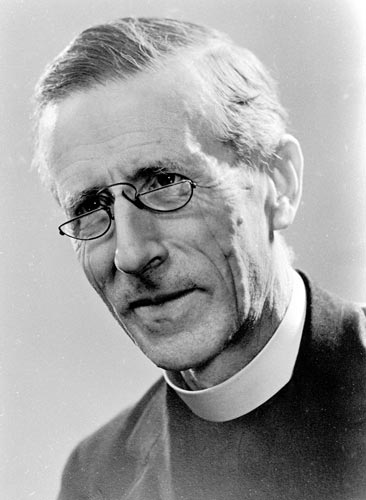 Pierre Teilhard de Chardin was a visionary French Jesuit, paleontologist, biologist, and philosopher, who spent the bulk of his life trying to integrate religious experience with natural science, most specifically Christian theology with theories of evolution. In this endeavor he became absolutely enthralled with the possibilities for humankind, which he saw as heading for an exciting convergence of systems, an "Omega point" where the coalescence of consciousness will lead us to a new state of peace and planetary unity. Long before ecology was fashionable, he saw this unity he saw as being based intrinsically upon the spirit of the Earth:
"The Age of Nations is past. The task before us now, if we would not perish, is to build the Earth." Teilhard de Chardin passed away a full ten years before James Lovelock ever proposed the "Gaia Hypothesis" which suggests that the Earth is actually a living being, a collosal biological super-system. Yet Chardin's writings clearly reflect the sense of the Earth as having its own autonomous personality, and being the prime center and director of our future -- a strange attractor, if you will -- that will be the guiding force for the synthesis of humankind.
"The phrase 'Sense of the Earth' should be understood to mean the passionate concern for our common destiny which draws the thinking part of life ever further onward. The only truly natural and real human unity is the spirit of the Earth. . . .The sense of Earth is the irresistable pressure which will come at the right moment to unite them (humankind) in a common passion.
"We have reached a crossroads in human evolution where the only road which leads forward is towards a common passion. . . To continue to place our hopes in a social order achieved by external violence would simply amount to our giving up all hope of carrying the Spirit of the Earth to its limits."
To this end, he suggested that the Earth in its evolutionary unfolding, was growing a new organ of consciousness, called the noosphere. The noosphere is analogous on a planetary level to the evolution of the cerebral cortex in humans. The noosphere is a "planetary thinking network" -- an interlinked system of consciousness and information, a global net of self-awareness, instantaneous feedback, and planetary communication. At the time of his writing, computers of any merit were the size of a city block, and the Internet was, if anything, an element of speculative science fiction. Yet this evolution is indeed coming to pass, and with a rapidity, that in Gaia time, is but a mere passage of seconds. In these precious moments, the planet is developing her cerebral cortex, and emerging into self-conscious awakening. We are indeed approaching the Omega point that Teilhard de Chardin was so excited about.
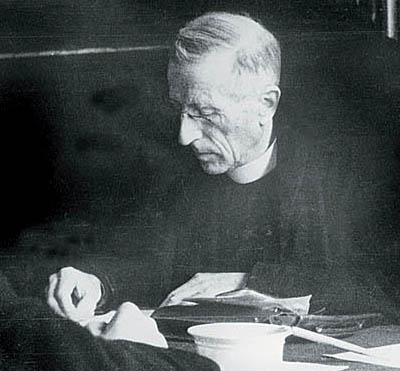 This convergence however, though it was predicted to occur through a global information network, was not a convergence of merely minds or bodies -- but of heart, a point that he made most fervently.
"It is not our heads or our bodies which we must bring together, but our hearts. . . . Humanity. . . is building its composite brain beneath our eyes. May it not be that tomorrow, through the logical and biological deepening of the movement drawing it together, it will find its heart, without which the ultimate wholeness of its power of unification can never be achieved?"
In his productive lifetime, Teilhard de Chardin wrote many books, which include the following:
Most of these quotes were taken from Building the Earth, and The Phenomenon of Man, but as I no longer have a copy, but only old notes, I can't quote exact page numbers.
by Anodea Judith, Dec. 96.
from: http://www.gaiamind.com/Teilhard.html
more on Teilhard de Chardin: http://en.wikipedia.org/wiki/Pierre_Teilhard_de_Chardin
Saturday, September 15, 2007
What Are Theologians Saying About Christology? ['America' magazine, Sept 17, 2007]

Editor’s Note: After the Congregation for the Doctrine of the Faith published a notification March 14 on some works of the liberation theologian Jon Sobrino, S.J., the editors wondered how we might inform our readers about the questions at stake. We concluded that the most useful approach would be to set the issues in the context of contemporary Christology, explaining what major theologians, Scripture scholars and schools of theology are saying regarding the six questions about Jesus to which the congregation drew attention in its notification: method, divinity/humanity, incarnation, the kingdom of God, Jesus’ self-consciousness and soteriology (explanations of how Jesus achieved our salvation). We have asked six theologians to explain what the tradition and their colleagues are saying today about the church’s confession of Jesus as Christ and Son of God. Alejandro Garcia-Rivera, Kevin Burke, Robert P. Imbelli, John R. Donahue, William Thompson-Uberuaga, Robert A. Krieg Faith and the Poor By Alejandro Garcia-Rivera Recently I had the honor of listening to Metropolitan Kallistos Ware as he gave a talk on the Orthodox understanding of the Holy Spirit. During the question-and-answer session, a young Roman Catholic seminarian asked him what he thought of the recent Vatican notification on the works of Jon Sobrino, S.J. Bishop Ware smiled, thought for a minute and quoted this famous passage from St. John Chrysostom: Would you see his altar?... This altar is composed of the very members of Christ, and the body of the Lord becomes an altar. This altar is more venerable even than the one which we now use. For it is…but a stone by nature; but become holy because it receives Christ’s body: but that is holy because it is itself Christ’s body…[which] you may see lying everywhere, in the alleys and in the marketplaces, and you may sacrifice upon it anytime…. When then you see a poor believer, believe that you are beholding an altar. When you see this one as a beggar, do not only refrain from insulting him, but actually give him honor, and if you witness someone else insulting him, stop him; prevent it. Homily 20 on 2 Corinthians Wisely Bishop Ware refused to elaborate on the quotation and left us to ponder its meaning. Its relevance to the Sobrino notification, however, has become more and more evident as I have studied the text by the Congregation for the Doctrine of the Faith. The notification questions first the methodological presuppositions of Sobrino’s Christology. Father Sobrino emphasizes the social setting defined by the “church of the poor”; the notification identifies the proper context as the “faith of the Church.” The C.D.F. apparently thinks Sobrino is playing fast and loose with the nature of the church. By identifying the church with the poor instead of with the faith, the C.D.F. warns that Sobrino’s Christ is being wrenched from his ecclesial matrix. What is feared, I suppose, is a Christ who emerges out of a social setting instead of a communion of faith. Such a Christ could be subject to political and ideological currents that have little interest in faith. Indeed, Sobrino’s method of taking the social context as the ecclesial matrix from which Christ emerges may lead to an unabashed theological pluralism where the one Lord can become a Christ of a thousand faces, each depending on its own social setting. Such a scenario might be one reason this notification was issued. Sobrino’s method opens up a postmodern Pandora’s box of theological speculation. To ask if Jon Sobrino’s Christ is too postmodern is to ask if the C.D.F.’s primary concern is the role that truth plays in theological reflections. The notification, referring to Donum Veritatis, suggests as much: “Thus the truth revealed by God himself in Jesus Christ, and transmitted by the Church, constitutes the ultimate normative principle of theology.” Trust in the normative power of truth claims is at odds with the postmodern zeitgeist, which questions not simply the truthfulness of statements but truth itself. Such faith and the deep value it holds can legitimately be offended by the skepticism over normative claims so prevalent today. Does the notification assert that Sobrino’s Christology falls prey to such skepticism? There is reason to think so, namely, the concern for “the manner in which the author treats the major Councils of the early Church.” The notification lifts out this particular quote from Sobrino’s Christ the Liberator: “While these texts are useful theologically, besides being normative, they are also limited and even dangerous, as is widely recognized today.” While recognizing the limited character of dogmatic formulation, the notification insists that “there is no foundation for calling these formulas dangerous, since they are authentic interpretations of Revelation.” Here the wisdom from the Orthodox tradition and the relevance of Chrysostom’s text become evident. The Orthodox warn against making dogmatic claims with too much confidence. While truth is behind all such claims, the ecclesial setting for truth is not objectivity but love. Truth is not simply about objectivity but also solidarity. And this is one of the lessons I learned from Chrysostom’s text. The Christ the church worships at its altar is also the Christ found at the altar of the world’s poor. In this sense both Sobrino and the C.D.F. appear to speak truthfully and accurately. Christ’s ecclesial matrix is the church that worships in faith. It is also the church of the poor. This is the famous both-and that marks the church as Catholic. Having a both-and Christology is not the same as postmodern skepticism. It is the very nature of a faith that proclaims that God is one and three, that Jesus is human and divine. There is something more dangerous to the faith than a Christ who can only be grasped through multiple views; it is a view of truth as either-or. “Definitive” truth that is not loving can bring only despair to an already nihilistic world. Postmodernism thrives precisely because it sees the suffering of this world as having reached horrendous and senseless proportions. A church that is methodologically indifferent to senseless suffering is at odds with the methods of Jesus himself. Only a Jesus who belongs to a church that is not afraid to identify itself with the suffering of this world can have any rational claim on the world itself. In other words, the normative character of the truth of the church’s faith is protected, defended and nurtured by a praxis that will not regard as normative the senseless suffering of billions. The church has two altars. The C.D.F. points rightly to one; Sobrino points to the other. Balancing Human and Divine By Kevin Burke Christology is a complex discipline. It requires an intricate balancing act among assertions perennially in tension with one another. One of my first theology teachers, Brian Daly, S.J., emphasized this point in a course tellingly entitled “The Christological Controversies.” He noted how every orthodox Christological claim tends toward one or another heresy and needs to be complemented by other claims. Moreover, this process of complementing and balancing involves more than rehearsing the facts of church doctrine, for the language of faith often explodes like a riot of color in a wild garden or a true poem. As such, Christology involves evocation. Its arguments turn on the subtlest of metaphors. And the work is always unfinished. Theology itself has to grow to stay alive. Theologians betray their vocation if they simply repeat word-for-word definitions taken from Scripture or doctrine, as if formulas could contain faith or words exhaust mystery. Every age, every culture needs to find access to Jesus Christ from within its own distinctive language and worldview. But the future of theology does not undermine the importance of its past. Theological growth needs direction to remain authentically alive. It needs Scripture (the normative witness to apostolic faith) and the Christological dogmas formulated by the theologians of the early church. However, the teachings of Scripture and tradition are not self-interpreting. For this reason, Christology is not only complex but dangerous. Even devout believers can lose their way in the thickets of Christological reasoning. Even clear and apparently unambiguous statements like “Christians believe in the divinity of Jesus Christ” need to be interpreted in relation to other statements. Taken in isolation, without reference to the full humanity of Jesus, this statement is misleading and potentially harmful. In contrast, the classic formula developed at the Council of Chalcedon in A.D. 451, affirms the full divinity and full humanity of the one person, Jesus Christ, “without confusion, without change, without division, without separation.” And even this profound and balanced definition is not the end of the matter, for inquiring minds want to know: How do we make sense of this? In the effort to make sense of the language of faith, the choice of where to begin is crucial because it shapes the way we imagine Jesus. This, I believe, represents the key difference between the Christology of Jon Sobrino, S.J., and the logic of the Vatican notification that criticizes his work. The notification implies that theology should start “from above,” with the Nicene Creed’s affirmation of Jesus’ divinity (“one in being with the Father”). Sobrino, by contrast, begins “from below” where the synoptic Gospels begin, with Jesus as he appeared to his contemporaries (“Is this not the carpenter’s son?”). The one approach starts with doctrine. The other begins in history. On the surface, starting from doctrine appears to be the strongest way to safeguard the faith. But throughout Christianity’s history, it is the return to Jesus that consistently protects theology from the greatest danger of all—the temptation to use its own logic to misrepresent God. Concern for this danger lies behind the commandment forbidding false images of God: God cannot be described by analogy to what we think a god ought to be like. For his part, Sobrino is wary of the assumption that “we already know what divinity is” when we apply the term to Jesus. Rather, Jesus reveals what divinity means. Starting with Jesus and moving from there to an interpretation of his being the eternal Word of God unmasks the temptation to manipulate his image (and thereby God’s image) for our own ends. Furthermore, Sobrino begins with Jesus precisely to “make sense” of Christian faith in a world burdened by “senseless” suffering, especially the suffering that results from inhuman poverty and violent oppression. Starting with Jesus and his scandalous love for the poor provides the best way today to lead people to authentic faith in Jesus Christ. It empowers Christians to live as disciples of Jesus while confirming their claim to be advocates of a universal, integral justice. Finally, it provides a credible way of holding the tension between the divine and the human natures of Jesus. Sobrino directs the imagination to that which is most easily imaginable: Jesus as he appeared to his contemporaries. He then leads it beyond its normal limits, as theology must, in order to give a complete account of Christian hope. The Vatican notification warns that Sobrino’s method might scandalize believers who are not sophisticated enough to follow his subtle theological ascent. If people begin by imagining Jesus in his humanity, they might remain there, with a “merely human” Jesus. Of course, a corresponding risk exists for those who start with the Nicene Creed and utilize a dogmatic imagination. This approach can lead simple believers into a heretically high Christology like Docetism, in which Jesus, the Son of God, only appears to be human. Christology wrestles with difficult questions. In-deed, its own use of reason can be dangerous. But not every danger can be addressed by authoritative pronouncements. More-over, while it may be prudent to warn believers about the possible dangers of Sobrino’s Christology, it seems equally necessary to call attention to corresponding dangers in Christologies that begin with Jesus’ divinity. At the very least it is a mistake to think that Christologies “from below” pose the only or the greatest danger to Christian faith. Word Incarnate By Robert P. Imbelli Pressed to choose but one New Testament verse to recapitulate the Good News, the Gospel within the Gospel, one might opt for the climax of the Prologue of St. John (1:14): And the Word became flesh and made his dwelling among us, and we saw his glory, the glory of the Father’s only Son, full of grace and truth. The Word, the eternal Son of the Father, who precedes and “pre-contains” all creation, became part of created reality, entered into human history, lived a complete human life, became one of us—even unto death. So stupendous is this mystery that already in the first century some demurred. Surely it was unseemly for the divine to enter into the muck of humanity, confined in a body, subject to the indignities and torments to which flesh is heir. So began the perennial Gnostic revulsion against the flesh, and especially against the flesh-taking of the Holy, Immortal One. The First Letter of John stands at the origin of the ecclesial tradition of discernment of spirits. It reiterates with insistence: “Beloved, do not trust every spirit, but test the spirits to see whether they belong to God, because many false prophets have gone out into the world. This is how you can know the Spirit of God: every spirit that acknowledges that Jesus Messiah has come in the flesh belongs to God” (1 Jn 4:1-2). The incarnation of the Word is not adventitious to God’s saving action; it is the very heart of salvation. The Letter to the Hebrews sealed the canonical New Testament’s incarnational conviction. “In the days of his flesh, Jesus offered prayers and supplications with loud cries and tears to God who was able to save him from death, and he was heard because of his reverence. Son though he was, he learned obedience from what he suffered; and having been made perfect, he became the source of eternal salvation for all who obey him” (Heb 5:7-9). Almost 400 years later, the great Christological Council of Chalcedon articulates, in the language of its culture and time, this core discernment and persuasion of the New Testament. Jesus the Christ is “perfect [Greek teleion] in divinity, perfect in humanity, truly God and truly human, of a rational soul and body.” In a famous formulation the council confesses the one Lord Jesus Christ “in two natures with no confusion, no change, no division, no separation...the property of both natures is preserved and comes together into a single person and a single subsistent being.” Here the mystery of the Incarnation is neither explained nor reduced, but confessed and celebrated. Chalcedon enunciates the “deep grammar” that governs the church’s preaching, catechesis and theological reflection. Fast-forward 1,500 years. As part of the commemoration of the anniversary of Chalcedon, Karl Rahner, S.J., wrote an essay that stands at the origin of renewed Christological reflection in the Catholic tradition. The essay, in revised form, appears in the first volume of his Theological Investigations under the title “Current Problems in Christology.” In the context of the Catholic theological world of the 1950s, these sentences rang like a manifesto: Rahner lamented that there was far too much mere repetition of creedal formulae, rather than genuine appropriation of the council’s insight. Moreover, he also judged that some of what was said in standard textbooks and in popular preaching was, often inadvertently, not consonant with Chalcedon’s measured doctrine. In particular, Rahner discerned a “crypto-monophysitism” that emphasized the divinity of Christ to the virtual exclusion of his full humanity. In retrospect, this article (published in German in 1954 and in English in 1961) anticipated the direction of much of post-Vatican II Christological reflection by Catholic theologians. It stressed the need to do full justice to the humanity of Jesus, to return anew to the canonical range of New Testament witness rather than relying, almost exclusively, on the Gospel of John. It advocated complementing a “Christology from above” with a “Christology from below,” one that takes with utmost seriousness “the human experience of Jesus.” Rahner already anticipated that this commitment would entail not only a focus on the human nature of the Word in some abstract, timeless fashion, but a consideration of the “flesh-taking” in its concrete historical, religious and social setting. This commitment, supported and promoted by the experience and teaching of Vatican II, led to a profusion of works in Christology: from Hans Küng to Edward Schillebeeckx, from Hans Urs von Balthasar to Walter Kasper, from Jon Sobrino to Elizabeth Johnson. Though the works of these authors certainly differ among themselves, all would echo Rahner’s claim that Chalcedon marks not only an end, but also a beginning of the church’s never-ending reflection on the mystery of its Lord. In the present situation of Catholic theology, at least in its university setting, I think few would contend, as Rahner did 50 years ago, that there flows “an undercurrent of monophysitism.” The acknowledgement of the humanity of Jesus, of his immersion in the Jewish religious-cultural world of his time, has become an indisputable given (see Elizabeth Johnson, Consider Jesus; N. T. Wright, Jesus and the Victory of God; Gerald O’Collins, Christology: a Biblical, Historical, and Systematic Study of Jesus). New archeological findings continue to “flesh out” the flesh of Jesus of Nazareth (see James H. Charlesworth, ed., Jesus and Archeology, Eerdmans, 2006). The present danger may lie, rather, in an inclination to present a Jesus who is fully, but only, human: a “Christology from below” that never quite manages to get off the ground. The church’s foundational faith in the incarnation of the only Son risks being reduced to a vague avowal of the divine inspiration of one who is a provocative prophet. Indeed, some even hint that the church’s dogmatic tradition distorts the reality of the first-century Jewish figure. I read the recent notification of the C.D.F. on some writings of Father Jon Sobrino as a call to accountability to the grammar of Chalcedon, even as theologians probe new insights and forge new language. In the spirit of 1 John, it offers guidelines for discernment. I do not think Karl Rahner would object in principle to this admonition, though he might differ, of course, with regard to the congregation’s specific findings. The challenge before us all, not only theologians, but preachers and parents, artists and educators, is to rekindle in our day and place the Christic imagination: to appropriate and extend Vatican II’s confident confession that Jesus is “the light of the nations” (Lumen Gentium, No. 1), that he is “the mediator and fullness of all revelation” (Dei Verbum, No. 2) and that the Holy Spirit offers to everyone “the possibility of being associated with Christ’s paschal mystery” (Gaudium et Spes, No. 22). In pursuing this inexhaustible blessing and mission, we can do no better than take as a sure guide the Letter to the Hebrews, which so forthrightly celebrates the humanity of the Lord. For it also, with equal boldness, proclaims his unsurpassable uniqueness (Heb 1:1-2): Jesus and the Kingdom of God By John R. Donahue The kingdom of God assumes a central place in the notification on the works of Jon Sobrino, S.J., as it does in contemporary New Testament scholarship. A wide spectrum of New Testament scholars of all denominations significantly agrees that the central theme of the public proclamation of Jesus was the arrival of God’s powerful reign. Beyond this consensus is a virtual storm of scholarly discussion and debate. The kingdom is a major topic in three recent scholarly tomes: Jesus: A Marginal Jew, Vol. 2, by John P. Meier (reviewed in America, 4/8/95); Jesus and the Victory of God, by N. T. Wright (Am. 3/8/97); and Jesus Remembered, by James D. G. Dunn (Am. 12/3/03). The Greek term itself, basileia tou theou (literally, “kingdom of God”), expresses the power of God active in the ministry of Jesus, but it also implies a spatial or local dimension, as in “United Kingdom.” The expression is a tensive symbol, evoking a host of associations rather than a single referent. The proclamation has a clear eschatological dimension—the final and definitive rule of God is at hand. A host of problems accompany interpretation of this proclamation. There are three principal groups of sayings. The first stresses the presence of the kingdom; the second, its future coming; the third, its demands on people who wish to accept or enter it. A seemingly endless debate centers on which sayings are closest to the actual statements of Jesus (his ipsissima vox). Advocates of the presence of the kingdom interpret Jesus primarily as a prophet of reform (John Dominic Crossan), while the future sayings form the basis of interpreting Jesus as an apocalyptic preacher (Albert Schweitzer). Current exegesis leans toward some version of the thesis of Joachim Jeremias, that Jesus proclaims God’s reign as already at work in his ministry, while anticipating its fullest realization in the future. Evidence for both positions is ample. Jesus inaugurates his public ministry by proclaiming that the kingdom of God is at hand and summoning people to reform and renewal (metanoia, Mk 1:16-17). Jesus also proclaims that the kingdom is “among you” (Lk 17:21), not “within you,” a translation that spawns many inaccurate appropriations. His mighty works of healing, confrontation with demons and his power over nature are the signs of God’s power now at work in his life and teaching. The kingdom is “of God,” both as gift and challenge; despite common parlance, nowhere does the New Testament speak of “building the kingdom of God.” For his part, Jesus speaks often of the kingdom in parables drawn from the ordinary lives of his hearers. Human experience is the path toward the transcendent. Future expectation is also strong. Disciples are to pray that the kingdom will come, just as they pray for God’s will to be be done on earth as in heaven (Mt 6:10). Other sayings of Jesus reflect Jewish apocalyptic thought, with its emphasis on the end of the world, when the exalted Son of Man will reign as king to judge evildoers and restore justice to the elect (the sheep and the goats, Mt 25:31-46). According to Paul, eschatological fulfillment of the reign of God will come when at the end time the risen Jesus will hand over his kingdom to “his God and Father” (1 Cor 15:24). The radical challenge of the kingdom is crystallized in a series of sayings on conditions for “entering” the kingdom. Rather than scandalize a child or commit other sins, one should be willing to enter the kingdom of God blind (Mk 9:47). Those who wish to enter the kingdom should be powerless like children (Mt 19:14); riches provide an overwhelming obstacle to entering (Mt 19:23-25). Disciples who seek the prestige of sitting at the right hand of Jesus in the kingdom are urged instead to become servants and slaves (Mt 20:21-25). The powerful reign of God is not otherworldly, but embodied in history. Its arrival brings special hope to the poor, the suffering and the marginal. When Jesus calls the poor happy because “the kingdom of God is yours” (Lk 6:26), he is declaring that God’s reign is on their behalf. After the rich young man fails to heed Jesus’ call to give his wealth to the poor, Jesus comments to his disciples about the young man’s reluctance, “How hard it is for the rich to enter the kingdom of God” (Mk 10:23). Jesus’ personal consciousness of the reign of God constitutes an enduring problem. Though, apart from John 18, Jesus never refers to “his kingdom” and does not accept the title “king,” he has a unique relationship to God’s reign. For decades scholars have called attention to Origen’s description of Jesus as autobasileia (literally “himself the kingdom”). Recent magisterial statements have frequently appealed to this text. While reflecting on Matt 18:23-35, Origen says that “king” refers to the Son of God. He goes on to ask: Since Jesus is “wisdom itself” (autosophia), “justice itself” (autodikaiosyne) and “truth itself” (autoasphaleia), is he not also autobasileia “the kingdom itself” (In Mt. Hom., 14:7)? Origen prefers the spiritual sense over the literal, and his commentary is allegorical and Christological. The phrase “the kingdom itself,” therefore, is a theological expression on the trajectory that leads to the councils of Ephesus and Chalcedon. It is an interpretation, rather than a description of the historical Jesus. Jesus’ Self-Consciousness By William Thompson-Uberuaga Regard for Jesus’ human identity and consciousness is not new. Luke 2:52 tells us that Jesus grew in wisdom. The Gospels attest to threshold moments in which Jesus’ consciousness unfolds, such as his baptism (which brings a heightened awareness of his relationship with his Father and his mission, tutored by John the Baptist), his desert experience (when he confronts his “demons” and readies himself for the struggles to come), his anointing by the Spirit (bestowing the gift of bringing good news to the poor), his transfiguration (opening up further depths of his particular person and mission) and his struggle in Gethsemane (about the will of God for him unto death). In the second century Irenaeus wrote that the Son established a genuine communion with us through passing “through every stage of life” (Against Heresies). Still, early church councils found that they had to defend Jesus’ authentic human soul, intellect, will and vital energy against some who would deny them, so counterintuitive did it seem that God would come among us as a human being. Since the connection between persons and their consciousnesses is an intimate one, it is reasonable to think that any special qualities of personhood would also shape one’s consciousness. Such thinking brings special challenges to our understanding of Jesus the Christ. His person, according to Christian doctrine, possesses two natures, divine and human. The communion between Jesus’ divinity and humanity, as a true communion, would entail an exchange of attributes between the two: God truly sharing the human condition. All of this is attested to by Scripture and taught by church councils. But does his divine identity and nature affect Jesus’ human consciousness? If so, in what way(s) can this happen without tampering with an integral human nature and human mind, and so risk being inconsistent with the doctrines of Chalcedon and Constantinople III? The question is difficult and brings us to one of the fault lines among theologians today. We might argue a case deductively, based on a view of how God would act. God would never do anything to harm Jesus’ consciousness, we might say, but rather would create it and sustain it. That position uses the theological principle that God as the creator always enhances rather than curtails creation. We cannot do much without general principles like that from which to make deductions. But we reach a limit here. For how well do we know who God is and how God should act? Some early heretics thought they knew God’s being well enough to argue that it would be inappropriate for Jesus to have a truly human intellect and will, because that would diminish the sovereignty of his divine nature, giving too much independence to his humanity. This sounded reasonable. Yet the church, following Scripture, could not accept such a view. The Word truly became human in Jesus, and being human entails the presence of a fully functioning human intellect and will. Apparently God was trying to reveal to us a different view of who he is and how he acts. Other theologians take an inductive approach, led by the witness of revelation. Scripture teaches that Jesus was sinless (Heb 4:15), for example. Sinlessness is one of the special ways in which Jesus’ divinity enhanced his humanity. It coheres with Jesus’ mission, too, which is to be the way out of humanity’s sinful condition. Scripture teaches that Jesus possessed an extraordinary ability to discern the depths of the human heart, like the hearts of Judas, Peter and the Samaritan woman at the well. Sinlessness and deep discernment of the human heart exemplify the exchange between Jesus’ divine and human natures. Overlapping the fault line is the theologians’ tendency either to maximize the ways in which Jesus’ divinity enhances his human consciousness or to understate them, in a more reserved way. For example, did Jesus enjoy the “full” beatific vision from the moment he was conceived—did he know as a fetus in the womb all that he would know after the resurrection? Was Jesus the only human ever able to see the Father continually creating his humanity, thus making it easier for him to be faithful to his Father’s will in accepting his death, as Bertrand de Margerie holds (“The Double Con-sciousness of Christ”)? When does the divine enhancement go too far, reducing Jesus’ humanity and leaving him with only one nature, the divine nature? Other theologians choose to be reserved about the divine effects, unless compelled by revelation. Jesus, they suggest, enjoyed some vision of his divine nature and of his Father and the Spirit, but not the full, beatific vision of the resurrection state. Jesus’ earthly vision likely started out dim and grew in clarity as he passed through threshold experiences and matured. These theologians suggest that along with his special visionary knowledge as the Son in obedience to his Father, Jesus still was a person of faith, albeit of a unique kind. Such reasoning can be found in the work of Karl Rahner (Theological Investigations, Vol. V), Hans Urs von Balthasar (Theo-Drama, Vol. III) and Walter Kasper (Jesus the Christ) as well as Jon Sobrino (Jesus the Liberator: A Historical-Theological View and Christ the Liberator: A View from the Victims). Gerald O’Collins (Christology) offers one of the more developed analyses of the types of faith manifested by Jesus, that of trust and that of believing certain truths, such as those about God taught him as a Jew. My impression is that the magisterium reflects the spread of views noted among the theologians. Reflecting the reserved, inductive tendency, the Catechism of the Catholic Church, so far as I can tell, rather than attributing the beatific vision to Jesus, speaks of his knowledge of everything pertaining to God, such as an “intimate” and “immediate knowledge” of the Father and a full understanding of those plans of God he had come to reveal (Nos. 472-74). This knowledge of his Father entails his knowledge of his own unique sonship (No. 444), of course. The catechism also attributes to Jesus a “trusting commitment” to the Father (No. 2600), which seems to be faith-as-trust. By contrast, the “Notification” sent to Jon Sobrino reflects a maximalist perspective, attributing the beatific vision to Jesus and arguing that it obviates the need for any faith by Jesus. The views expressed on both sides of the fault lines fall within a legitimate spread of interpretations of the Catholic faith. From time to time we theologians may go too far, but doing so results in error rather than heresy in faithful theologians. Occasionally “some magisterial documents might not be free from all deficiencies” either, as Cardinal Ratzinger has written (Instruction on the Ecclesial Vocation of the Theologian, 1990, No. 24). Jesus as Savior By Robert A. Krieg How did/does Christ bring about our salvation? The question comes to mind when reading the recent notification by the Congregation for the Doctrine of the Faith concerning the theology of Jon Sobrino, S.J. In the C.D.F.’s judgment, Sobrino’s writings contain an inadequate account of the “salvific value” of Jesus’ death. In theology an entire subdiscipline, called soteriology, is devoted to such matters. Soteriology means critical, systematic reflection on the mystery of God’s saving activity on our behalf. In particular, it inquires into the redemptive significance of Jesus’ life, death and resurrection by examining Jesus’ own proclamation as found in the New Testament and as interpreted and transmitted in the Christian tradition, in specific church teachings and in the witness of contemporary Christians. Today six widely held convictions shape soteriology. 1. Jesus saw his suffering and death as the price he would need to pay for remaining faithful to his proclamation of the coming of God’s reign (Mk 1:14-15). He judged his passion to be part of his mission and, along with his entire life and ministry, it had redemptive significance (Mk 8:31-33). 2. Jesus did not, however, explicitly offer a complete explanation, much less a doctrine concerning the salvific value of his life, death and resurrection. Rather, he spoke of his passion using such images as a “ransom” (Mk 10:45), a “grain of wheat” that dies and “bears much fruit” (John 12:24), the “beloved son” sent by his father to reclaim the vineyard (Mk 12:6), and his body “that is for you” and his blood “poured out for many” (1 Cor 11:24; Mk 14:23). 3. To elucidate the redemptive meaning of Jesus’ life, death and resurrection, the New Testament writers employ a wide range of metaphors. Paul speaks of Jesus Christ as the “new Adam,” who lived and died in unswerving faithfulness to God, bringing grace “for the many” (Rom 5:15). Mark depicts Jesus as succumbing to death and thereby “tying up the strong man,” Satan (Mk 3:27). Matthew portrays Jesus’ passion as the death of an “innocent” and hence truly “righteous” person (Mt 27:19; Wis 2:12; 3:1). Luke perceives Jesus’ death and resurrection as the releasing of the Holy Spirit into history (Lk 24:49; Acts 2:4). John presents Jesus’ entire life, culminating in his suffering and death, as the revelation of God’s love (Jn 10:11). 4. The Christian tradition in the West similarly contains at least five different types of models or “theories” concerning the salvific value of the cross. The Christus-Victor view of St. Gregory of Nyssa (d. 395) speaks of Jesus Christ freeing us from Satan’s grasp. The “satisfaction theory” of St. Anselm (d. 1109) presents Jesus Christ initiating the restoration of right relationships in creation. According to the “penal-substitution” theory of John Calvin (d. 1564), Jesus Christ deliberately became the victim of the wrath of God that we all deserve. The sacramental view of Abelard (d. 1142) perceives Jesus’ cross as the definitive revelation of God’s love. And the representative theology of St. Irenaeus (d. 200) holds that Jesus Christ brought about the cosmic breakthrough of human faithfulness and love in response to God’s grace. 5. Although God’s saving activity in Jesus Christ happened once and for all, it is at the same time an ongoing reality. Thus it can be mediated through the sacraments, the act of faith, participation in the life of the church and care for people in need. 6. God’s redemption in Jesus Christ is a mystery, a reality that we can increasingly understand but never fully fathom. For this reason it is best understood by means of a variety of metaphors and models. In the Second Vatican Council’s “Pastoral Constitution on the Church and the Modern World” (Gaudium et Spes), four distinct “theories” of how Christ saved us occur all within the same article (No. 22). Jesus Christ saved us because he is “the very revelation of the mystery of the Father and his love” (sacramental model); he is also identified as the “new Adam,” who “has restored in the children of Adam that likeness to God which had been disfigured ever since the first sin” (representative model). Moreover, Christ “merited life for us by his blood, which he freely shed” (satisfaction model), and he united us with God by “freeing us from the bondage of the devil and of sin” (Christus-Victor Model). As the C.D.F. rightly states, Catholic theologians must uphold “the normative value of the affirmations of the New Testament as well as those of the great Councils of the early Church” (Explanatory Note, No. 3). Yet the C.D.F. neglects to clarify that theologians serve the church by exploring the soteriological implications of these “affirmations,” especially since the church possesses no complete and final doctrinal formulation concerning the theological value of Jesus’ life, death and resurrection. An evaluation of an individual theologian’s soteriology is a complex endeavor. It requires analyzing the scholar’s entire use of redemptive metaphors and classic theories, and then locating this theological configuration within the spectrum of soteriological positions contained in Scripture, tradition and church teachings. On the one hand, Sobrino’s work contains some soteriological statements that are inadequate or ambiguous, especially when they are extracted from their texts. For example, Sobrino wrote in Jesus the Liberator, as the C.D.F. notes, “Let it be said from the start that the historical Jesus did not interpret his death in terms of salvation....” This statement by itself is inadequate. When it is completed by its subordinate clause, it becomes more acceptable, but remains ambiguous: “Let it be said from the start that the historical Jesus did not interpret his death in terms of salvation, in terms of the soteriological models later developed by the New Testament, such as expiatory sacrifice or vicarious satisfaction” (P. 201). Also problematic, as the C.D.F. has observed, is the following statement concerning Jesus’ death: “This saving efficacy is shown more in the form of an exemplary cause than an efficient cause” (P. 230). Is Jesus Christ no more than an example or role model of a life of love? On the other hand, the notification understates the merits of the Jesuit theologian’s critical, systematic reflections on salvation in Jesus Christ. In Jesus the Liberator Sobrino unites three of the classical “theories” of Jesus Christ as redeemer—Christ the victor who remained faithful to the true God amid “the battle of the divinities and their mediators,” and thereby overcame death by “bearing the evil from which we have to be redeemed” (Pp. 219, 217); Jesus the new Adam, “the revelation of the homo verus, the true and complete human being...depicted by the New Testament as one who ‘goes about doing good,’ who was ‘faithful and merciful,’ who came ‘not to be served but to serve’” (P. 229); and the cross as sacramental: “Jesus’ cross is the expression of God’s love.... And God chose this way of showing himself, because he could not find any clearer way of telling us human beings that he really wills our salvation” (P. 231). Taken as a whole, Sobrino’s writings express a rich—though not flawless—Catholic soteriology. Father Sobrino deserves the church’s gratitude, not its suspicion.We shall never cease to return to this formula [of Chalcedon], because whenever it is necessary to say briefly what it is that we encounter in the ineffable truth which is our salvation, we shall always have recourse to its modest, sober clarity. But we shall only really have recourse to it (and this is not at all the same thing as simply repeating it), if it is not only our end but also our beginning.
In times past, God spoke in partial and diverse ways to our ancestors through the prophets, but in these, the days of fulfillment, God has spoken to us through a Son, whom he has made heir of all things and through whom he created the universe.
Alejandro Garcia-Rivera is a professor of systematic theology at the Jesuit School of Theology in Berkeley, Calif.
Kevin Burke, S.J., is academic dean of the Jesuit School of Theology in Berkeley, Calif.
The Rev. Robert P. Imbelli, a priest of the Archdiocese of New York, teaches systematic theology at Boston College, Chestnut Hill, Mass.
John R. Donahue, S.J., is the Raymond E. Brown Distinguished Professor of New Testament Studies (emeritus) at St. Mary’s Seminary and University, Baltimore, Md., and was author of America’s The Word column from 1999 to 2002.
William Thompson-Uberuaga is a professor of systematic theology at Duquesne University in Pittsburgh, Pa.
Robert A. Krieg is a professor of theology at the University of Notre Dame.
Thursday, August 30, 2007
Emmanuel Charles McCarthy podcast: Behold the Lamb

Pie and Coffee Podcasts Emmanuel Charles McCarthy podcast: Behold the Lamb
Here’s Rev. Emmanuel Charles McCarthy’s recorded retreat “Behold the Lamb” in podcast form: podcast feed list of recordings
“He takes as his central theme the Nonviolent Lamb of God and focuses on this biblical symbol and reality as the true icon and transcendental model for encountering God as revealed by Jesus, and for understanding and following the Way of God as taught by Jesus.”
More info at the Center for Christian Nonviolence site.
At a time when I had more or less convinced myself nonviolence was the way to go, I attended a small talk by Father McCarthy which sent me racing down that path.
Here’s the first part of the series, to whet your appetite:
Behold the Lamb pt 1: Hide Player Play in Popup
Here’s Rev. Emmanuel Charles McCarthy’s recorded retreat “Behold the Lamb” in podcast form: podcast feed list of recordings
“He takes as his central theme the Nonviolent Lamb of God and focuses on this biblical symbol and reality as the true icon and transcendental model for encountering God as revealed by Jesus, and for understanding and following the Way of God as taught by Jesus.”
More info at the Center for Christian Nonviolence site.
At a time when I had more or less convinced myself nonviolence was the way to go, I attended a small talk by Father McCarthy which sent me racing down that path.
Here’s the first part of the series, to whet your appetite:
Behold the Lamb pt 1: Hide Player Play in Popup
Wednesday, August 15, 2007
Wednesday, 15 August 2007, Assumption of the Virgin Mary into Heaven

Woman of the magnificat, servant-singer, lowly and lovely Lady, coming in haste with the compassion of God surging beneath your flesh, gather us under your cloak. Remind us that there is room for all of us and there is welcome abundance of Mercy. Let us rejoice with you, tell of the deeds of God again and again and cry out with you of the honour of God, the care of the poor and the coming of justice. You, Mary are the music of God. Your presence moves on all the roads and you step first over the thresholds of the homes of the poor. In your dark countenance and strong hands God's flesh is exposed and we know we are loved, saved and embraced by God in the light that dawns upon us in your great "Yes." In imitation of your stance before God, may we stand open hearted with arms extended towards one another. May we who are born of grace be the beloved children of God and your children who walk to every corner of the earth. We ask this in the name of the Trinity, the Father, the Son and the gracious Spirit.
Amen Amen Alleluia.
Megan McKenna
-------------
Mary's Magnificat:
My soul proclaims the greatness of the Lord, and my spirit rejoices in God my Saviour.
For he has looked with favour on his lowly servant, and from this day all generations will call me blessed. Yes, the Almighty has done great things for me and holy is his name.
He has mercy on those who honour him, from generation to generation.
He has shown strength with his arm and has scattered the proud in their conceit,
He has cast down the mighty from their thrones and lifted up the lowly.
He has filled the hungry with good things and sent the rich away empty.
Gospel of Luke, Chapter 1
Thursday, August 9, 2007
Caught between chaos and promise: Fr. Albert Nolan Pocasts

Listen!
Episode 1: Jesus was amazingly free (21 min.)
Episode 2: People are disillusioned (22 min.)
Episode 3: New voices give hope and the ‘new science’ (17 min.)
Episode 4: Jesus’ spirituality (26 min.)
Episode 5: In the presence of colossal mystery (21 min.)
Episode 6: The sharing Jesus had in mind (22 min)
Dominican Fr. Albert Nolan, 73, was born in Cape Town, South Africa as a fourth-generation South African of English descent. Reading the works of Thomas Merton, Nolan became attracted to the idea of religious life. Eventually he joined the Dominican Order in 1954, and studied in South Africa and Rome, where he received a doctorate. From 1976 to 1984, he was Vicar-General of the Dominicans in South Africa. In 1984, he was elected the Master of the Dominican Order. He however declined the office which would have meant transferring to his order's Rome headquarters, preferring to remain in South Africa during this decade of intense political and social transition. In the 1990s, as a result of his conviction that theology must come from the grassroots level and not an academic, he started a radical church magazine called Challenge, of which he was the editor for many years. From 2000-2004, Nolan served a third term as Vicar-General of the Dominicans in South Africa.
He is the author of Jesus Before Christianity, which is the best selling book ever published by Orbis Books, and last year, Jesus Today, A Spirituality of Radical Freedom.
Thursday, August 2, 2007
Wednesday, August 1, 2007
Eugene McCarraher on the enchantments of mammon

[Picture: Fritz Eichenberg, "Pax Vobiscum" (1969) ][Woodblock Etching]
Tuesday, July 24, 2007
The phony "Catholic Right" and "Catholic Left"
By Michael Joseph, at VOX NOVA
A Snippet:
There are two seeds of creativity in the world--social engagement and spirituality. Similarly within the Christian community, these two movements have their echo--on one side the justice and peace movement, often developed in secular style; and on other side the prayer movement, often without social engagement.
It is sad when good people from both sides fail to see the other's complementary gift.
Is it the terrible sin of human pride on both sides which causes this division? Is it the pride of secularism on the Left--afraid of spiritual energies because they are not subject to rational control? And is it the pride of religiosity on the Right--afraid of the Spirit's prophetic power in the secular arena because it is not subject to religious control?
Thus we may speak of two criteria for guiding our path in the crisis which envelops us. The first criterion is openness to the creative transformation of our civilization. The second criterion is openness to the spiritual roots of creative energies. The classic secular Left fails the test of the second criterion. The classic religious Right fails the test of the first criterion.
[Quoting Joe Holland's Social Analysis ]
Friday, July 20, 2007
...I will give you rest
Gospel for Thursday 7/19:
“Come to me, all you who labor and are burdened, and I will give you rest. Take my yoke upon you and learn from me, for I am meek and humble of heart; and you will find rest for your selves. For my yoke is easy, and my burden light."
-- Matthew 11: 28-30
“Come to me, all you who labor and are burdened, and I will give you rest. Take my yoke upon you and learn from me, for I am meek and humble of heart; and you will find rest for your selves. For my yoke is easy, and my burden light."
-- Matthew 11: 28-30
Subscribe to:
Posts (Atom)