Showing posts with label Interreligious. Show all posts

Thursday, February 14, 2008

Archbishop Willams' Sharia Controversy...


by Becky Garrison
[some good comments after the article]

Wednesday, January 30, 2008

Great review of what seems like an interesting book...


"I'm lost in admiration for Lamin Sanneh's magnificent study of world Christianity, for the work's geographical scope and historical sweep, and for the breadth of the author's learning. Throughout, Sanneh asks the critical question: how can we reconceive Christianity in a way that frees it from its European and imperial contexts, permitting the faith to adapt to the kaleidoscopic realities of different societies around the globe. This is a splendid achievement." --Philip Jenkins, author of The Next Christendom and The New Faces of Christianity


By Matt K. "happy reader" (Michigan, USA)

A spate of recent works on "world (or global) Christianity," including Philip Jenkins' widely read "The Next Christendom" (New York: Oxford Univ. Press, 2007), have drawn needed attention to one of the most striking developments of the past century: the rise of a "Post-Western Christianity" which is now firmly rooted and growing dramatically in parts of Africa, Asia, and Latin America.

In his recent book, "Disciples of All Nations: Pillars of World Christianity," Lamin Sanneh sets out to describe some of the "pillars" or roots of this worldwide Christian awakening, which he calls the "Third Awakening" (p. 274). It is a wide-ranging study that chronicles the fascinating, if somewhat messy, story of Christianity's naturalization (or "inculturation") and growth among various peoples throughout its history. It is the story of Christianity becoming "the most diverse and pluralist religion in the world." To tell the story, Sanneh focuses on certain themes ("pillars") that define "world Christianity," and then illustrates them in multiple ways, drawing out interesting implications along the way.

It is an eye-opening study that contains fascinating, and sometimes myth-busting insights about our understanding of the nature of the Christian religion, our understanding of Western missions, and the role of local agency and native resources in the spread of Christianity. Anyone interested in the worldwide Christian movement or current events would greatly benefit from Professor Sanneh's thorough study.

Let me offer one small warning: someone reading "Disciples of All Nations" without a decent background in the history of Christian missions may well find this book overwhelming. Sanneh has such a remarkable breadth of knowledge and draws his examples from such a variety of contexts that I sometimes struggled to stay with him. At times, Sanneh rather abruptly turns to particular historical examples that feel more like extended rabbit trails than helpful contributions to the flow of his argument. The book would have been much strengthened by clearer organization. Still, in spite of this, I warmly recommend the book.

One of Sanneh's dominant themes that emerges again and again is that Christianity has a "peculiar temper"(p. 12) acquired through its long encounter with a dizzying diversity of cultural, political and social contexts. "The characteristic pattern of Christianity's engagement with the languages and cultures of the world has God at the center of the universe of cultures, implying equality among cultures and the...relative status of cultures vis a vis the truth of God. No culture is so advanced or so superior that it can claim exclusive access or advantage to the truth of God, and none so marginal...that it can be excluded. All have merit, none is indispensable" (p. 25).

As such, Christianity both absorbs and transforms the cultures it encounters. It spreads by making local appropriations and adaptations with local cultural resources, while investing those preexisting materials with new meaning and purpose. All that is to say, one reason for Christianity's appeal as a world religion is that it is a "translated and translating" religion, a religion with an "amazing power of adaptation" which enables it to speak to the heart of human beings in exceedingly diverse historical and cultural situations.

If this "peculiar temper" of Christianity is one of the faith's greatest strengths, it has too often been hindered by notions of cultural superiority, and connections to political power. Sanneh shows, again through a multitude of examples, the "heavy price" that has often been paid when Christianity's "intrinsic character as a worldwide religion... was framed in the uniform tenets of Christendom," and thus used to justify exploitation and domination (p. 54).

In the West, this is an often-told story: the story of missionary complicity in colonial imperialism. Sanneh is not shy to point out many examples of this. But, he is quick to add, though western scholarship and popular opinion would have us believe otherwise, that is not the whole story.

Sanneh writes, "I am urging a revisionist history without claiming that missions and colonialism were not in cahoots." So while acknowledging the colonial connections and mindset of many missions, Sanneh contends that "the frontier experience... ultimately transformed missions' agenda and modus operandi," so that many missionaries repudiated their ties to the colonial powers and worked for local empowerment in the cause of Christ. There were many shining examples of this throughout missions history. Missions saw increasingly that though the Gospel was a universal message meant to flourish in any and every cultural milieu, the "crushing burden" of "Europeandom" had muted the Gospel and robbed it of its power.

Moreover, wether consciously or unconsciously, missionaries who translated the Bible into local vernacular languages, and who preached the essentials of Christianity, often sowed the seeds of local empowerment that contributed to the undermining of colonial domination.

Bible translation, it turned out, was a great act of cultural affirmation and empowerment. Bible translation work also produced grammars and lexicons for languages that otherwise might have disappeared.

Though Sanneh devotes a great deal of attention to foreign missions, that is not his ultimate focus; to focus on Western missions would be to misread Sanneh. Throughout "Disciples of All Nations," he explicitly shifts the focus from expatriate initiative to local reception, from foreign control to native direction. This is another crucial and convincing aspect of Sanneh's argument.

Sanneh claims that scholarship related to the growth of Christianity in Africa and the colonial era often makes the same mistake the colonial powers made: they ignore the vital, creative, energetic response and involvement of local people themselves.

However, Sanneh contends that this one-sided picture of native passivity in the face of missionary hegemony is far wide of the mark. It soon became clear that while foreigners may have been the initial bearers of Christian teaching to parts of Africa, Africans had taken the ball for themselves and run with it.

In the last chapter of the book, Sanneh points out a similar Chinese appropriation of Christianity which took place in very different circumstances. In its paranoid repression of Christianity as a "foreign religion," the communist revolution in China (itself the bearer of a foreign ideology - Marxism) ironically cleared the decks for the thoroughly Chinese Christian awakening that is currently underway in China (ch. 8).

Returning to Africa, it became clear that Africans wanted Jesus, they wanted the Bible, they wanted healing and miracles and power over evil in the spirit realm (things they found ample evidence for in the Bible), but not the European civilization that was supposed to accompany Christianity (something the Bible seemed to oppose at many points). Sanneh provides a cogent summary: "It is remarkable the extent to which colonial co-option weakened Christianity by presenting it as a freshly minted European creed. Africans rejected that view by circulating the religion as local currency" (p. 161).

On the one hand, then, African Christians brilliantly separated the Christian kernel from the colonial husk, and made Christianity their own. In so doing, they often recaptured the spirit of primal apostolic Christianity against its secularized European counterpart. On the other hand, this story illustrates that Christianity itself, with its "peculiar temper" refused to be domesticated. It is almost as if Christianity itself was just waiting to shake off its colonial baggage and break out in fresh ways in these new contexts.

In the end, by putting the Christian movement into the broader context which I have attempted to summarize above, Lamin Sanneh has convincingly shown that the present growth of world Christianity, while unprecedented in its scale, is not at all out of character. By carefully demonstrating the "peculiar temper" of Christianity, the two-sided process of Christian expansion (missionary outreach and local appropriation), and the "serial nature" of Christian history, Sanneh has helped us to see again that Christianity is a dynamic world religion, a religion able to flourish and be "at home" in a wide variety of cultural, linguistic, social and political contexts.

This may be surprising in certain quarters, for example, where the Western pedigree of Christianity has been long assumed, or where the supernaturalism of Christianity has been long assumed discredited. But this surprise may well say more about the cultural or ideological captivity of these quarters than it does about the true nature of the faith.

Thursday, January 10, 2008

Who is Jesus Christ?

Interesting ruminations by Joseph S. O'Leary

Silence

Thursday, November 15, 2007

Mindblowing..."Globalization, Spirituality, and Justice: Navigating the Path to Peace"


Globalization, Spirituality, and Justice: Navigating the Path to Peace (Theology in Global Perspective) (Paperback)

By Mary J. Miller (Iowa and Indiana, USA) - See all my reviews
(REAL NAME)

"This book may take our breath away." So states the cover blurb from Walter Brueggemann on "Globalization, Spirituality, and Justice: Navigating the Path to Peace," released on April 17, 2007 by Daniel G. Groody. The basic premise is, metaphorically, that the global family has booked passage and is now aboard the ship of globalization and there is no turning back to the shore. The question we must ask ourselves, as passengers on this ship, is, "who is at the helm and where are we going?" As Gustavo Gutierrez quips, "Being against globalization is like being against electricity." We can't stop the ship, and one would question the wisdom of wanting to, but the issues of who's driving and where will we end up are legitimate.

The book begins by offering an overview of the dual nature of globalization--its inherent propensity for good, such as the triumphs of technology, and for ill, such as the tragedy of poverty. Perhaps more importantly, chapter one details where we have sailed on this ship so far. This chapter seeks to give a realistic picture of the world today and paints that picture by using the most current statistics available. These statistics were gathered from sources such as the World Bank, the United Nations annual Human Development and World Development reports, and the World Institute for Development Economic Research. It is staggering to learn that 19 percent of the global population lives on less than $1 per day, 48 percent live on less than $2 per day, 75 percent live on less than $10 per day, and, according to the World Bank, two-thirds of the population of the planet lives in poverty. The weight of these income disparities is compounded when one looks at the unequal distribution of wealth and our disordered spending patterns. According to an article in the December 2006 issue of "The Economist," half of all wealth is held by only 2 percent of the world's adults. The world spends almost as much money on toys and games as the poorest 20 percent of the population earns in a year, and four times as much on alcohol as on international development aid. The troubling area of military spending is also addressed.

The world picture, from the perspective of poverty and need is indeed bleak, but Professor Groody does not leave us in the grip of its reality with no hope. He is convinced that, while fully aware of the abuses committed in the name of religion throughout history, the gift theology can bring to the process of globalization is a navigation system that has the potential to guide us to a place of solidarity and peace, where if globalization is left to itself or to those leaders who are only motivated by profit we may run aground on the icebergs of greed. As Groody notes, we are doing theological reflection all the time, but he argues that to find a place of human solidarity we must undergo a conversion from "money-theism" to monotheism. The remaining eight chapters of the book deal with how the various sub-disciplines of theology inform the process of globalization.

* Chapter two details the core narratives of the Bible--the Narrative of the Empire, the Narrative of the Poor, the Narrative of Yahweh, the Narrative of Idolatry, and the Narrative of the Gospel, integrating them all with the Narrative of the Passover.
* Chapter three challenges idolatry and excessive wealth through the words of the early church writers.
* Chapter four lays out an overview of Catholic social teaching with an acronym ("A God of Life") that provides a framework on which to hang the basic tenets. There are also several very useful charts that detail the documents of the universal and regional churches by categories of year, author, context, and key concept.
* Chapter five consists of a short section (five or six pages) on the basic social teachings of each of the major, non-Judeo-Christian, world religions--Islam, Hinduism, Buddhism, Bahai Faith, and African Indigenous religions. Here we see that social justice is not unique to Christianity.
* In chapter six the lives of five contemporary models of justice are briefly chronicled: Gandhi, Martin Luther King, Jr., Dorothy Day, Mother Teresa, and Oscar Romero. Attention is paid especially to their foundational experiences, the major metaphor of their life, their operative theology, and their core contribution to justice.
* Chapter seven reflects on God through the perspective of the poor by looking at liberation theology and the preferential option for the poor. This chapter is an especially helpful read for anyone who wishes to understand what is meant by these two terms and the position of the Vatican on liberation theology. The global perspective is readily apparent again in this chapter as attention is paid to Black, Hispanic, Feminist, and Asian liberation theology.
* Chapter eight concerns the rite of the liturgy, and justice as living in right relationships with God, self, others, and the environment. This chapter also has several nice charts that are helpful in linking the sacraments to social teaching by way core issue.
* The final chapter on spirituality and transformation beautifully sums up the book by looking to the spiritual disciplines which can strengthen us for doing the work of justice in the world: fasting, prayer, community, solidarity, nature, simplicity, recollection, and Sabbath.

Each chapter begins with a relevant story, and ends with a set of questions that would be helpful for personal reflection, group discussion, or classroom use, and a detailed bibliography for further reading and study.

I recommend Globalization, Spirituality, and Justice for upper level undergrads and graduate students in theology, peace studies, political science, ethics and justice, and economics and business, as well as justice groups, and the general reader interested in this vital and timely topic. Groody has managed to research and write a compelling treatise on global injustice without conveying a bleak and hopeless message. At its core, this book seeks to respond to the deeper issues of the human heart that globalization has largely left unexplored--questions related to belonging and loneliness, good and evil, peace and division, healing and suffering, meaning and meaninglessness, hope and despair, love and apathy, justice and injustice, freedom and slavery, and ultimately life and death. He is not interested in overwhelming readers with guilt, but rather with guiding readers to examine our personal and corporate lives and motivations, all the while encouraging us to think beyond ourselves to the needs of our brothers and sisters in the global family. The book is clear and well documented, exquisitely written, and sings a wonderful melody of the gratuitousness of God that is both a gift to and a demand on our lives.

Thursday, November 1, 2007

Great new book: "The Divine Milieu Explained: A Spirituality for the 21st Century"

67/68. Who was this guy called Pierre Teilhard de Chardin? Why is he Famous in the Scientific Community?

From Are Jesuits Catholic?

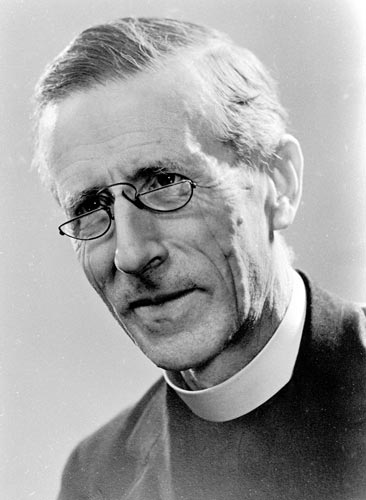
Pierre Teilhard de Chardin was a visionary French Jesuit, paleontologist, biologist, and philosopher, who spent the bulk of his life trying to integrate religious experience with natural science, most specifically Christian theology with theories of evolution. In this endeavor he became absolutely enthralled with the possibilities for humankind, which he saw as heading for an exciting convergence of systems, an "Omega point" where the coalescence of consciousness will lead us to a new state of peace and planetary unity. Long before ecology was fashionable, he saw this unity he saw as being based intrinsically upon the spirit of the Earth:
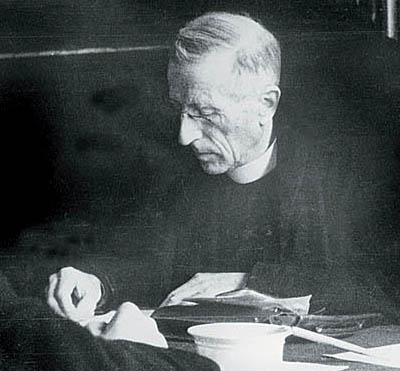
"The Age of Nations is past. The task before us now, if we would not perish, is to build the Earth." Teilhard de Chardin passed away a full ten years before James Lovelock ever proposed the "Gaia Hypothesis" which suggests that the Earth is actually a living being, a collosal biological super-system. Yet Chardin's writings clearly reflect the sense of the Earth as having its own autonomous personality, and being the prime center and director of our future -- a strange attractor, if you will -- that will be the guiding force for the synthesis of humankind.

"The phrase 'Sense of the Earth' should be understood to mean the passionate concern for our common destiny which draws the thinking part of life ever further onward. The only truly natural and real human unity is the spirit of the Earth. . . .The sense of Earth is the irresistable pressure which will come at the right moment to unite them (humankind) in a common passion.

"We have reached a crossroads in human evolution where the only road which leads forward is towards a common passion. . . To continue to place our hopes in a social order achieved by external violence would simply amount to our giving up all hope of carrying the Spirit of the Earth to its limits."

To this end, he suggested that the Earth in its evolutionary unfolding, was growing a new organ of consciousness, called the noosphere. The noosphere is analogous on a planetary level to the evolution of the cerebral cortex in humans. The noosphere is a "planetary thinking network" -- an interlinked system of consciousness and information, a global net of self-awareness, instantaneous feedback, and planetary communication. At the time of his writing, computers of any merit were the size of a city block, and the Internet was, if anything, an element of speculative science fiction. Yet this evolution is indeed coming to pass, and with a rapidity, that in Gaia time, is but a mere passage of seconds. In these precious moments, the planet is developing her cerebral cortex, and emerging into self-conscious awakening. We are indeed approaching the Omega point that Teilhard de Chardin was so excited about.

This convergence however, though it was predicted to occur through a global information network, was not a convergence of merely minds or bodies -- but of heart, a point that he made most fervently.

"It is not our heads or our bodies which we must bring together, but our hearts. . . . Humanity. . . is building its composite brain beneath our eyes. May it not be that tomorrow, through the logical and biological deepening of the movement drawing it together, it will find its heart, without which the ultimate wholeness of its power of unification can never be achieved?"

In his productive lifetime, Teilhard de Chardin wrote many books, which include the following: LET ME EXPLAIN
THE APPEARANCE OF MAN
THE DIVINE MILIEU
THE FUTURE OF MAN
HOW I BELIEVE
HYMN OF THE UNIVERSE
LETTERS FROM A TRAVELLER
LETTERS TO LEONTINE ZANTA
THE MAKING OF A MIND
MAN'S PLACE IN NATURE
THE PHENOMENON OF MAN
SCIENCE AND CHRIST
THE VISION OF THE PAST
WRITINGS IN TIME OF WAR
BUILDING THE EARTH

Most of these quotes were taken from Building the Earth, and The Phenomenon of Man, but as I no longer have a copy, but only old notes, I can't quote exact page numbers.

by Anodea Judith, Dec. 96.

from: http://www.gaiamind.com/Teilhard.html
more on Teilhard de Chardin: http://en.wikipedia.org/wiki/Pierre_Teilhard_de_Chardin
posted by sonoftheprodigal at 8:43 PM 3 comments

Wednesday, August 15, 2007

Free book: "FAITH: SECURITY & RISK..." by Richard W. Kropf

I just saw the book in the library earlier and it prompted me to find this site again. Worth bookmarking...

FAITH: SECURITY & RISK:
The Dynamics of Spiritual Growth

By Richard W. Kropf

(Originally published by Paulist Press,
Mahwah, New Jersey, 1990)
Copyright: 1990, Richard W. Kropf


Table of Contents

Introduction

Chapter 1: Faith and Happiness:
Faith and the Search for Meaning
The Quest for Self-Fulfillment
Meaning and Transcendence

Chapter 2: The Meaning of Faith:
Models of Faith
The Anatomy of Faith
Faith, Hope, and Love

Chapter 3: The Beginnings of Faith
The Stages of Faith
"Undifferentiated" or Instinctive Faith
Intuitive Faith

Chapter 4: Literal Faith
Myth and Belief
Fundamentalism and Biblical "Inerrancy"
Faith and Morality

Chapter 5: Conventional Faith
Adolescence and Conventional Faith
Society and Security
Conscientious Conformism
Catholic Traditionalism

Chapter 6: Personal Faith
Crisis and Conversion
Excesses and Regressions in Personal Faith
The Refusal of Faith
The Risk of Commitment

Chapter 7: Conjunctive Faith
Personal Integration and Conjunctive Faith
Ecumenical Faith
Openness or Indifference?
The Risk of Risking

Chapter 8: Unitive Faith
The Perfection of Faith
The Risks of Sanctity
The Night of Faith
Faith Beyond Beliefs

Epilogue: Can There Be a Universal Faith?

Bibliography


Return to DIALOGOS Issue #12


Jaroslav Pelikan on NPR's "Speaking Of Faith"

Monday, August 13, 2007

Another Excerpt from "Religion in a violent age"

[EXCERPT]

...THE LACK AT THE ORIGIN

A Jewish psychoanalytical writer, born in Morocco, Daniel Sibony, has probed the dark side of monotheism. His work can be read in tandem with Karen Armstrong’s work on Jewish, Christian and Islamic fundamentalism. Both writers help Christians to self-knowledge by showing them their own reflection in pathological aspects of Judaism and Islam.
All three religions live by a myth of the purity of their origins, a myth that breeds violence when it is threatened. Each religion offers a supremely satisfying identity, and the last word about the riddles of life and death. But supposing the identity is based on denial, on a papering over of cracks and flaws in its original construction? Some will attain intellectual and spiritual growth by opening up honestly to a recognition of these cracks and flaws. Others will see such honesty as apostasy and will bunker down in traditionalism and absolutism. The repressed insecurity of threatened identity will show itself in hostility to the rival who embodies the threat and becomes a scapegoat, as the Jews were for Christians throughout history. Throughout the centuries each of the three monotheisms proclaimed its own legitimacy in refuting that of the others. This fruitless apologetical debate is itself a fixational behaviour that indicates the true nature of the three religions. The splitting of human community into elect and reprobate, sheep and goats, is an intrinsically violent structure, pervasive in Scripture. The teaching of Jesus, “love your enemies”, and his reaching across barriers to build inclusive community, go against this, but this is a virtuality that has to be drawn out of the texts by dint of careful spiritual and ethical discernment. In time of friction, this aspect of Scripture is ignored; “love your enemies” has hardly been the favoured slogan of the USA since 9/11. Instead the old dualism of good and evil comes into play.
The more relaxed vision of Vatican II marks a certain retreat of the question of identity, under the auspices of an inclusivism invoking the universality of grace and of divine self-revelation, in the spirit of the stories of Cornelius or of Paul’s preaching at Athens in Acts and of the broad Logos-theology of the Apologists and the Alexandrian theologians of the second and third centuries. Unfortunately the spirit of sectarianism has revived as part of the general regression from the vision of Vatican II, tainting various Vatican documents such as Dominus Iesus (2000). The renewed worry about rival claims, which is causing ecumenism to flounder, perhaps indicates that ecumenical idealism about shared origins is bound to collapse back into the old game of “my origin is better than yours”. Sibony proposes an alternative:
.
Perhaps these three monotheistic currents will one day tolerate and pardon one another not because they derive from the same God and are ‘brothers’ (that kind of fraternity produces more wars than agreements, more rendings than ententes), but because they will find in themselves the same deficiency, the same type of infidelity to what founds them; because they will recognize themselves as children of the same original lack: each marked by a flaw at the origin, a flaw imputable to no one, in any case not to one’s neighbour, a flaw intrinsic to the human and which other humans outside the religious field face as best they can. (Les trois monothéismes : Juifs, Chrétiens, Musulmans entre leurs sources et leurs destins , Seuil, 1997, 10)
.
A recognition of lack at the origin has surfaced occasionally in theology, only to meet with sharp repression, notably in the Modernist controversy. Some space must be made for what Dominus Iesus rejects, the sense that Christianity on its own is a broken and incomplete project, which needs to reach out humbly to other spiritual paths to find its proper role. Christ may be complete, but Christianity enjoys in practice only a very partial understanding of Christ and has to work on its legacy of deadly misunderstandings.
Recognition of the historical and unfinished nature of the Christian, Jewish and Islamic projects, and of the violent foreclosures that launched all three and that recur throughout their career, would certainly have a humbling effect on these traditions. Renouncing absolutism, they would think of themselves as modest and imperfect paths, and would refrain from brandishing the name of the God who unites and divides them as a warrant of legitimacy and superiority. Our construction of God is a powerful fiction, into which we have invested all sorts of delusive passions as well as the higher spiritual discernment that overcomes those passions. The voice of God in Scripture is in the first place the voice of a dialectic going on within human consciousness, both individual and collective. The scandals of this discourse, even when canonized as infallible, bear witness to the divine in a negative mode : “the ultimate is not here, seek it elsewhere”, or perhaps, “do not seek the ultimate at all, but live modestly in the conventional; do not seek certitude, but abide with questions”. This, of course, brings us into the vicinity of Buddhism, especially the Madhyamaka philosophy of conventional and ultimate reality and the Zen saying, “If you meet the Buddha, slay the Buddha”. [FULL PIECE HERE]

Thursday, July 19, 2007

GETTING THE POOR DOWN FROM THE CROSS: CHRISTOLOGY OF LIBERATION

FREE eBOOK!


ISBN:978-9962-00-232-1
Pages: 300

More than 40 Co-Authors: Leonardo BOFF (foreword), Tissa BALASURIYA, Marcelo BARROS, Teófilo CABESTRERO, Oscar CAMPANA, Víctor CODINA, José COMBLIN, CONFER de Nicaragua, Lee CORMIE, Eduardo DE LA SERNA, José ESTERMANN, Benedito FERRARO, Eduardo FRADES, Luis Arturo GARCÍA DÁVALOS, Ivone GEBARA, Eduardo HOORNAERT, Diego IRARRÁZAVAL, Jung Mo SUNG, Paul KNITTER, João Batista LIBÂNIO, María y José Ignacio LÓPEZ VIGIL, Carlos MESTERS, Alberto PARRA, Richard RENSHAW, Jean RICHARD, Pablo RICHARD, Luis RIVERA PAGÁN, José SÁNCHEZ SÁNCHEZ, Stefan SILBER, Ezequiel SILVA, Alfonso Mª Ligório SOARES, José SOLS LUCIA, Paulo SUESS, Luiz Carlos SUSIN, Faustino TEIXEIRA, Pedro TRIGO, José María VIGIL, and Jon SOBRINO (epilogue).

Wednesday, June 27, 2007

Trinity, Creation and the Energy of Love [By Brian J. Pierce, O.P]


picture by Alex Grey

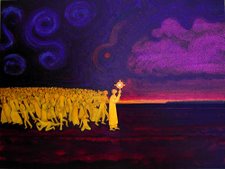
...Fr. Bede begins by calling attention to the web of inter - relationships of which we are all part, in and among ourselves, and with God. As he was so fond of doing, Fr. Bede draws on the wisdom of the New Physics to point to a scientific way of talking about the energy fields which hold us all together in an interdependent whole. He then says that the same inter-being (to use Thich Nhat Hanh's phrase) is also at the heart of the fluid process of differentiation in the Godhead. "We all come from the Source, the Absolute, which is an interdependent relationship," he says. God's inter-being and ours is one. Bede points to this interdependence in the Hindu tradition, showing how there is a dynamic interplay between Shiva and Shakti, a vibration of energy and movement, called Spanda. "The whole creation comes into being through that Spanda, through the vibration between Shiva and Shakti," says Fr. Bede. It is, he notes, a transcendent reality, a divine movement, which becomes manifest in the created world.

Moving then to the Buddhist tradition, Bede draws on a quote from a great Zen teacher, Suzuki, in which he said that "Sunyata is not static but dynamic." So even in Buddhism, even in the great emptiness of sunyata, notes Bede, there is a movement, a tendency towards outpouring. "In the void there is a constant urge to differentiate itself. And the whole creation is the differentiation of the void...At the very moment of the differentiation it returns to itself. It is always coming out and returning." The void flows out in differentiation and simultaneously returns to the void. "That is why the Buddhists say that Nirvana and Samsara are the same," says Fr. Bede. "Ultimately they are one."

CONTINUE...

Tuesday, June 12, 2007

Book Recommendation: Arise, my love..."


Just getting into this. I highly recommend it:


“Arise, my love…”: Mysticism for a New Era
William Johnston., Maryknoll, NY, Orbis Books, 2000. Pp. 261

Review by Anton Hoogland, O. Carm.
Manila, Center for Spirituality

In October 1986 religious leaders from all over the world came together in Assisi upon the invitation of Pope John Paul II to pray for peace. It was a historic moment. The writer quotes Tennyson saying that “more things are wrought with prayer than these world dreams of.” As we enter the third millennium Johnson says that mystical prayer or mysticism assumes an importance it has never had before. By mysticism he means wisdom, the wisdom that goes beyond words and letters, beyond reasoning and thinking, beyond imagining and fantasy, beyond before and after into the timeless reality. Mysticism then is quite different from the knowledge that comes from understanding and judging.
In the West many parish churches have closed their doors. Well-established Catholic organizations and institutes have disappeared over the last decades. People have turned away from a church that paid more attention to truth "than to the subjective experience, to the process by which a person comes to the truth and to the conscience of every human person.
Empty churches cannot be equated with a-religiosity. There is a great hunger for spiritual experience. Thousands of peoples traveled to the East in the third quarter of the 20th century. People became more and more dissatisfied with an institutional religion that asked them to believe dry doctrines and dogmas and to follow blindly rules and regulations. Lonergan makes a distinction between a superstructure that is cultural and is crumbling, and the core which is faith. Many, even in the Church's top echelon, do not know how to distinguish the two.
The Second Vatican Council was a hope-filled and refreshing happening. It realized the need of so many Christians for a Church of dialogue and love. People are more in need of wisdom than knowledge, of love rather than of laws. The Christian mystical path has one distinctive feature; it is above all a path of love.
Asia is the home of billions of deeply religious people who have been taught to pray and meditate in their own great religious traditions. Their values, their history and their culture have been shaped by the great religions. While Buddhist and Christian mysticism have much in common, both being forms of transcendental wisdom, one cannot say they are the same. It is possible that they are complementary. The fundamental difference is that while the Hindu and the Buddhist focus primarily on a transformation of consciousness, the heart of Christian mysticism is a mystery of love.
During the Synod of the Asian bishops held in Rome April-May 1998 the bishops spoke frankly about inter-religious dialogue and about the woeful lack of inculturation in the Asian way of thinking and feeling. William Johnston says, "As Rome seeks reconciliation with Constantinople, with Geneva and with Canterbury, we hope that Rome will be open to inter-religious dialogue with Delhi, Beijing and Tokyo." A new mysticism is needed, that is holistic and will embrace both matter and spirit. The apophatic mysticism of darkness as we find among others in John of the Cross, must go hand in hand with the kataphatic mysticism of light. Mystical theology must include matter and the cosmic dimension of the Incarnation, the Resurrection and the Second Coming.
A mystical theology that will appeal to the 21st century must listen to the hungry, the marginalized and the oppressed. It must listen to liberation theology. And finally, mystical theology needs Asian mysticism which seeks the unity of the universe and the human person. Asian religious thought in dialogue with the Christian tradition of the Western and Eastern Churches will form the basis of a mystical theology of the future. From the side of the Christian Church a deep humility and conversion is necessary. The Japanese bishops say, "The church, learning from the kenosis of Jesus Christ, should be humble and open its heart to other religions to deepen its understanding of the Mystery of Christ." While Johnson brings us on a journey through the Buddhist and Hindu traditions he is concerned principally with Christian mysticism. It is the self-emptying of the Christian mystic in imitation of Jesus who “emptied himself, taking the form of a slave,” that leads to the highest wisdom.
Johnston writes in simple and understandable words an inspiring message for all who struggle with the decline of a western church but who hope for a re-born Christianity. Johnson believes that our global era presents us with major challenges calling for new mystics. Focusing on the Incarnation as the distinctively Christian gift in the global world, he suggests a more mystical approach to Scripture and Christian theology. His great knowledge of the great eastern religions and his inculturation in the eastern culture qualify him eminently for the topic of this book: mysticism for a new era.


Thursday, May 3, 2007

Great Podcast: Fr. Robert E. Kennedy, Catholic priest and a Zen master (roshi)

Pic: Matteo Ricci, S.J.

http://ncrcafe.org/node/1057

'I wanted a faith that was deeper,' a Tom Fox interview

Jesuit Fr. Robert E. Kennedy is an American Catholic priest and a Zen master (roshi). "I have never felt that I was a Buddhist. I have always felt that I am Catholic and a Jesuit," Kennedy tells Tom Fox. "But I wanted a faith that was deeper, that was rooted in my experience, that was not a theory that could be blown away with a change in culture." He explains:

"Christianity is not a triumphal march to the Kingdom." It is an emptying of self. "This profound teaching of Christian life is very close to Buddhism. Buddhism tries to empty ourselves of a false identity and to come to the world as naked and as crucified as Christ was."


Episode 1: Come at life fresh, moment by moment (27 min.)
"I was talking with a Chinese Zen master once and he said one of the difficulties of dealing with Catholics is that they love their spiritualities ... as if it was a parallel life," Kennedy tells Tom Fox. Buddhists root us in this moment, he said. "Buddhists would say, 'If God isn't present in this moment, where is he? You meet God in doing the deed of this moment in front of you. Never withdraw from it.' "

Episode 2: Helping a person take another step (24 min.)
When Kennedy went to study with a Japanese Zen master, the Buddhist told him: " 'I do not want to make you a Buddhist. I want to empty you in imitation of your Lord Jesus Christ who emptied himself and poured himself out.' This is at the heart of what it means to be Catholic. To follow Christ is to empty ourselves." He continues: "I remember thinking then, 'This Buddhist might make a Christian of me yet.' It was so profoundly Christian and beautiful."


More about the author
Ordained a priest in Japan in 1965, Jesuit Fr. Robert E. Kennedy was installed as a Zen teacher in 1991 and was given the title Roshi in 1997. Kennedy studied Zen with Yamada Roshi in Japan, Maezumi Roshi in Los Angeles and Bernard Glassman Roshi in New York. He teaches in the theology department of Saint Peter's College in Jersey City, N.J. In addition to his work at the college, he is a practicing psychotherapist. He is the author of two books, Zen Spirit, Christian Spirit and Zen Gifts to Christians.

Tuesday, April 24, 2007

A Review of Meditations on the Tarot by Anonymous (Valentin Tomberg), [review by Stratford Caldecott]


[I Still do not have any time to comment, but wanted to post this here for future reference, as this book had a profound effect on me a few years ago]

"...We are all aware of the popularity of witchcraft, magic, astrology and the "New Age" movement. The cults and new religions are growing in number and strength every year: in contrast, the Catholic Church is often represented as a fossil, its life extinguished by centuries of dogmatism. True Christianity, says the New Age, has been lost, or retreated underground where only an elite few can find it. Meditations on the Tarot answers these accusations. It claims that Christianity has not been lost at all, but has been preserved precisely by those institutions and dogmas that, to the New Agers, appear opposed to the life of the Spirit. The book was written by a remarkable convert, an experienced occultist who finally discovered "that there are guardian angels; that there are saints who participate actively in our lives; that the Blessed Virgin is real... that the sacraments are effective... that prayer is a powerful means of charity; that the ecclesiastical hierarchy reflects the celestial hierarchical order... that, lastly, the Master himself--although he loves everyone, Christians of all confession as well as all non-Christians--abides with his Church, since he is always present there, since he visits the faithful there and instructs his disciples there."

By means of 22 meditations, in the form of "letters to an unknown friend", the anonymous author attempts to assimilate his vast store of "esoteric" knowledge, gleaned from years of spiritual training in the more serious New Age groups, within the orthodox Catholic vision of faith. The Tarot cards are used, not for divination, but as symbolic encapsulations of the wisdom he has leant. "The High priestess warns us of the danger of Gnosticism in teaching the discipline of true gnosis. The Empress evokes the dangers of mediumship and magic in revealing to us the mysteries of scared magic. The Emperor warns us of the will-to-power and teaches us the power of the Cross."

Hans Urs von Balthasar has compared the author to Charles Williams, Hildegard of Bingen and even St Bonaventure, praising (with certain qualifications) the book's "superabundance of genuine, fruitful insights". An example of such an insight might be the distinction it draws between three forms of mystical experience: union with Nature, with the transcendental human Self and with God. The first is pantheism; the second lies at the heart of the Eastern religions, and leads to metaphysical distortions when Westerners take the Self to be identical with God. The third is the goal of Christianity, and is inevitably dualistic because it involves the union in love between two distinct beings. Characteristic of this third kind of mystical experience is the "gift of tears", whereas the "advanced pupil of yoga or Vedanta will forever have dry eyes".

At its orthodox core, the Hermetic wisdom boils down to the doctrine of analogy: "As above, so below." By exploring the implications of this symbolic correspondence between different levels of reality, the author opens a dimension of depth on the Scriptures and dogmas of the Church. Take the so-called Law of Reward: "Renunciation of what is desired below sets in motion forces of realization above." This leads the author into an analysis of the three sacred vows--poverty, chastity and obedience--as the basis, not just of monastic life, but of all spiritual realization. The three temptations of Christ in the wilderness are directed at the three vows, the angels who came to minister to him after his triple victory are the "response from above", bringing him a threefold reward.

The three vows are also related to the five wounds, the Stigmata: "obedience rivets the will-to-greatness of the heart", "poverty holds fast the desire to take and the desire to keep of the right hand and the left hand", while "chastity pins down the desires of the 'Nimrodic hunter'." Christ's triple victory flowers into the seven sacraments, each corresponding to one of the "seven archetypal miracles" and one of the seven "I am" sayings in the Gospel of John. Exposing in this way hidden connections that link seemingly unrelated events in the Bible, Meditations on the Tarot aims to attune us with the breath of the Holy Spirit, who inspires and vivifies Scripture.

Meditations on the Tarot has flaws: the influence of anthroposophy is still too evident, for example, in the discussion of reincarnation. But potentially important for the future of the New Age movement is its breakthrough realization that, in Christianity, the esoteric and the exoteric cannot be separated, because "the spiritual world is essentially moral"... CONTINUE READING

Sunday, March 11, 2007

American Islam: the Struggle for the Soul of a Religion, by Paul M Barrett


http://caelumetterra.typepad.com/blog/

...American Islam has a chapter devoted to Sheikh Muhammad Hisham Kibanni, spiritual leader of the Naqshbandi order of Sufis in the United States.

To my amazement I read that the Naqshbandi own a farm near Fenton, Michigan, the town where I grew up. Not only that, but what had been the local Episcopal church is now their mosque.

I guess I haven't been to my old town for a while.

Sheikh Kabbani's Sufi approach to Islam emphasizes love, recognizes the presence of God in all, and urges tolerance and peace.

He was disturbed, when he came to the US in 1990, by the intolerant tone of much of what he heard in American mosques.

He has denounced those who spew hate and destruction in the name of Allah, a stance that has brought death threats.

Yet the Sheikh is no liberal Muslim. Naqshbandi Islam is a deeply rooted tradition within Islam, rather that a newly minted secular imitation. It is mystical, not rationalistic; devotional, not dogmatic.

Besides the Naqshbandi, there are other movements- Sufi, Sunni and Shia- which are traditional expressions of Islam and who view the Wahhabi and Salafi violence as aberrational, who affirm the traditional Islamic prohibitions against killing civilians, against slaying Muslims, and against committing suicide.

To pray for a revival of these expressions of Islam is to pray not only for the common good and for peaceful times. It is to pray for the good of souls; it is to pray movement toward Catholic truth and Catholic charity.

I do not see it as contrary to praying for the conversion of Muslims.

--Daniel Nichols
Tuesday, March 6, 2007

"Christ died on the cross with a crown of thorns on his head defying the might of a whole empire." - Gandhi

Strange Virtue


"Christ died on the cross with a crown of thorns on his head defying the might of a whole empire." - Gandhi

This is the power that we must wield, by our suffering and by our faith: "He or she must have a living faith in non-violence. This is impossible without a living faith in God. A non-violent man can do nothing save by the power and grace of God. Without it he won't have the courage to die without anger, without fear and without retaliation. Such courage comes from the belief that God sits in the hearts of all and there there should be no fear in the presence of God. The knowledge of the omnipresence of God also means respect for the lives of even those who may be called opponents."

The empire works by division - Shiite against Sunni, Iranian against Iraqi, secular leftist versus Christian, and so on. Perhaps no one analyzed this as clearly as Thomas Aquinas. Here he is analysing the common good, a concept that is more and more explicitly denied by the powers that rule the current empire: "Security is banished and everything is uncertain when people are cut off from law and depend on the will, I would even say the greed, of another. A tyrant oppresses the bodies of his subjects, but, what is more damnable, he threatens their spiritual growth, for he is set on his own power, not their progress. He is suspicious of any dignity that he may possess that will prejudice his own iniquitous domination. A tyrant is more fearful of good persons than of bad persons, for he dreads their strange virtue. Fearful lest they grow strong and so stout of heart as no longer to brook his wicked despotism, but resolve in companionship to enjoy the fruits of peace, a tyrant is constrained to destroy good people's confidence in one another, lest they band together to throw off his yoke. Therefore he sows discord among them and encourages dissensions and litigation. He forbids celebrations that make for good fellowship, wedding and feasts and such events that are likely to promote familiarity and mutual loyalty."

The spiritual growth which we seek is to become conscious of our inner power in order to end the anonymous impotence induced by the empire's propaganda. The spiritual disease we are suffering from is comfort. Bit by bit we have lost the taste for anything but comfort, until it becomes a treasure incapable of risk. This is the addiction that paralyzes our best efforts because it ultimately means that we would rather see hundreds of thousands of far-off people killed than risk losing the oil supply that makes our comfort possible. The Democrats efforts to stop the bloodletting will remain ineffectual as long as they accept the basic premise that our comfort is more important than the life of an unknown foreigner or the sovereignty of their nations.

The consequences of comfort are revealed in the very phrasing employed by the Democrats: "Questioned by a reporter about making 'an urgent end to the Iraq war and asking Congress to cut the funding immediately." he asked, 'Is that a bad idea?' Nancy Pelosi, whom most observers believe to be opposed to the war, said, 'Why would it be a bad idea not to support our troops?' - rephrasing a funding cutoff as an attack on the soldiers.

It is a demonstration of the entirely artificial and false character of 'official' US politics that sending hundreds if not thousands more soldiers to their deaths is hailed as 'support,' while removing them from the battlefield and returning them safely to their families is denounced as 'undermining the troops.'"

Here we can see that liberals have internalized the arguments, as well as the premises of those arguments, of those who would use military power to gain control of key economic resources. The louder and more incessant the cries that rise from the Democrats with their meaningless expressions of distaste for Mr. Bush's tactics, the more likely that the underlying hegemonic imperative is being buried beneath a waste dump of moralistic rhetoric.

To end the war means to end the taste for violence in ourselves - through action that risks comfort, career, and all the perks that the empire can provide to buffer us from the consequences of that comfort - the price of which is alway paid by others far away. The truth we cannot face is the truth Gandhi knew so well: "We must voluntarily put up with the losses and inconveniences that arise from having to withdraw our support from a Government that is ruling against our will. Possession of power and riches is a crime under an unjust Government, poverty in that case is a virtue, says Thoreau...if a Government does a grave injustice the subjects must withdraw co-operation wholly or partially, sufficiently to wean the ruler from his wickedness. In each case conceived by me there is an element suffering whether mental or physical. Without such suffering it is not possible to attain freedom." - Gandhi
posted by Boyd at 9:24 AM | 0 comments links to this post