Monday, April 30, 2007

Working for the Clampdown

[Lots of good info in the whited hyperlinks]

Blueprint for Dictatorship
Recent legislation sets us up for tyranny
by Justin Raimondo, antiwar.com

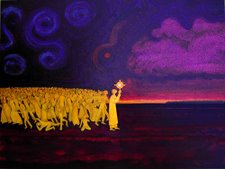
[picture: Eric Drooker]

America is headed for a military dictatorship – and recent legislation makes this all but inevitable. Last September, Congress passed the Defense Authorization Act, which empowered the president to declare martial law with very little provocation, namely in the aftermath of a "terrorist attack or incident." Having determined that "the execution of the laws" is hampered by the "incident," the president can unilaterally impose martial law – without the consent of Congress, which need only be informed of the event "as soon as practicable." The only condition attached instructs the president to report to Congress after 14 days, and every 14 days thereafter.

This use of the military to enforce domestic order is a new development in American history, one that augurs a turning point not only in terms of law, but also in our evolving political culture. Such a measure would once have provoked an outcry – on both sides of the aisle. When the measure passed, there was hardly a ripple of protest: the Senate approved it unanimously, and there were only thirty-something dissenting votes in the House. Added to the Military Commissions Act [.pdf], this new brick in the wall of domestic repression creates the structure of a new imperial system on the ruins of the old constitutional order. George W. Bush and his hard-core neoconservative henchmen may have lost the war in Iraq, but they have won a virtually uncontested victory at home: the conquest of the old republic by an emerging imperial order. This recalls the opening of Garet Garrett's 1952 philippic, Rise of Empire, wherein he diagnosed the essential indeterminacy of the transition:

"We have crossed the boundary that lies between Republic and Empire. If you ask when, the answer is that you cannot make a single stroke between day and night; the precise moment does not matter. There as no painted sign to say: 'You are now entering Imperium.'"

The usually prescient Garrett got it somewhat wrong here: The single stroke between day and night can be fixed precisely in time, at 8:45 a.m. EDT on Sept. 11, 2001, and the Military Commissions Act and the disturbing changes in the U.S. Code outlined above are the closest to painted signs we are likely to get. Waiting in the wings, an infamous cabal took advantage of the 9/11 terrorist attacks, moving with preternatural speed to consolidate a dictatorship of fear. With the passage of more recent legislation, they are now moving to consolidate their gains. Sinisterly, the new legislation also alters the language of Title 10, Chapter 15, Section 333 of the U.S. Code (the so-called Insurrection Act) in an ominous manner:

"Whenever the president considers it necessary to use the militia or the armed forces under this chapter, he shall, by proclamation, immediately order the insurgents or those obstructing the enforcement of the laws to disperse and retire peaceably to their abodes within a limited time."

Why insert the bolded phrase – unless your objective is to widen the category of miscreants to include those exercising their First Amendment rights? No one expects an insurgency to be launched in this day and age in America, yet peaceably assembling to protest government policies can easily be interpreted to include "obstructionists" who might be "dispersed." As José Padilla discovered, any American can be kidnapped and held without trial – or even formal charges – on the orders of the president, and the granting of unprecedented power to rule by decree builds on this neo-royalist theory. The Bushian doctrine of the "unitary executive," which gives the occupant of the White House monarchical power in wartime, has now been approved by the Democrats, who can't wait to wield it themselves. Of course, they would exercise such unholy power only in a good way – say, if a state refused to cooperate in enforcing or implementing federal legislation instituting a draft, or, more likely, federalizing a state National Guard unit to be shipped to the Middle East.

Oh, you mean that's not so good? Just wait until the Democrats get their hands on all that power: then you'll see the real collapse of the movement to preserve civil liberties in America. Remember, it was Hillary Clinton who said of the Internet: "We are all going to have to rethink how we deal with this, because there are always competing values. There's no free decision that I'm aware of anywhere in life, and certainly with technology that's the case." Yes, the technology is very "exciting," she averred, yet "there are a number of serious issues without any kind of editing function or gatekeeping function. What does it mean to have the right to defend your reputation, or to respond to what someone says?"

The First Amendment is not big with Hillary and never has been. She's power-mad, and every once in a while the frigid mask gives way to the face of a real authoritarian, albeit a different one than that of the red-state fascists, as Lew Rockwell describes the anti-libertarian Right. Blue-state fascists trample on our civil liberties "for the children," but the effect is the same: bipartisan support for the abolition of our old republic and the inauguration of a new era in American history: the Age of Empire.

With the neoconized "conservative" movement transformed into a force fully committed to outright authoritarianism, and the "liberals" defending the depredations of the Democrats in power, who will be left to defend what's left of the Constitution? Just Ron Paul and Alexander Cockburn. The rest will go with the herd instinct of sheep threatening to stampede at the apparent intrusion of a wolf in their pasture.

Under the terms of this legislation, who defines a terrorist "incident"? The president. Who defines an "unlawful combination"? The president. Who determines that a "conspiracy" is in progress, one that threatens national security and domestic order? The president of these United States – which are to be united, in our darkest future, by a superpresident who can outlaw the opposition with the stroke of a pen and is more a military leader than the chief executive of an ostensible republic.

Stop, for a moment, and consider where we are in the spring of 2007.

On the home front, the representatives of the people have conceded the last of their waning powers to the executive branch and paved the way for the restoration of royalism in America. Overseas, American troops are fighting a war of conquest – there is no other way to describe it – in an effort to prop up a rapidly failing puppet government in the Middle East. Meanwhile, U.S. forces are gathering in the Persian Gulf for what looks to be a strike against Iran.

The unpopularity of our foreign policy is increasingly a cause for concern in the Imperial City, where both parties have colluded – with surprisingly little dissent – in ensuring a permanent U.S. military presence in the Middle East. It is merely a question of the size of our footprint that divides the two major parties on this all-important question. The Democrats want to "redeploy" – to Qatar and other neighboring countries. The Republicans won't give up an inch of conquered Iraqi territory and instead want to extend the battle into Iran, which is already the target of a not-so-covert campaign aiming at "regime change." (The Iran Freedom Support Act, authorizing millions in aid to "democratic" groups, was supported by the leadership of both parties in Congress.)

Rising antiwar sentiment worries William F. Buckley Jr., who opines that "There are grounds for wondering whether the Republican Party will survive this dilemma." Given the authoritarian proclivities of the Bush administration and the neoconized GOP, there are grounds for wondering whether the republic will survive. We are just a terrorist "incident," either real or imagined, away from a declaration of martial law and all its attendant consequences. Buckley grimly notes the polls are "savagely decisive" on the war question, and he asks: "Beyond affirming executive supremacy in matters of war, what is George Bush going to do?" The answer may be contained in Title 10, Chapter 15, Section 333.

Senators Patrick Leahy (D-Vt.) and Kit Bond (R-Mo.) are sponsoring legislation that would repeal the changes, but, as Sen. John Warner pointed out the other day, when the Insurrection Act was revised to give the president extraordinary powers, no one raised any objection. Now, suddenly, the senators, including Warner, see some reason to regret their hasty actions – do they know something we don't?

I fear, however, that it may be too late. Bush will surely veto the Leahy-Bond measure – and, if necessary, declare America's governors, who all oppose this brazen usurpation, an "unlawful combination," as the Insurrection Act puts it. Then he will be empowered to "disperse" them, and the Senate, at will.

I'm back to Garet Garrett, who never fails to come up with some apt aphoristic prognostication, this one being from his classic The Revolution Was:

"There are those who still think they are holding the pass against a revolution that may be coming up the road. But they are gazing in the wrong direction. The revolution is behind them. It went by in the Night of Depression, singing songs to freedom."

Sunday, April 29, 2007

Saturday, April 28, 2007

The Living Wage, the Family Wage


Stephen Hand is on the ball again...

TCR Note: When an economy is engineered to force both parents into the work force, not only is the emotional and spiritual welfare of the family placed in jeopardy, but the downward pressure on wages becomes very difficult for very many. Such is closer to slavery than liberation. Even in what is perceived to be affluent suburban areas, if one of the working parent gets sick or otherwise loses a job disaster is not far off.

The Popes on Wages: In "Rerum Novarum" (on capital and labor), 1891, Pope Leo XIII wrote: "There is a dictate of nature more imperious and more ancient than any bargain between man and man, that ... remuneration must be enough to support the wage earner in reasonable and frugal comfort."

# In "Quadragesimo Ano" (on reconstructing the social order), 1931, Pope Pius XI wrote: "In the first place, the wage paid to the workingman should be sufficient for the support of himself and his family. ... Social justice demands that reforms be introduced without delay which will guarantee every adult workingman just such a wage."

# In "Pacem in Terris" ("Peace on Earth), 1963, Pope John XXIII wrote: "Furthermore - and this must be especially emphasized - the worker has a right to wages determined by the criteria of justice, and sufficient, therefore, in proportion to available resources, to give the worker and his family a standard of living in keeping with the dignity of the human person."

# In "Laborem Exercens" ("On Human Work"), 1981, Pope John Paul II introduced the term "family wage": "Just remuneration for the work of an adult who is responsible for a family ... what is called a family wage - that is, a single salary given to the head of a family for his work, sufficient for the needs of the family without the spouse having to take up gainful employment outside the home." Putting a dollar figure on the concept of a living wage is where the controversy is centered, Miller said.

Friday, April 27, 2007

The Ecology of Work

Environmentalism can't succeed until it confronts the destructive nature of modern work—and supplants it

by Curtis White

Published in the May/June 2007 issue of Orion magazine

Last of a two-part series. See The Idols of Environmentalism for part one.


ENVIRONMENTALISTS SEE THE ASPHALTING of the country as a sin against the world of nature, but we should also see in it a kind of damage that has been done to humans, for what precedes environmental degradation is the debasement of the human world. I would go so far as to say that there is no solution for environmental destruction that isn’t first a healing of the damage that has been done to the human community. As I argued in the first part of this essay, the damage to the human world has been done through work, through our jobs, and through the world of money.

We are not the creators of our own world; we merely perform functions in a system into which we were born. The most destructive aspect of our jobs is that in them we are mere “functionaries,” to borrow Josef Pieper’s term. Just as important, we have a function outside of work: consumption. Money in hand, we go into the market to buy the goods we no longer know how to make (we don’t even know how to grow and preserve our own food) and services we no longer know how to perform (frame a house? might as well ask us to design a spaceship).

Challenging our place in this system as mere isolated functions (whether as workers or consumers) is a daunting task, especially for environmentalists, who tend to think that human problems are the concern of somebody else (labor unions, the ACLU, Amnesty International, Habitat for Humanity, etc.). We’re about the “Earth first.” My argument is simply that the threats to humans and the threats to the environment are not even two parts of the same problem. They are the same problem. For environmentalism, confronting corporations and creating indignant scientific reports about pollution is the easy stuff. But these activities are inadequate to the real problems, as any honest observer of the last thirty years of environmental activism would have to concede. The “last great places” cannot be preserved. We can no more preserve them than we can keep the glaciers from melting away. Responding to environmental destruction requires not only the overcoming of corporate evildoers but “self-overcoming,” a transformation in the way we live. A more adequate response to our true problems requires that we cease to be a society that believes that wealth is the accumulation of money (no matter how much of it we’re planning on “giving back” to nature), and begin to be a society that understands that “there is no wealth but life,” as John Ruskin put it. That is the full dimension and the full difficulty of our problem.

Unfortunately, on these shores the suggestion that there is something fundamentally destructive in work, money, and capitalism leads quickly to emotional denials. This is so even among self-described environmentalists, card-carrying members of the Sierra Club and The Nature Conservancy. So we try to persuade ourselves that capitalism can become green. I don’t believe that capitalism can become green, simply because the imperatives of environmentalism are not part of its way of reasoning. Capitalism can think profit but it can’t think nature. It’s not in its nature to think nature. What is part of its nature is marketing ("We’re organic! Buy us!"), even while its actions—industrial livestock practices that masquerade as Earth-friendly, for instance—are really only about market share, dividends, and stock value.

Capitalism as a system of ever-accelerating production and consumption is, as we environmentalists continually insist, not sustainable. That is, it is a system intent on its own death. Yet the capitalist will stoically look destruction in the face before he will stop what he’s doing, especially if he believes that it is somebody else whose destruction is in question. Unlike most of the people living under him, the capitalist is a great risk-taker largely because he believes that his wealth insulates him from the consequences of risks gone bad. Ever the optimistic gambler with other people’s money, the capitalist is willing to wager that, while there may be costs to pay, he won’t have to pay them. Animals, plants, impoverished people near and far may have to pay, but he bets that he won’t. If called upon to defend his actions, he will of course argue that he has a constitutionally protected right to property and the pursuit of his own happiness. This is his “freedom.” At that point, we have the unfortunate habit of shutting up when we ought to reply, “Yes, but yours is a freedom without conscience.”

Being willing to say such things about capitalism does not mean that one has a special access to the Truth, but it also doesn’t mean that one is a mere ideologue, or that most dismissible of things, a communist. It merely requires honesty about what looks us right in the face. It requires intellectual conscience. CONTINUE...

Iraq

Another good discussion at dotCommonweal

Monks Who Play Punk


James Estrin/The New York Times


Father Luke in his room at St. Joseph’s Friary in Harlem.
By JOHN MITCHELL
Published: April 22, 2007

IT was 9 o’clock on a wintry Saturday night, and in the dimly lighted basement of Our Lady of Good Counsel, a Roman Catholic church on 90th Street and Second Avenue, the chatter of more than 400 young people competed with the din of a rock band. Those not shouting in one another’s ears were dancing, singing, laughing and jumping up and down while trying not to spill their cups of coffee.

“Who has ever heard of a monk playing funk music?” shouted Brother Agostino Torres, a 30-year-old friar wearing sandals and a hooded gray robe. Hands shot into the air.

“O.K., all right, but I’ll bet you never heard of this one,” Brother Agostino went on. “Because tonight, we’re going to have some monks play some punk!” Half a dozen other bushy-bearded, gray-frocked friars broke into a cacophony of drums, bass, saxophone and electric guitar... READ MORE

-----------------------------
Also, interview with Fr Stan Fortuna here during his recent trip to Australia:

http://www.abc.net.au/rn/spiritofthings/stories/2007/1888683.htm

Irish Peace Laureate Shot By Israeli Troops at Non-Violent Protest - Why Isn’t This News?


, by Robert Naiman

If you listened to Democracy Now on Monday, you already know the following:

Irish Nobel Peace Laureate Mairead Maguire was among a number of people shot Friday by Israeli troops at a nonviolent protest of the “apartheid wall” in the Palestinian village of Bil’in, near Ramallah.

But if you didn’t listen to Democracy Now Monday, you probably didn’t know that.

Maguire was shot with what the Israeli military - and some press reports - misleading refer to as a “rubber bullet” - that is, a rubber-coated steel bullet.
Why isn’t this “news” in the United States? There’s nothing on the web sites of the New York Times, the Washington Post, or the Los Angeles Times, not even a wire story.

Those who blame the Palestinian people for their fate, attributing it to Palestinian violence, and faulting the Palestinians for not emulating Gandhi, King, or Mandela (whose role in the “armed struggle” against apartheid in South Africa is always conveniently elided for the purpose of this comparison) should periodically ask themselves, when Palestinians do engage in nonviolent protest, and are subjected to brutal repression as a result, how come the mainstream U.S. media don’t pay any attention? CONTINUE...

TCR Deeply Regrets Vatican Invitation of Alleged War Criminal Henry Kissinger

As always, some great posts at Stephen Hand's TCRNews Musings
including this:

Friday, April 27, 2007 TCR Deeply Regrets Vatican Invitation of Alleged War
Criminal Henry Kissinger


"Mary Ann Glendon, a U.S. law professor and president of the Pontifical Academy of Social Sciences, invited Kissinger to speak at the academy's April 27-May 1 plenary session.

"The academy, which advises the Vatican on social issues, was to focus on "Charity and Justice in the Relations Among Peoples and Nations." ...more

Genocide in East Timor:

The 1975 Indonesia invasion of -- and subsequent genocide in -- East Timor was delayed a few hours so as not to embarrass President Ford and Kissinger, who were visiting Jakarta. Noam Chomsky writes, "The Indonesia invasion of December 1975 following several months of military actions that were well-known to Australia, the US and Britain was an unprovoked act of aggression, a war crime, which makes all participants war criminals, from Henry Kissinger on down."

Despite a UN condemnation and call for the immediate withdrawal of troops and for "all States to respect the territorial integrity of East Timor as well as the inalienable right of its people to self-determination," Secretary of State Henry Kissinger increased the flow of arms to Indonesia and instructed the UN ambassador Moynihan to, according Chomsky, "to block any diplomatic reaction to Indonesia's criminal aggression, adopting the stance that Australian diplomat Richard Woolcott...admiringly called 'Kissinger realism,' a technical term for cowardly thuggishness and criminality."

Moynihan writes in his memoirs "The Department of State [under Kissinger] desired that the United Nations prove utterly ineffective in whatever measures it undertook. This task was given to me, and I carried it forward with no inconsiderable success." In the following few months some 60,000 people had been murdered -- 10 percent of the population.


Limited Nuclear War: An "Appropriate" Policy

As one of the most powerful men in the United States, Kissinger never shied away from the potential use of nuclear weapons. In his memoirs, Kissinger equates courage with an ability to "face up to the risks of Armageddon," for example, "go[ing] to the brink over Pakistan." In response to tensions in the Middle East in 1973, Kissinger ordered a worldwide alert for U.S. nuclear forces, with B-52s loaded with 20-megaton nuclear bombs taking off from Guam, US aircraft carriers loaded with nuclear weapons heading toward the Mediterranean, and U.S. anti-aircraft missiles raised to firing position in West Germany. The goal of this action, among many others, was, as Kissinger wrote, "to ensure that the Europeans and Japanese did not get involved in the diplomacy regarding the Middle East." Kissinger informed the Soviet ambassador, "This is a matter of great concern. Don't you pressure us. I want to repeat again, don't pressure us."

Although the crisis thankfully subsided when the Soviets declared they had no intention of going into the Middle East, it was evidence that Kissinger (who was the basis for Dr. Strangelove) had no problem with using the most destructive weapons on the planet like chess pieces, with no regard for human lives. Indeed, in 1969, he was, with Nixon, involved in the so-called "Madman: ultimatum to Hanoi, threatening to drop nuclear weapons to end the U.S. invasion of Vietnam. Thanks to popular dissent against the war, Nixon concluded that he could not keep the country together if he went ahead with these plans.

Kissinger's views on nuclear war were expounded in Nuclear Weapons and Foreign Policy (1957). He praised the idea of "limited nuclear war," declaring "Everything depends on leadership of high order, personal initiative and mechanical aptitude; qualities more prevalent in our society than in the regimented system of the USSR." For a capitalist nation, he wrote, "the most productive form of war is to utilize weapons of an intermediary range of destructiveness, sufficiently complex to require a substantial productive effort, sufficiently destructive so that manpower cannot be substituted for technology, yet discriminating enough to permit the establishment of a significant margin of superiority. It would seem that the weapons systems appropriate for limited nuclear war meet these requirements."


"Covert action should not be confused with missionary work."

The recent headlines about the Kurds in Iraq have historical roots which implicate Kissinger in criminal activity as well. In the early 1970s, the Shah of Iran (whose regime had one of the worst human rights records in the world), supported by Kissinger, hoped to use the Kurds to undermine the government of Iraq. The Nixon administration, under the guidance of Kissinger and the CIA, provided the Kurds with weaponry but, according to a Congressional report, "none of the nations who were aiding them seriously desired that they realize their objective of an autonomous state." One CIA memo stated clearly there was never any intention of helping the Kurds achieve an autonomous state, and that "Neither Iran nor ourselves wish to see the matter resolved one way or the other." The Pike Committee investigating CIA abuses concluded "Even in the context of covert action, ours was a cynical enterprise." As a result of these actions,. at least 35,000 Kurds were murdered, and 200,000 Kurdish refugees fled to Iran, but neither Iran or the US gave them adequate humanitarian assistance. "In fact, Iran was later to forcible return over 40,000 of the refugees and the United States government refused to admit even one refugee into the United States by way of political asylum even though they qualified for such admittance." Pike report


Support for apartheid and racist white-minority African States

In a National Security Study Memorandum, Kissinger concentrates on South Africa as a strategic asset, not as a criminal apartheid regime. "The whites are here to stay and the only way that constructive change can come about is through them. We can, by selective relaxation of our stance toward the white regimes, encourage some modification of their current racial and colonial policies...We would maintain public opposition to racial repression but relax political isolation and economic restrictions on the white states..."

MORE at TCR

Thursday, April 26, 2007

The right words at the right time

A galley copy of journalist Robert Novak's memoir "The Prince of Darkness" came in yesterday from Crown Forum. The gossips will mine barbed comments about some conservative journalists. Novak, who opposed the Iraq War, still chafes at the treatment he got at the hands of David Frum in the famous "Unpatriotic Conservatives" cover story in National Review. Novak, though not a paleocon, was listed as one of the "unpatriotic conservatives" who, in Frum's words, "In a time of danger ... turned their backs on their country. Now we turn our backs on them." CONTINUE...

The Everlasting Man

Pure Gold...

Wednesday, April 25, 2007

Savvy and the preaching of the Gospel, by Desmond Fennell [Follow-up to article posted below]

...Beyond this basic role which savvy plays in all effective evangelisation, there is a further role it can play if, rather than being merely instinctive and approximate, it is intellectually profound and exact. When the savvy of the evangelisers has this quality, their cannily chosen language not only reflects the secular situation; it also clarifies it – and does so to a much greater degree than the politically conditioned explanatory discourse that the situation exudes. Their profound and exact savvy performs this function even when, because of limited time or the limited cognitive interest of an audience, they revealonly, so to speak, the foreground of what they know. Always, from the profound and precise background of their knowledge, flows an informed understanding of the immediate and particular. And this, regardless of time available or of audience, enables them to supply coherence to the disjointed perceptions of most people, of whatever educational background, regarding the way things are.

As occurs with the mere reflection of the shared situation in the evangeliser’s discourse, so, too, with this clarification of it: it furthers acceptance of the Gospel in either of two ways. When the recipients are well-disposed, it evokes gratitude towards the evangeliser as for a gift received, and consequently a greater trustful openness to his message’s Gospel core. When the recipients are ill-disposed, it disconcerts them by its perceptible but unwelcome truth, reduces their public standing (if they have such) as definers of the situation, and consequently lessens their ability to offer confident opposition to the Church’s teaching and to build support for this. (Even a superficial perusal of the Gospels shows that this is a very Christ-like manner of dealing with opponents of the Good News.)...CLICK HERE TO READ MORE


THE END OF IRISH CATHOLICISM? By Vincent Twomey

(Veritas Publications, 7 Lr. Abbey St., Dublin, Ireland, 2003), 220 pp. PB $18.95 [Available in the U.S. from Ignatius Press]

During the past few years we have seen much speculation about the rapidly declining state of the Church in Ireland after a series of clerical scandals and a drop in religious practice. Many are wondering if Ireland is still Catholic and where is Ireland going. Fr. Twomey, a Divine Word priest and Moral Theologian at the Pontifical University in Maynooth, offers us an analysis of this situation...

...First, Twomey examines the situation of the Church and Irish culture prior to Vatican II to see if there are any causes beyond dissent and the confusion after the Council to account for the present situation. Due to the loss of independence the Irish had to define their identity primarily in terms of Catholicism. Unfortunately, their loss of political autonomy and the Irish language separated the Irish from their rich Catholic medieval heritage. He notes that an excessively legalistic moral theology prior to the Council led to an overreaction marked by laxity. He also asks whether Jansenistic tendencies may also have caused some later problems. Although there was less public dissent over Humanae Vitae than elsewhere, there was much passive resistance and few defended the teaching of Paul VI with any vigor. A certain sense of superiority and complacency in Irish Catholicism may have rendered the Church ill-prepared for the changes of Vatican II and the greater secularization of the culture.

Second, the author also asks how deep are the roots of Catholicism in Irish culture and society. His own experience of a deeply public Catholic culture in Germany enabled him to see a certain impoverishment of Catholic culture in Ireland. For example, he contrasts the traditional Irish attitude of attending Mass out of a sense of pure obligation with the richer continental celebration of Sundays and feast days as religious and community events. Although at times he overly emphasizes the defects of Irish Catholicism prior to the Second Vatican Council, he also describes its many strengths and even heroism under persecution.

What path should Irish Catholicism take in the wake of its present decline? The greatest danger according to Twomey is complacency or a "sterile orthodoxy" that is conformist and simply maintains the status quo and does nothing. He decries the lack of imagination on the part of the hierarchy and clergy to a crisis of faith. I suggest we are not dealing with a question of "orthodoxy" but of a sterile conformism and unreflective and anti-intellectual approach to the Catholic faith as well as a certain inertia that arises from original sin, complacency and sloth. He contrasts this Irish situation of stagnation and decline with the new Catholic springtime that is slowly bearing fruit in other secularized European Catholic nations with an increase in priestly and religious vocations and the rise of new orders and dynamic lay movements. So far, the Irish Church has experienced few of these positive developments. The Church and an intimidated, silent clergy also need to regain a public face and moral voice. He points to Cardinal Lustiger of Paris as an example of a bishop who does not hesitate to speak on controversial issues in the public square in a manner that does not merely repeat various dogmatic statements but attempts to persuade others and offer new approaches to problems.

He also maintains that Irish Catholicism needs to rediscover its rich medieval contemplative heritage, which was destroyed by the Reformation. Most religious orders in Ireland have been active ones, justly esteemed for their work in education and health care; however, the Church must also gain new strength from its spiritual roots and the life of monastic contemplation. He also laments a certain anti-intellectualism within Irish Catholicism and the lack of esteem for theology. The modern world is searching for answers and only those whose lives are grounded in deep theological reflection can provide answers to their questions and dilemmas. He is surprised to discover that despite the rich tradition of missionary work of Irish priests and religious throughout the world, there is no serious center devoted to missiology in Ireland. He rightly suspects that these missionaries may provide new pastoral solutions to Ireland's present crisis.

Twomey makes several interesting proposals. We note that he is not calling for dissent. First, he calls for a reorganization of the hierarchy by reducing drastically the number of dioceses and concentrating more of the Church's resources in urban areas. The provincialism of the diocesan clergy is seen as an obstacle to cooperation. Second, he calls for the Church to rediscover its moral and cultural public voice. Genuine democracy cannot flourish unless there is a moral discussion to which the Church must contribute. Democracy which avoids discussing issues of truth and justice will quickly degenerate into politics based upon pure power. Politicians must be encouraged to speak and vote according to their conscience and avoid being intimidated by party discipline, which is far stronger in a parliamentary system of government than in the American system. The bishops should establish an academic center in Dublin to enter into dialogue with the culture as the German bishops have done in Berlin. The laity need to discover their legitimate role and autonomy and be guided by Catholic wisdom as they seek to find solutions to various problems. Third, he calls for a new theological vision for the Church based upon an authentic interpretation of the Council. The present inertia of the Irish Church must be confronted by theological and spiritual vision. Catholic Ireland must open itself to the experience of other Catholics in Europe who deal with similar problems yet have experienced some signs of new life and growth Finally, he insists that the Church must issue an invitation to all members of society to do public penance as a way to move beyond the impasse of various clerical and governmental scandals.

This reviewer is convinced that the author offers us much sound analysis and good advice despite some of his harsh comments about the defects of Irish Catholicism and some of his comments are applicable to the American scene. I do wonder to what degree a certain "dour" and puritanical attitude among Irish clergy and laity maybe a reflection of attitudes present among the Anglo-Irish ruling classes in Ireland as opposed to Jansenism alone. This book should be read by anyone concerned about the future of Irish Catholicism.

Edmund W. Majewski, S.J.

St Peter's College
------------------------------------------

Another [quite similar] Review HERE [click]

Tuesday, April 24, 2007

So funny I almost want to drink their watered down beer...

You have to give these a listen...

Some good posts on Commonweal's blog:

Lessons from Notre Dame.

His Own Pope?

The Continuing Saga of the Sopranos...


A Review of Meditations on the Tarot by Anonymous (Valentin Tomberg), [review by Stratford Caldecott]


[I Still do not have any time to comment, but wanted to post this here for future reference, as this book had a profound effect on me a few years ago]

"...We are all aware of the popularity of witchcraft, magic, astrology and the "New Age" movement. The cults and new religions are growing in number and strength every year: in contrast, the Catholic Church is often represented as a fossil, its life extinguished by centuries of dogmatism. True Christianity, says the New Age, has been lost, or retreated underground where only an elite few can find it. Meditations on the Tarot answers these accusations. It claims that Christianity has not been lost at all, but has been preserved precisely by those institutions and dogmas that, to the New Agers, appear opposed to the life of the Spirit. The book was written by a remarkable convert, an experienced occultist who finally discovered "that there are guardian angels; that there are saints who participate actively in our lives; that the Blessed Virgin is real... that the sacraments are effective... that prayer is a powerful means of charity; that the ecclesiastical hierarchy reflects the celestial hierarchical order... that, lastly, the Master himself--although he loves everyone, Christians of all confession as well as all non-Christians--abides with his Church, since he is always present there, since he visits the faithful there and instructs his disciples there."

By means of 22 meditations, in the form of "letters to an unknown friend", the anonymous author attempts to assimilate his vast store of "esoteric" knowledge, gleaned from years of spiritual training in the more serious New Age groups, within the orthodox Catholic vision of faith. The Tarot cards are used, not for divination, but as symbolic encapsulations of the wisdom he has leant. "The High priestess warns us of the danger of Gnosticism in teaching the discipline of true gnosis. The Empress evokes the dangers of mediumship and magic in revealing to us the mysteries of scared magic. The Emperor warns us of the will-to-power and teaches us the power of the Cross."

Hans Urs von Balthasar has compared the author to Charles Williams, Hildegard of Bingen and even St Bonaventure, praising (with certain qualifications) the book's "superabundance of genuine, fruitful insights". An example of such an insight might be the distinction it draws between three forms of mystical experience: union with Nature, with the transcendental human Self and with God. The first is pantheism; the second lies at the heart of the Eastern religions, and leads to metaphysical distortions when Westerners take the Self to be identical with God. The third is the goal of Christianity, and is inevitably dualistic because it involves the union in love between two distinct beings. Characteristic of this third kind of mystical experience is the "gift of tears", whereas the "advanced pupil of yoga or Vedanta will forever have dry eyes".

At its orthodox core, the Hermetic wisdom boils down to the doctrine of analogy: "As above, so below." By exploring the implications of this symbolic correspondence between different levels of reality, the author opens a dimension of depth on the Scriptures and dogmas of the Church. Take the so-called Law of Reward: "Renunciation of what is desired below sets in motion forces of realization above." This leads the author into an analysis of the three sacred vows--poverty, chastity and obedience--as the basis, not just of monastic life, but of all spiritual realization. The three temptations of Christ in the wilderness are directed at the three vows, the angels who came to minister to him after his triple victory are the "response from above", bringing him a threefold reward.

The three vows are also related to the five wounds, the Stigmata: "obedience rivets the will-to-greatness of the heart", "poverty holds fast the desire to take and the desire to keep of the right hand and the left hand", while "chastity pins down the desires of the 'Nimrodic hunter'." Christ's triple victory flowers into the seven sacraments, each corresponding to one of the "seven archetypal miracles" and one of the seven "I am" sayings in the Gospel of John. Exposing in this way hidden connections that link seemingly unrelated events in the Bible, Meditations on the Tarot aims to attune us with the breath of the Holy Spirit, who inspires and vivifies Scripture.

Meditations on the Tarot has flaws: the influence of anthroposophy is still too evident, for example, in the discussion of reincarnation. But potentially important for the future of the New Age movement is its breakthrough realization that, in Christianity, the esoteric and the exoteric cannot be separated, because "the spiritual world is essentially moral"... CONTINUE READING

Monday, April 23, 2007

A Feral Dog Howls in Harvard Yard

By Joe Bageant

...If there is one bright spot in the bleak absurdity of slogging along in our new totalist American state, it is that ordinary working Americans are undisciplined as hell. We are genuine moral and intellectual slobs whose consciousness is pretty much glued onto an armature of noise, sports, sex, sugar and saturated fats. Oh, we nod toward the government bullhorns of ideology, even throw beer cans and cheer when told we are winning some war or Olympic sports event. But when it comes right down to it, we could generally give a rat's ass about government institutions and are congenitally more skeptical of government than most nations, especially nations that get things like good teeth and free higher education for their tax dollars.

Surely, there are governmental facts of life no working American can escape, like the IRS, but no ordinary person is dumb enough to actually trust political parties, banks, the courts or the news media. Born with the organizational instincts and global awareness of a box turtle, we take the most torpid political path -- we call it all bullshit, pay lip service, vote occasionally, then forget about our government altogether until April 15th of the next year.

As inhabitants (you couldn't really call what we practice citizenship) of a nation that is essentially one big workhouse/shopping compound, American life is simultaneously both easy for us and rather dangerous to the rest of the world. For instance, when the corporate state's CBS-ABC-CBS-FOX-NBC-XYZ television bullhorns told us some warthog named Saddam Hussein blew up the World Trade Center and probably fixed the NFL ratings too...

FULL ARTICLE HERE

A Killer Cocktail-Prozac Madness


By FRED GARDNER

...A lonely, picked-on boy was given Prozac (or one of its chemical analogs) like Kip Kinkel in Oregon, like Eric Harris in Colorado This is not a scoop, America: Prozac causes horrible, bizarre flip-outs. It is a fact that has been known for 20 years and that Eli Lilly and the other manufacturers of "selective" serotonin reuptake inhibitors (SSRIs) have relentlessly denied and are still trying to suppress.

On the very day after the shootings at Virginia Tech, the Journal of the American Medical Association published a study challenging the "black box" warning that the Food and Drug Administration had finally attached to Prozac in October, 2004. "Antidepressants Get a Boost For Use in Teens" read the Wall St. Journal headline. "Despite Warnings on Labels, Study says Benefits Outweigh Risk of Suicidal Tendencies."

The New York Times ran its account of the new pro-Prozac study on the page facing the obituaries of students and faculty members killed at Virginia Tech! "Scales Said to Tip in Favor of Antidepressant Use in Children -A risk of suicidal thoughts is found to be more than offset." You'd think that 33 deaths would more than offset it back.

Evidence that Prozac induces suicidal ideation and actions emerged when the drug was in clinical trials in Germany in the mid-1980s. The German findings were misrepresented to the FDA by a Lilly employee named Joachim Wernicke. U.S. marketing approval was granted in December, 1988, with no warning required. After a drug is marketed here in Guinea Pig Nation, only a very small fraction of the adverse events brought on by the drug get reported. Patients have to tell their doctors who then have to file paperwork with the manufacturers who then have to voluntarily tell the FDA that their products are dangerous.

Among the adverse events brought on by Prozac soon after it hit the market were numerous suicides and homicides, some of which resulted in legal action by the victims or survivors. Lilly's strategy was to conceal the trend by settling every case out of court. One of the first to capture national attention involved Joseph Wesbecker, a Louisville, Kentucky printing press operator who, on Sept. 14, 1989, killed eight co-workers with an AK-47 and injured a dozen others before committing suicide. Wesbecker had been prescribed Prozac five weeks before and his psychiatrist, noting that Wesbecker had become "very, very agitated," told him to stop taking it on Sept. 11. Victims who survived the shooting, relatives of those who died, and members of Wesbecker's family subsequently sued Eli Lilly, charging that the company "knew or should have known that users of Prozac can experience intense agitation and preoccupation with suicide, and can harm themselves or others."

...Most of these people on Prozac like myself lose all natural ability to love. It becomes a spiritual dullness. You cease to know right from wrong. Because there's no wrong and you're right 100 percent and the hell with the rest of you."


CLICK FOR FULL ARTICLE:

Sunday, April 22, 2007

The Human Face of Death


by Louis Freedberg

What the green hills of Blacksburg, Va., and the dusty streets of Baghdad have in common is that in the last few days terrible acts of violence have been perpetrated there.

But the reactions to that violence could not have been more different.

...

It is entirely appropriate that the violence at Blacksburg be personalized. Putting the human face on death will help focus the nation’s attention on an out-of-control culture of violence, which allows easy access to guns to the most demented among us.

If the violence in Iraq were humanized to the same extent, perhaps the war in Iraq would be over by now.

Yet, instead of putting a human face on the carnage there, the human toll in Iraq has been mostly reduced to body counts. The victims of the Iraq war have received little of the outpouring of grief and national attention focused on the Virginia victims.

Here’s a cold number: as of this week, 3,309 U.S. servicemen and women have been killed in Iraq. Typically, the victims get a story or two in their hometown newspaper or a report on local television. (I just read my colleague Steve Rubenstein’s wrenching obituary on Sgt. Mario De Leon from Rohnert Park, who died in Baghdad on Monday. “Sweet, polite kind,” his wife said of her 26-year-old husband, who loved to watch his collection of “Star Wars” movies. “I never met anyone like him.”)

But then everyone moves on (except, of course, the survivors).

Some might say soldiers are in a line of work where casualties are expected. Mass homicide on a college campus, they’d argue, is a different story that deserve special attention.

But the civilian casualties of the civil war in Iraq rarely emerge as human beings who have lives as rich and complex lives as the Virginia dead. News reports from Iraq invariably provide a daily casualty count in a sentence or two, the numbers usually prefaced by the words “at least.”

On the Saturday just before the Virginia Tech massacre, “at least” 37 people were killed, and another 150 wounded in a car bomb explosion in Karbala.

On Sunday, 34 people were killed in two suicide bombings in Baghdad. Of those who died half were women and children, according to a report.

On Wednesday, “at least” 158 people were killed in Baghdad in some of the deadliest attacks of the war.

So it goes, each day in Iraq. More deaths. More numbers.

I’ve been searching for a report profiling even one of yesterday’s victims in Iraq. What did they look like? What music were they interested in? What were their hobbies? Who is mourning them?

I’ll concede that it’s tough to identify victims of suicide and car bombings. Language and security barriers make it difficult for reporters to track down relatives and friends of the victims.

Of course, they aren’t Americans. It’s understandable we would care more about our own.

The daily statistical reports from Baghdad on the latest atrocity are numbing to the point where we hardly pay attention to them anymore. They read like a table from Dow Jones Industrial index — up today, down tomorrow.

Imagine what would happen if mass killings on the scale of the Virginia Tech massacre — or multiples thereof — occurred each day in the United States.

Yet that is exactly what is happening in Iraq, a country one-tenth our size.

The Virginia victims deserve to be remembered as vibrant human beings. The images of them that dominate the airwaves have the potential to spark action to make sure something like it does not happen again.

But the anonymous victims of a war begun by the United States should also be memorialized. By reducing them to ciphers, it’s too easy to avoid confronting the full impact of the catastrophe that has overtaken Iraq.

And so the war goes on.

Louis Freedberg is a Chronicle editorial writer. E-mail him at lfreedberg@sfchronicle.com.

© 2007 The San Francisco Chronicle

Warning: Euphemism Free Zone


From Justice Kennedy's opinion in Carhardt:

Citing a 1992 presentation by a Dr. Martin Haskell describing the method of "intact D&E" :

"The surgeon then forces the scissors into the base of the skull or into the foramen magnum. Having safely entered the skull, he spreads the scissors to enlarge the opening.

The surgeon removes the scissors and introduces a suction catheter into this hole and evacuates the skull contents...

The baby's little fingers were clasping and unclasping, and his little feet were kicking. Then the doctor stuck the scissors in the back of his head, and the baby's arms jerked out, like a startle reaction, like a flinch, like a baby does when he thinks he is going to fall...

Another doctor, for example, squeezes the skull after it has been pierced "so that enough brain tissue exudes to allow the head to pass through." ... Still other physicians reach into the cervix with their forceps and crush the fetus' skull... Others continue to pull the fetus out of the woman until it disarticulates at the neck, in effect decapitating it. These doctors then grasp the head with forceps, crush it, and remove it. " [citations omitted]

Wednesday, April 18, 2007

An Atonement Update

From James Alison's "Undergoing God: Dispatches from the Scene of a Break-In"

An Atonement Update:

"If you are undergoing atonement it means that you are constantly in the process of being approached by someone who is forgiving you... "

"The difficult thing for us is to sit in the process of being approach by someone. Because we are used to theory we want someone to say, 'This is what it is. Get the theory right. Now put it into practice.'

This imagines that we are part of a stable universe that we can control. But if the real centre of the our universe is an 'I AM' coming towards us as our victim who is forgiving us then we are NOT in a stable place. We are in that place of being destabilized, because we are being approached by someone who is entirely outside our structures of vengeance and order.... "

"What forgiveness looks like in the life of the person is 'breaking of heart'; and the purpose of being forgiven--the reason why the forgiving victim has emerged from the Holy of Holies offering himself as a substitute for all our ways of pushing away being forgiven, trying to keep order-- the reason he has done that is because we are too small; we live a snarled-up version of creation, and hold on to that snarled-up version of creation because we are frightened of death. "

"What Jesus was doing was opening up the Creator's vision, which knows not death, so that we can live as though death were not. In other words, we're being given a bigger heart. That is what being forgiven is all about. It's not, 'I need to sort out this moral problem you have.' It's, 'Unless I come towards you, and enable you to undergo a breaking of heart, you're going to live in too small a universe, you're not going to enjoy yourselves and be free. How the hell do I get through to you? Well, the only way is by coming against you as your victim. That's the only place in which you can be undone. That is the place you're so frightened of being that you'll do anything to get away from it. So if I can occupy that space, and return to you and say, "Yes, you did this thing to me. But don't worry! I'm not here to accuse you. I'm here to play with you! To make a bigger space for you. And for you to take part in making that bigger space with me." '

And of course the way Jesus acted this out before his death was setting up the last supper, in which he would give himself to us so that we would become him.

"... This is the risky project of God saying, 'We don't know how this is going to end. But I want you to be co-participants with me on the inside of this creative project. And that means I'm running a risk of this going places I haven't thought of because I want to become one of you as you, so that you can become me as me.' We get this in John's Gospel: 'You will do even greater things.' And we think, 'Oh Jesus is just being modest about his miracles.' No, he is being perfectly anthropologically. To the degree in which, by receiving this sacrifice, we learn to step out of a world which sacrifices, try to run things protectively over and against 'them', to that extent we will find ourselves doing greater things than he could even begin to imagine. That's what the opening up of creation does."