Friday, November 30, 2007

Spe Salvi a 'Greatest Hits' collection of core Ratzinger ideas


Brilliant report by JohnAllenJr.:

By John L Allen Jr Daily
Created Nov 30 2007 - 07:44

By JOHN L. ALLEN JR.
New York

If one were to compile a list of the core concerns of Joseph Ratzinger, his idees fixes over almost sixty years now of theological reflection, it might look something like this:

• Truth is not a limit upon freedom, but the condition of freedom reaching its true potential;
• Reason and faith need one another – faith without reason becomes extremism, while reason without faith leads to despair;
• The dangers of the modern myth of progress, born in the new science of the 16th century and applied to politics through the French Revolution and Marxism;
• The impossibility of constructing a just social order without reference to God;
• The urgency of separating eschatology, the longing for a “new Heaven and a new earth,” from this-worldly politics;
• Objective truth as the only real limit to ideology and the blind will to power.

All those themes take center stage once again in the encyclical Spe Salvi, released today in Rome. In that sense, one could argue that the text represents a sort of “Greatest Hits” collection of Ratzinger’s most important ideas, developed over a lifetime, and now presented in the form of an encyclical in his role as Pope Benedict XVI.

Jesuit Fr. Federico Lombardi, the Vatican spokesperson, lent credence to this reading in a Rome news conference this morning, saying that in Spe Salvi “we see very clearly the hand and the style of the author,” describing the encyclical as “absolutely and personally” the pope’s own thought. (In fact, Lombardi said, papal advisers are working on the draft of another encyclical, this one on social themes, and were "surprised" that in the meantime Benedict produced an encyclical more or less entirely on his own.)

One should hasten to add, of course, that Benedict himself would not really see these as “his” ideas, but rather as foundational principles of 2,000 years of Christian teaching and tradition. Yet few figures over the last 60 years have articulated these points with the force, or the political and ecclesiastical consequence, of Joseph Ratzinger.

In essence, the message of Spe Salvi can be expressed this way: If human beings place their hopes for justice, redemption and a better life exclusively in this-worldly forces, whether it’s science, politics, or anything else, they’re lost. The carnage of the 20th century, the pope suggests, illustrates the folly of investing human ideology and technology with messianic expectations.

Instead, ultimate hope – what the pope describes as “the great hope” – lies only in God, because only through the moral and spiritual wisdom acquired through faith can technology and political structures be directed towards ends which are truly human.

As early as 1977, in his book Eschatologie: Tod und ewiges Leben (“Eschatology: Death and Eternal Life”), which Ratzinger once described as his “most thorough work,” the future pope argued that under the impact of Marx, mistaken notions of the Kingdom of God were threatening the integrity of the Christian message. When people confuse the gospel with a political message, he wrote, the distinctively Christian element is lost, “leaving behind nothing but a deceptive surrogate.”

In his 1987 book Church, Ecumenism and Politics, Ratzinger returned to the theme: “Where there is no dualism,” he wrote, meaning a strong distinction between eschatology and politics, “there is totalitarianism.”

The fear that politics could replace the Last Judgment and the afterlife as the focus of Christian hope was also perhaps Ratzinger’s deepest underlying objection to liberation theology, the movement in Latin America in the 1960s, 70s and 80s that sought to align the church with progressive efforts for social change.

Thus it is no surprise in Spe Salvi to see Benedict XVI drawing a sharp distinction between Jesus and social revolutionaries of his era such as Spartacus and Bar-Kochba, nor warning once more that Marx’s “fundamental error” of materialism led to “a trail of appalling destruction.”

The necessary link between reason and faith is also a favorite preoccupation of the pope; it was the heart, for example, of his now-famous lecture at the University of Regensburg in Bavaria on Sept. 12, 2006, that touched off protest in the Islamic world because of Benedict’s citation of a 14th century Byzantine emperor concerning Muhammad.

“Reason needs faith if it is to be completely itself,” Benedict writes in Spe Salvi. “Reason and faith need one another in order to fulfill their true nature and their mission.”

Throughout the 19,000-word encyclical, there are several other vintage Ratzinger touches.

For example, Ratzinger has long pressed the need to re-present basic concepts of the faith to a modern world he regards as jaded by a sort of weary familiarity with Christianity. Thus in Spe Salvi, we find him writing: “We who have always lived with the Christian concept of God, and have grown accustomed to it, have almost ceased to notice that we possess the hope that ensues from a real encounter with this God.”

Likewise, both as a personal theologian and as pope, Benedict has long said that he has no objection to the theory of evolution as such, but is alarmed by a radically materialistic philosophy that would see human beings as exclusively the random product of an evolutionary process.

“It is not the law of matter and of evolution that have the final say,” he writes in the new encyclical, "but reason, will, love – a Person … Life is not a simple product of laws and the randomness of matter, but within everything and at the same time above everything, there is a Spirit who in Jesus has revealed himself as Love.”

Many observers have noted that sometimes Benedict the Supreme Pastor and Joseph Ratzinger the exacting theologian sit in uneasy tension with one another, and those contrasting elements of his personality are clearly visible once again in Spe Salvi.

At times, Benedict can be almost poetic, as in this passage attempting to express the notion of eternal life: “It would be like plunging into the ocean of infinite love,” he writes, “a moment in which time – the before and after – no longer exists.”

In other passages, however, Spe Salvi can read like an essay one might find in a journal of theology of Biblical studies. Benedict critiques an ecumenical translation of the New Testament, for example, one approved by the German Catholic bishops, for offering what he regards as an overly subjective reading of the Greek word hypostasis. The pope prefers the term "substance" arguing that what's meant is not an inner conviction about the faith but rather its objective foundation. Benedict also spends considerable time reflecting on two pairs of Greek terms: hypostasis/hyparchonta and hypomone/hypostole.

Benedict can also be surprisingly ecumenical in his erudition; to correct the translation mentioned above, the pope cites approvingly the work of a liberal German Protestant exegete, Helmut Köster. (Köster, by the way, was a student of Rudolf Bultmann, the liberal exegete who developed the idea of “demythologizing” the Bible, and a longtime bête noire of Ratzinger’s.)

Benedict is, by his own admission, a convinced Augustinian, and no one could miss that in Spe Salvi: Augustine is cited no fewer than 13 times, often at some length.

Finally, Benedict the intellectual is also a man deeply respectful of pious popular tradition, and this too shines through Spe Salvi. For example, towards the end of the encyclical, Benedict recommends a return to the custom of “offering up” one’s small daily sufferings in prayer to God, writing that even if there were “exaggerations and perhaps unhealthy applications” of the idea, it still offers Christians a way to insert small inconveniences “into Christ’s great compassion.”

Benedict XVI is a classic music lover who, at age 80, still enjoys passing time at a piano keyboard. To evoke another musical metaphor, Spe Salvi amounts to Ratzingerian “variations on a theme,” reworking and refining key leitmotifs of his thought. The question is whether the new score in Spe Salvi will also catch the ears of those who, to date, have not yet started humming the tune.

HOPE


Full text of Pope Benedict XVI's second encyclical, Spe Salvi: On Christian Hope

Spe Salvi a 'Greatest Hits' collection of core Ratzinger ideas, by John Allen Jr. Nov 30, 2007. National Catholic Reporter

Thursday, November 29, 2007

NonviolentJesusBlog


Go to the blog and read his posts. This is just a sample:

"When we contemplate, not the ephemeral regimes of Republican or Democratic flavor, but the powers of global dominance for which they act as marketing representatives, it is almost impossible not to succumb to a sense of futility. In fact, they have labored long and hard to instill this sense of impotence in us, the idea that there is no alternative to the everlasting dominance of savage capitalism - the end of history, indeed. But the weapons God has given us are the same as those which the early Christians used against an equally powerful empire. And he will not abandon us now either.

We begin by acting on our conscience - there is no substitute for action, but the action must be supported by the twin pillars of prayer and strategic analysis. Prayer must be sincere, but the strategic analysis must penetrate to the depth of the power relations that we face. Otherwise, we will be satisfied with small concessions while the real crimes continue...."

Western Christians can learn much from Eastern Christians, says pope


By Cindy Wooden
Catholic News Service

VATICAN CITY (CNS) -- Christianity is not and never has been a uniquely European phenomenon, and Christians of the West can learn much from the cultural expressions of Eastern Christians, especially those of the early church, Pope Benedict XVI said.

"Today it is a common opinion that Christianity is a European religion that exported European culture to other countries, but the reality is much more complicated and complex," he said Nov. 28 at his weekly general audience.

"It is not only that the roots of the Christian religion are found in Jerusalem, in the Old Testament, in the Semitic world and Christianity is constantly nourished by these Old Testament roots," he said, "but the expansion of Christianity in the first centuries" went simultaneously West and East.

In Europe, but also throughout the Middle East and over to India, "Christianity with a different culture was formed," he said. Christians in the East lived the faith "with their own expressions and cultural identities," demonstrating "the cultural plurality of the one faith from the beginning."

With fewer than 8,000 people present, the weekly gathering was held inside the Vatican audience hall, offering greater protection from the cold and wind for the pope, whose voice was hoarse.

The pope's main audience talk focused on the life, teaching and poetry of St. Ephraem the Syrian, a fourth-century deacon.

"He remained a deacon throughout his life and embraced virginity and poverty," the pope said.


Pope Benedict, whose new encyclical on the virtue of hope was to be released at the Vatican Nov. 30, said St. Ephraem was a model of the Christian virtues: "faith, hope -- this hope that allows us to live poor and as virgins in this world, placing all one's hope in the Lord -- and, finally, charity to the point of self-giving in the care of victims of the plague," which he contracted and which caused his death.

In his hymns and poetry, St. Ephraem offered theological reflections using images "taken from nature, daily life and the Bible."

His use of song, especially liturgical song, the pope said, was an effective means of religious education because "precisely by singing, celebrating, praising God, we see not only the beauty, but the truth of the faith and we encounter the truth in person, Christ."

St. Ephraem's reflections on God the creator, he said, are very important.

The saint taught that "nothing in creation is isolated. The world, alongside the Scriptures, is God's Bible. By using his freedom in an erroneous way, man upsets the order of the cosmos," the pope said.

- - -

Editor's Note: The Vatican text of the pope's remarks in English is available online at: http://www.vatican.va/holy_father/benedict_xvi/audiences/2007/documents/hf_ben-xvi_aud_20071128_en.html.

Quotations from AnneRice.com


From Karl Rahner and Herbert Vorgrimler
“…in Jesus Christ God has absolutely accepted the finite and communicated himself to it in an absolute manner…”
Dictionary of Theology, p. 1

From Walter Cardinal Kasper
“Jesus is different from John the Baptist. He does not lead a life of withdrawn asceticism apart form the world. He does not cut himself off and retreat into a monastery like the Qumran sect. He approaches people and lives among them. In one sense he could be said to be an enlightened secular man. To him the world is God’s good creation; and its things are good gifts to mankind. He is not too proud to eat with the rich or to be supported by pious women (Lk 8.2-3). Nor, on the other hand, is he a ‘liberal’ like the Sadducees. He does not think he can satisfy his religious obligations by the correctness of the orthodox, and specific cultic and ritual observances. The will of God takes over totally. Many of his sayings reveal a total claim and fundamental seriousness. He is concerned about everything. This ‘abandoning all’ leads him to a break with his family (Mk 3.20-21; 31-35), makes him homeless in this world (Mt 8.20). But he is no zealot or fanatic. His zeal is never brutish. And he is different from the Pharisees. He is not pious in the average meaning of the word. He teaches neither religious technique nor moral casuistry. He calls God his Father, whose love breaks down all categories and frees people from anxiety (Mt 6.25-34).”
Jesus the Christ, p. 68

From Ellis Rivkin
“In a word, the essence of the Jewish experience has been God-seeking, and God-seeking has meant coming to a more profound knowledge of the way God works in the world, in human nature and in the process of human interaction with nature. Through such a growing understanding and historical process, not only the Jewish people but mankind itself may be able to achieve the glorious end of days envisaged by Isaiah. The belief that God teaches can be juxtaposed against the myth of Sisyphus that portrays the gods as mocking, and not found wanting.”
The Unity Principal, p. 326

DISCLAIMER

Do not think that the articles posted, books recommended etc. give any insight into the state of my life or spiritual development. Unfortunately this is 90% head knowledge for me. I have the hardest time integrating any of it into my life and actually living it...


["... I would rather experience repentance in my soul than know how to define it....

...Whoever sets his mind on anything other than what serves his salvation is a senseless fool. A barrage of words does not make the soul happy, but a good life gladdens the mind and a pure conscience generates a bountiful confidence in God...

...The more things you know and the better you know them, the more severe will your judgment be, unless you have also lived a holier life. Do not boast about the learning and skills that are yours; rather, be cautious since you do possess such knowledge...

Thomas Kempis "The Imitation of Christ", Chapter 1

Fire of Love: Encountering the Holy Spirit

Globalization, Spirituality, and Justice: Navigating the Path to Peace

Our Days Are Numbered


[art: Michael O'Brien]


"We do not know how many more days we have left to live. Consequently, it is better to live one day at a time. We must approach everything with great involvement and with the love that God expects from us. At the same time, we must do everything as if tomorrow we will have to move on and leave it all behind."

(Open Wide the Door to Christ, pg. 161)

Monday, November 19, 2007

25,000 protest the SOA/WHINSEC and U.S. policy


[And not a peep from the corporate media...]

From VoxNova

The annual protest at Ft. Benning in Georgia to close the SOA/WHINSEC continues to grow. This past weekend, 25,000 protesters, including Catholic presidential hopeful Dennis Kucinich, made the trip to Georgia. Read reports here and here.

Michael J. Iafrate Says:
November 19, 2007 at 10:40 pm

Strange, isn’t it, that it is so silent considering the media’s recent sudden realization that — gasp! — torture is a real issue. Recognizing this movement now would show the media’s own complicity in remaining silent on the issue of torture for decades. The media will recognize torture as a mere election year issue, but on its own terms, not facing up to the fact that torture is as American as apple pie.

Kitzmiller v. Dover Area School District


Kitzmiller v. Dover Area School District
Trial transcript: Day 5 ((September 30), PM Session, Part 1
John F.Haught, PH.D., called as a witness, having been duly sworn or affirmed, testified as follows:

Continue

Sunday, November 18, 2007

The suffering-servant God


"The mature Christian does not expect an all-powerful God to dramatically break into time/space to manipulate nature in marvelous ways. I don't doubt that he could, if he chose to, but that's not how the suffering-servant God works. The earth and its future is a human project. It's on us humans, not God. But nothing we humans do is good unless it's inspired by grace. And that's the key to prayer--not to ask God to get it done, but to ask for the wisdom or inspiration that will enable us to get it done. And there is help there for us if we choose to avail ourselves of it."

Jack, at "After The Future"

Beyond Liberal & Conservative (Updated)


From Jack at "After The Future"

November 11, 2007
Beyond Liberal & Conservative (Updated)

From Frank Rich, "The Coup at Home:

Last weekend a new Washington Post-ABC News poll found that the Democratic-controlled Congress and Mr. Bush are both roundly despised throughout the land, and that only 24 percent of Americans believe their country is on the right track. That’s almost as low as the United States’ rock-bottom approval ratings in the latest Pew surveys of Pakistan (15 percent) and Turkey (9 percent).

Wrong track is a euphemism. We are a people in clinical depression. Americans know that the ideals that once set our nation apart from the world have been vandalized, and no matter which party they belong to, they do not see a restoration anytime soon.

Anybody who is still stuck in the liberal/conservative dichotomy is hopelessly incapable of understanding what's happening to us. We're now into the American/unAmerican dichotomy, in which 'American' stands for honor, decency, and the rule of law, while unAmerican stands for the kind of corruption and brutality in the name of national security that has overtaken the GOP. As Rich says earlier in this column:

To believe that this corruption will simply evaporate when the Bush presidency is done is to underestimate the permanent erosion inflicted over the past six years. What was once shocking and unacceptable in America has now been internalized as the new normal.

This is most apparent in the Republican presidential race, where most of the candidates seem to be running for dictator and make no apologies for it. They’re falling over each other to expand Gitmo, see who can promise the most torture and abridge the largest number of constitutional rights. The front-runner, Rudy Giuliani, boasts a proven record in extralegal executive power grabs, Musharraf-style: After 9/11 he tried to mount a coup, floating the idea that he stay on as mayor in defiance of New York’s term-limits law.

Democracies are certainly capable of electing governments that will do away with democracy. It's happened elsewhere, and while most Americans don't want to face up to it, it's happening here. Lots of people understand this, but it has been troubling to me that it has taken those Americans who think of themselves as moderates and principled conservatives so long to catch on. There are a few like Andrew Sullivan and John Cole, both GOP cheerleaders earlier on, who have publicly and repentantly repudiated their earlier administration support. They both understand that the Republican Party no longer stands for what they thought it did, even remotely. Why they ever thought this particular group was trustworthy is another question, but both have become ardent critics, and they should be credited for not allowing their good sense and decency from being obscured by their ideology. ...CONTINUE READING JACK'S POST

Thursday, November 15, 2007

Mindblowing..."Globalization, Spirituality, and Justice: Navigating the Path to Peace"


Globalization, Spirituality, and Justice: Navigating the Path to Peace (Theology in Global Perspective) (Paperback)

By Mary J. Miller (Iowa and Indiana, USA) - See all my reviews
(REAL NAME)

"This book may take our breath away." So states the cover blurb from Walter Brueggemann on "Globalization, Spirituality, and Justice: Navigating the Path to Peace," released on April 17, 2007 by Daniel G. Groody. The basic premise is, metaphorically, that the global family has booked passage and is now aboard the ship of globalization and there is no turning back to the shore. The question we must ask ourselves, as passengers on this ship, is, "who is at the helm and where are we going?" As Gustavo Gutierrez quips, "Being against globalization is like being against electricity." We can't stop the ship, and one would question the wisdom of wanting to, but the issues of who's driving and where will we end up are legitimate.

The book begins by offering an overview of the dual nature of globalization--its inherent propensity for good, such as the triumphs of technology, and for ill, such as the tragedy of poverty. Perhaps more importantly, chapter one details where we have sailed on this ship so far. This chapter seeks to give a realistic picture of the world today and paints that picture by using the most current statistics available. These statistics were gathered from sources such as the World Bank, the United Nations annual Human Development and World Development reports, and the World Institute for Development Economic Research. It is staggering to learn that 19 percent of the global population lives on less than $1 per day, 48 percent live on less than $2 per day, 75 percent live on less than $10 per day, and, according to the World Bank, two-thirds of the population of the planet lives in poverty. The weight of these income disparities is compounded when one looks at the unequal distribution of wealth and our disordered spending patterns. According to an article in the December 2006 issue of "The Economist," half of all wealth is held by only 2 percent of the world's adults. The world spends almost as much money on toys and games as the poorest 20 percent of the population earns in a year, and four times as much on alcohol as on international development aid. The troubling area of military spending is also addressed.

The world picture, from the perspective of poverty and need is indeed bleak, but Professor Groody does not leave us in the grip of its reality with no hope. He is convinced that, while fully aware of the abuses committed in the name of religion throughout history, the gift theology can bring to the process of globalization is a navigation system that has the potential to guide us to a place of solidarity and peace, where if globalization is left to itself or to those leaders who are only motivated by profit we may run aground on the icebergs of greed. As Groody notes, we are doing theological reflection all the time, but he argues that to find a place of human solidarity we must undergo a conversion from "money-theism" to monotheism. The remaining eight chapters of the book deal with how the various sub-disciplines of theology inform the process of globalization.

* Chapter two details the core narratives of the Bible--the Narrative of the Empire, the Narrative of the Poor, the Narrative of Yahweh, the Narrative of Idolatry, and the Narrative of the Gospel, integrating them all with the Narrative of the Passover.
* Chapter three challenges idolatry and excessive wealth through the words of the early church writers.
* Chapter four lays out an overview of Catholic social teaching with an acronym ("A God of Life") that provides a framework on which to hang the basic tenets. There are also several very useful charts that detail the documents of the universal and regional churches by categories of year, author, context, and key concept.
* Chapter five consists of a short section (five or six pages) on the basic social teachings of each of the major, non-Judeo-Christian, world religions--Islam, Hinduism, Buddhism, Bahai Faith, and African Indigenous religions. Here we see that social justice is not unique to Christianity.
* In chapter six the lives of five contemporary models of justice are briefly chronicled: Gandhi, Martin Luther King, Jr., Dorothy Day, Mother Teresa, and Oscar Romero. Attention is paid especially to their foundational experiences, the major metaphor of their life, their operative theology, and their core contribution to justice.
* Chapter seven reflects on God through the perspective of the poor by looking at liberation theology and the preferential option for the poor. This chapter is an especially helpful read for anyone who wishes to understand what is meant by these two terms and the position of the Vatican on liberation theology. The global perspective is readily apparent again in this chapter as attention is paid to Black, Hispanic, Feminist, and Asian liberation theology.
* Chapter eight concerns the rite of the liturgy, and justice as living in right relationships with God, self, others, and the environment. This chapter also has several nice charts that are helpful in linking the sacraments to social teaching by way core issue.
* The final chapter on spirituality and transformation beautifully sums up the book by looking to the spiritual disciplines which can strengthen us for doing the work of justice in the world: fasting, prayer, community, solidarity, nature, simplicity, recollection, and Sabbath.

Each chapter begins with a relevant story, and ends with a set of questions that would be helpful for personal reflection, group discussion, or classroom use, and a detailed bibliography for further reading and study.

I recommend Globalization, Spirituality, and Justice for upper level undergrads and graduate students in theology, peace studies, political science, ethics and justice, and economics and business, as well as justice groups, and the general reader interested in this vital and timely topic. Groody has managed to research and write a compelling treatise on global injustice without conveying a bleak and hopeless message. At its core, this book seeks to respond to the deeper issues of the human heart that globalization has largely left unexplored--questions related to belonging and loneliness, good and evil, peace and division, healing and suffering, meaning and meaninglessness, hope and despair, love and apathy, justice and injustice, freedom and slavery, and ultimately life and death. He is not interested in overwhelming readers with guilt, but rather with guiding readers to examine our personal and corporate lives and motivations, all the while encouraging us to think beyond ourselves to the needs of our brothers and sisters in the global family. The book is clear and well documented, exquisitely written, and sings a wonderful melody of the gratuitousness of God that is both a gift to and a demand on our lives.

Tuesday, November 13, 2007

Brilliant post by Jeff at Aún Estamos Vivos


Monday, November 12, 2007
Tagging Myself For a Meme
The So-Called "Extraordinary" Meme

I'm tagging myself for this meme for two reasons. The first is that I would never be tagged for it otherwise. You see, the originators and devotees are waiting for people like me to "die off" before they would ever consider it.

Second... There really wasn't anything wrong with this meme in principle, but it took a nasty twist at the end, and I'd like to stick up for the maligned individual in question. I don't know if the last question was on the original meme or not, I think it was an accretion, but it epitomizes the ugliness, chortling malevolance, and mean-spiritedness that has unfortunately become the dominant characteristic of the posts and combox responses to be found in the Catholic blogging world today. It sickens me.

As I alluded earlier on Crystal's blog, I'm sick and tired of people who are still wet behind their ears from their chrismation presuming to tell people who've lived their entire lives in the faith what authentic Catholicism is and what it is not.

I'm also frustrated by all these young traditionalists, "re-discovering" their Catholicism on some apologetics website within the last two or three years imagining a so-called Golden Age prior ot Vatican II, either trashing the Second Vatican Council outright, or giving it the most tepid endorsement possible, characterizing it as a sort of failed "pastoral" council that didn't change any dogma thank goodness, and should be quietly jettisoned. Another variant urges people to look at the "letter" of the Vatican II texts rather than the "demonically-inspired 'Spirit of the Council'". Anyone old enough to remember, on the other hand, who actually happened to be around in those years, is spurned as a gray-haired liturgical-dancing loving fogey who presided over the "ruin" of the Church, which is lying in shambles, and waiting for the young traditionalists to fix it. The fogeys are urged to die off as soon as possible.

It's more likely that the young trads will shrink it down to a curious museum piece, if they get their way.

The truth of the matter is, every single indicator that worries them so much was already present in the years before Vatican II. Europe was already in a crisis of faith. That's why the Council was held. That's why Henri de Lubac, a peritus at the Council, wrote The Drama of Atheistic Humanism, seeking to explore why the Church had already lost the hearts and souls of so many of the faithful. As for the US, it was living a hermetically-sealed ghetto Catholicism in a hostile Protestant society. Once Catholics became educated, affluent, and mainstream, those very elements, along with the secular upheavals in the sixties and seventies themselves, contributed to leading us where we are today.

The young radtrads cry, "Look at the wreckage in the Church after Vatican II! Wow! Great idea that was! What fruits of the Council! It's Springtime!"

I answer, "World War I - 9.7 million military deaths, and 10 million civilian deaths. World War II - 25 million military deaths and 50 million civilian deaths... Yes, It was Summertime before Vatican II!" That's not counting all the other wars around the planet in the Twentieth Century. What kind of Christian continent was that? That Latin Mass certainly was a panacea for everything that was ailing Western Civilization, wasn't it? It certainly was doing the job, obviously.... If anything, the Council was held about 10 years too late, putting it up against the perfect storm of the sixties.

As for these youngsters who are bitter about their whiffle-catechesis while growing up, angry that all they got in their classes was word-search puzzles and smiley-faces, I hear you excorciating the nuns and laywomen who taught you. Well, I remember how difficult is was for them to educate the spoiled brats in your generation, because you had no manners and you had no attention span for anything much deeper. Don't blame those educators for your woeful lack of knowledge. If you were brought up without the Faith in your households, it was the fault of your parents, not the fault of the educators who worked their hearts out trying to get through to you. Just because you're jealous of the vitality of Evangelical Protestantism in comparison to how you view Catholicism these days, don't blame the educators. Look closer to home. Truth is, your parents likely checked out with Humanae Vitae (when Paul VI listened to his curial mandarins instead of the laity) , which is why you weren't brought up like they were themselves.

I consider myself to be in neither the traditionalist nor the liberal camp. I must say, however, that I can certainly understand the frustration on the part of progressives in recent decades. I don’t have a problem with Latin. I don’t have a problem with the historical legacies of our Church, although I do agree with traditionalists that Vatican II was in fact a revolution. It was not a revolution in the sense that they mean it, in that the values of the French Revolution infected the Church. It was a revolution in the sense that the assembled bishops finally stood up like men and acted like real bishops, and were not cowed by the coterie of extreme anti-modernist integrists in the Roman Curia who equated the Church with themselves. The bishops had the support of the Pope in that regard, at least with John XXIII. The Curia has been fighting a rear-guard action in a restorationist effort ever since. The Curia was never reformed as it should have been. They just waited for the bishops and the theologians to go home, then it was back to business as usual. Now that the Church is in a mess, they point the accusing finger at others rather than themselves, casting aspersion and blame on the very council they worked so hard to scuttle.

I understand the frustration of progessives on matters related to the liturgy in particular, because a lot of this was SSPX-driven, and there is a lot more wrong with the SSPX than the illicit consecration of a handful of bishops in defiance of the Pope. In addition to their non-acceptance of the Council is their obnoxious anti-semitism (which should be roundly condemned by all Catholics everywhere) and their inane, crackpot theories around Judeo/Masonic/Communist plots. These Jansenists are still obsessed with the French Revolution and the Ancien Regime. These are the people Benedict is extending an olive branch to, while progressives, concerned about more lay involvement in the governance of the Church, a wider role for women, a reconsideration of mandatory celibacy, and a recognition of positive aspects of Liberation Theology, are shunted to the side, or investigated, censured and disciplined.

Anyhow, here's this meme...

Contine reading Jeff's post

Thursday, November 1, 2007

Great new book: "The Divine Milieu Explained: A Spirituality for the 21st Century"

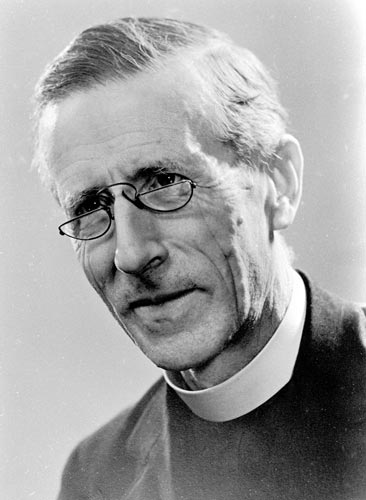
67/68. Who was this guy called Pierre Teilhard de Chardin? Why is he Famous in the Scientific Community?

From Are Jesuits Catholic?

Pierre Teilhard de Chardin was a visionary French Jesuit, paleontologist, biologist, and philosopher, who spent the bulk of his life trying to integrate religious experience with natural science, most specifically Christian theology with theories of evolution. In this endeavor he became absolutely enthralled with the possibilities for humankind, which he saw as heading for an exciting convergence of systems, an "Omega point" where the coalescence of consciousness will lead us to a new state of peace and planetary unity. Long before ecology was fashionable, he saw this unity he saw as being based intrinsically upon the spirit of the Earth:

"The Age of Nations is past. The task before us now, if we would not perish, is to build the Earth." Teilhard de Chardin passed away a full ten years before James Lovelock ever proposed the "Gaia Hypothesis" which suggests that the Earth is actually a living being, a collosal biological super-system. Yet Chardin's writings clearly reflect the sense of the Earth as having its own autonomous personality, and being the prime center and director of our future -- a strange attractor, if you will -- that will be the guiding force for the synthesis of humankind.

"The phrase 'Sense of the Earth' should be understood to mean the passionate concern for our common destiny which draws the thinking part of life ever further onward. The only truly natural and real human unity is the spirit of the Earth. . . .The sense of Earth is the irresistable pressure which will come at the right moment to unite them (humankind) in a common passion.

"We have reached a crossroads in human evolution where the only road which leads forward is towards a common passion. . . To continue to place our hopes in a social order achieved by external violence would simply amount to our giving up all hope of carrying the Spirit of the Earth to its limits."

To this end, he suggested that the Earth in its evolutionary unfolding, was growing a new organ of consciousness, called the noosphere. The noosphere is analogous on a planetary level to the evolution of the cerebral cortex in humans. The noosphere is a "planetary thinking network" -- an interlinked system of consciousness and information, a global net of self-awareness, instantaneous feedback, and planetary communication. At the time of his writing, computers of any merit were the size of a city block, and the Internet was, if anything, an element of speculative science fiction. Yet this evolution is indeed coming to pass, and with a rapidity, that in Gaia time, is but a mere passage of seconds. In these precious moments, the planet is developing her cerebral cortex, and emerging into self-conscious awakening. We are indeed approaching the Omega point that Teilhard de Chardin was so excited about.

This convergence however, though it was predicted to occur through a global information network, was not a convergence of merely minds or bodies -- but of heart, a point that he made most fervently.

"It is not our heads or our bodies which we must bring together, but our hearts. . . . Humanity. . . is building its composite brain beneath our eyes. May it not be that tomorrow, through the logical and biological deepening of the movement drawing it together, it will find its heart, without which the ultimate wholeness of its power of unification can never be achieved?"

In his productive lifetime, Teilhard de Chardin wrote many books, which include the following: LET ME EXPLAIN
THE APPEARANCE OF MAN
THE DIVINE MILIEU
THE FUTURE OF MAN
HOW I BELIEVE
HYMN OF THE UNIVERSE
LETTERS FROM A TRAVELLER
LETTERS TO LEONTINE ZANTA
THE MAKING OF A MIND
MAN'S PLACE IN NATURE
THE PHENOMENON OF MAN
SCIENCE AND CHRIST
THE VISION OF THE PAST
WRITINGS IN TIME OF WAR
BUILDING THE EARTH

Most of these quotes were taken from Building the Earth, and The Phenomenon of Man, but as I no longer have a copy, but only old notes, I can't quote exact page numbers.

by Anodea Judith, Dec. 96.

from: http://www.gaiamind.com/Teilhard.html
more on Teilhard de Chardin: http://en.wikipedia.org/wiki/Pierre_Teilhard_de_Chardin
posted by sonoftheprodigal at 8:43 PM 3 comments

Tuesday, October 23, 2007

Boomer Culpability (Updated)

From the blog 'After the Future'

October 21, 2007

MZ in response to my "Soft Tryranny" post asked what I thought about boomer culpability in getting us where we are. I'll share a few thoughts here, but what do other boomers think? Non-boomers--what's your take on the responsibility of your elders in getting us all into this fix?

I'd say first of all, the boomer generation is no different than any other except that it was young during an unusual--perhaps aberrational--moment in history. The technocracy trembled a little during that moment, but it didn't take long for it to recover and to reassert its control. Some boomers were affected by an awakening to new possibility that the sixties pointed to, but most in my generation were not affected. There's a reason Nixon pushed for the voting age to be lowered to 18 in 1970--he knew most young people would vote for him, and they did in '72.

As a young man, I wanted to believe that the creative burst that manifested in the sixties represented the introduction of a new cultural era, and I searched everywhere to find people to connect with who shared that hope. I went to meetings of the SDS and other radical left groups and was for the most part disgusted by the egoism, anger, and hedonism that seemed to be their animating spirit. It became clear that the idealism I was looking for would not be found there because for the most part the people in my generation who were leading the student movements didn't have it. They were driven primarily by narcissism and fear of the draft. The technocracy finally figured this out and adjusted by endorsing sexual license and taking away the draft. I learned then that the New Left in this country had its head up its ass then, and nothing much has changed since insofar as its ghost still dominates political discourse on the left.

There were and are exceptions. I admired what Saul Alinsky and his serious disciples were able to achieve. I admired the for the most part the sober analysis of Noam Chomsky, and there are several bloggers in the Chomsky "school" to whom I refer from time to time. But the closest thing I found to what I was looking for was in the Christian social activism of Dorothy Day, Cesar Chavez, and I admired what Daniel Berrigan was trying to do, and the liberation theology movement in Latin America. These people were all for real. I was influenced by the hope for a Church "devoid of means of power" envisioned by the brothers of Taize (Rest in peace, Brother Eric) went to Yale to study theology, worked as a book editor, and then faded away to live on the margins of the technocracy in the late eighties and nineties, allowing myself to become preoccupied by family and other local concerns as it became clearer that whatever the sixties were, they were a moment that had come and gone.

I woke up to the fact that while the American ideal is real, it has had a relatively weak influence in American history. The American spirit has mostly been a celebration of unrestrained greed and powerlust. Looking back on it now, it would appear that the only lasting effect of the sixties was to allow unrestrained sexuality join up with unrestrained greed and power. The technocracy is indifferent to sexual behavior or even promotes destroying traditional restraints. Sex keeps us all distracted. Better from the technocracy's point of view that we should be preoccupied with sexual rights than with political or economic rights.

If "freedom" becomes primarily identified with sexual freedom, not a problem for the technocracy. Whatever the the debate team pros and cons regarding abortion, its promotion as a technological solution to a deeply human and morally complex problem always bothered me and should have bothered more on the serious left, which was so easily co-opted by the technocracy on this issue. No fuss, no muss--so hygienic. I have always seen abortion as cognate with the technocracy's soul-numbing agenda, and it's no wonder that the narcissism of the left blinded them to that aspect of it. It shouldn't be surprising that abortion was enthusiastically approved by the elites in the technocracy and their children in my generation. Stupid sex without life consequences--cool. And it fits in so well with the technocracy's agenda to trivialize, demystify, and dehumanize us.

If the sixties had a political focus beginning the attempt to analyze and understand the technocracy's power, the seventies gave up on that project, focussed on its new sexual liberation toy, my generation and the tweener generation born in the thirties and the war years thus distracted averted their eyes from the more important developments taking place in the economic and political spheres. The tweeners and the boomers were essentially bought off with drugs, sex, and rock 'n roll, our late-modern version of Roman bread and circuses. And people on the left today wonder why they can't mobilize opposition to the technocratic beast? Our generation and those that followed us haven't even a shred of the discipline or the willingness to sacrifice and fight that would be required to face it down. In that we're all culpable. We're soft, and that's the way the technocracy likes us.

So are we boomers culpable more than others? Sure we were too easily bought off (Remember Jerry Rubin?), but it's hard for me to imagine what the leaders of our generation could have done differently. Is it realistic to believe that our generation could have dismantled the military industrial technocracy before 1989? I don't think so. The moment for that would have been in the fifties when we were kids, but the cold-war hysteria of our parents' 'greatest' generation made that an impossibility. And everyone in power at that time believed that the only way to keep the prosperity machine running was by feeding the military-industrial beast.

I suggested that our generation grew up in a historically aberrational era, and what made it so was its historically unprecedented affluence so quickly after a time of such horror and suffering. It was a dizzying time, and no one wanted to mess with success.The lingering fear of a return to the horrors of the 30s and 40s made it psychologically impossible for our parents' generation to consider starving the beast rather than to give it everything it demanded. As a result it became the fat, insatiable horror it is today. Sanity was an impossible option because the preservation of American prosperity and power was the only real option, so American society adjusted to the madness and called it normal.

And so after 1989 we elected for the first time one of our own. He is the boomer paradigm: a patina of idealism thinly coating crude instinctuality, ambition, and a ready willingness to serve the technocratic beast created in the forties and fifties. The technocracy prefers Republicans, but it can work with housetrained Democrats. And Clinton pretty much did everything he was told (as will his wife). His boomer VP, Al Gore, though compromised and complicit in the system, was still the better man in which genuine idealism had not been completely squeezed out of him. But the sincerity of his idealism is precisely what disqualified him from being elected. The beast does not tolerate genuine idealism, only its appearance.

And that's how it stands. Washington has become Babylon on the Potomac, a place attractive primarily to the power depraved, the money depraved, or the sexually depraved. No truly decent person could thrive there, and any person naive enough to think differently and who goes there with the idea to change things is quickly disillusioned and leaves, adapts, or in some rare cases makes a stand for principle, usually futile That's why Mukasey's getting a pass. That's why FISA is being dismantled. That's why we lost habeas corpus. That's why if Cheney/Bush decide to attack Iran, congress will get on the bandwagon.

That's what inside-the-Beltway politicians and media understand that the rest of us don't: nothing really matters except feeding the beast. Even the decent ones would say: "Unless you live in the belly of the beast, you cannot have any realistic idea what it's like to work in such an environment. Criticize all you want, unless you're here, you have no idea how things work and what's possible." I understand that, and that's why I don't believe there's any changing things from inside the system--pressure has to be brought from outside.

That kind of pressure is not likely to be brought against this system any time soon--certainly not by the boomer generation. So what is there to be done? the typical American might ask. They might quite reasonably answer: Not much, so why pay attention? Might as well enjoy the bread and circuses while they last. That's pretty much all you can do until the whole thing sooner or later collapses of its own corrupt weight as these systems inevitably do. Katrina was just a shot across the bow. We're evolving into Brazil where the elites will be safe and comfortable within their plushly appointed, Blackwater-guarded, gated communities, and the rest of us will be living in various versions of New Orleans.

So I think the idealism of the sixties was always something of a sham. Deep-seated, sincere Idealism is always a minority position in every generation. In that respect the boomers are no better or worse than any other generation. Maybe future generations will do better.

Update: Some might think my argument about the bloated beast is the same as the Libertarian argument to shrink government. The size of the government is not the issue, but whose interests it serves, and ours has ceased to serve the common good, serving instead the forces that have gradually transformed us into a militaristic surveillance state. Any government-shrinking Libertarian who supported the invasion of Iraq or approves the militarization of our economy over the last sixty years wants opposite things at the same time. Ron Paul seems to get that. I'm not sure so-called libertarian conservatives like Sullivan do. I don't buy into Paul's Libertarianism--I think it leads inevitably to the Brazilification of the country whether it's intended or not--but I would vote for him in a heartbeat if the only other choice was Hillary.

| | Comments (2) | TrackBack (0)

Thursday, October 11, 2007

It Takes A Village to Start World War III

by Nancy Kricorian

On September 26, 2007, Senator Hillary Rodham Clinton voted yes on the Kyl-Lieberman Amendment that effectively labeled the Iranian Revolutionary Guard Corps a “terrorist organization.” The Revolutionary Guard Corps is the largest branch of the Islamic Republic of Iran’s military. It is unprecedented in American history that the armed forces of a sovereign nation have been named “a terrorist organization.” In response to the Kyl-Lieberman Amendment, Iran’s Foreign Ministry and parliament have designated the U.S. Army and CIA as terrorist organizations.

Clinton was the lone Democratic presidential candidate to support this legislation that many view as giving President Bush authority to launch an air war against Iran. Senator Chris Dodd, in explaining his negative vote, said, “We learned in the run up to the Iraq war that seemingly nonbinding language passed by this Senate can have profound consequences. We need the president to use robust diplomacy to address concerns with Iran, not the language in this amendment that the president can point to if he decides to draw this country into another disastrous war of choice.” He added, “We shouldn’t repeat our mistakes and enable this President again.”

Saturday, September 22, 2007

Body-Snatched Nation

By BRENDAN COONEY

As scary as it is to watch someone electrocuted for speaking his mind, the most horrifying parts of the Andrew Meyer incident at the University of Florida are the things happening on the periphery. (The video can be seen here: http://youtube.com/watch?v=HgrFSHZfD1o)

There is the face of the woman on the right of the aisle, staring obediently ahead to Sen. John Kerry as Meyer is pinned to the ground just behind her. Or the man on the left smiling as the action comes right past him like actors tearing down the fourth wall.

The only person with the power to stop the assault was the man with the microphone, and his affect never rose above flat. Shortly before the cops pressed the volts into Meyer's chest, Kerry can be heard droning, "Folks, I think if we all just calm down." The folks he is addressing, of course, are not the police but the few audience members who have risen from their seats.

It's as if one is watching the end of "Invasion of the Body Snatchers," with Meyer coming out as the last human who has not been struck by the pods that replace people with emotionless doubles.

Perhaps half the comments of Youtube viewers support the Tasing as an apt treatment for someone so disruptive. Meyer may have been loud, attention-hungry and an awkward presence in the room, but the awkwardness is nothing compared with that of people trying to work out the concept of free speech in their online comments.

"The First Amendment does not guarantee anyone the right to make a public ass of oneself at the expense of others..." writes Russ Thayer. Joseph (comment 87 on the New York Times site) agrees: "I hate to tell you, but the meaning of Freedom of Speech doesn't mean you can scream and shout at people. To exercise your right to Freedom of Speech you need to remain calm." Says Dusty Bottoms, also on the Times site: "Freaking idiot deserved it.... [H]ow many times does one have to be warned? I'm all for free speech, but do it in an intelligent way."

The proportion of voices sympathetic to Meyer was altogether different among readers of the Times of London. Thirty-three thought the Tasing was wrong, and only three supported it. Should it be any surprise that readers of the foreign press are less authoritarian than readers of our mainstream media?

Duncan Roy, a United Kingdom resident, posts this comment on the New York Times site: "If shouting and agitation were the criteria for tasing then our entire british parliament would be tazed! What is it with you Americans that you have become so frightened of free and passionate speech?"

Police tasing students and others without cause is nothing new. A video of an even scarier incident at UCLA last fall can be watched on youtube at: http://youtube.com/watch?v=AyvrqcxNIFs

Police Tased this student because he didn't have his student ID in the library. The cell-phone video shows an eerily passive group of zombies, inching slowly forward as the victim cries for help. Only after the student is hauled out of the library, still being tased, do a couple students start asking for badge numbers, to which the reply is: "Back up or you'll get Tased too."

The alien pods haven't gotten us all, however. Based on the volume of comments people posted on the Meyer incident, watching the video clearly hit many Americans a lot harder than it did mainstream journalists.

Mike Bellman of Columbia, Missouri, wrote, "I am ten times ashamed for the spectators who watched this debacle slack-jawed and motionless like they were watching the you-tube video online. Shame on citizens who idly watch this kind of abuse and not recognize it. Shame on all of them including John Kerry who didn't relieve the police of their duties. And finally shame on anyone who doesn't have the courage to question authority or believe that another American has the right to speak freely in an open forum. I am ashamed to live in this America and I weep for the US Constitution."

And an "ECartman" wrote that a "lot worse happened in Berkeley in late 60's and early 70's.... Wish these students could get more incensed with what we are doing in Iraq everyday.... Don't expect this to happen though as these kids really got no soul."

There's a whole racially charged aspect to the question of police authority that I can't begin to unpack here, but "Jargon" says on the Times site: "I am so sick of this blind, unquestionable trust that whites hold for police."

On the spectrum of eeriness, watching Jimmy Kimmel laugh about the incident on late-night TV was strange, but not as bad as reading dismissive accounts of it in the mainstream press.

Shameful ad hominem reporting appeared in The New York Times, Washington Post, and Salon.com. It's as if these reporters can't keep these two concepts separate: "he was annoying" and "he deserved to be arrested and assaulted." This confusion reminds me of people I sometimes meet overseas who can't treat me as an individual because I come from the loathsome United States. The fact that Meyer's website features pranks and skits, notably that he carried a "Harry Dies" sign after the release of the last Harry Potter book, seems to have persuaded many people that he deserved what he got.

Someone who exudes such a reclining air that he will probably never be on the receiving end of a Taser is The Washington Post's Emil Steiner, who writes, "Kerry's voice, however, was no match for Meyer's, who despite not having a mic continued to hog the audience's attention with such glib catch phrases as: Help me! Help!'..."

This smug tone is jolted awake by the first comment below the piece, by a "Mark" from Rhode Island: "One word: FASCISM! Be afraid to ask vital questions in our free republic."

Steiner refers to the "mysterious" yellow book Meyer recommended for Kerry. The book was Armed Madhouse by Greg Palast. Meyer identified the author as a top investigative journalist; the senator said he'd already read it. What's the mystery, aside from the stunning disconnect between body-snatched reporters and the citizenry they putatively inform?

In observing the cultural milieu in which this incident took place, from the blank reaction of students and Kerry to online comments to press reports, there was an atavistic smack of the taste of what it was to be living in the United States in 2002 and 2003. It was the most haunting time I have known, when story after story in the mainstream press sold the war, and when friends of mine with college and law and medical and doctoral degrees jumped on the bandwagon, and I looked all around me and saw only pods.

The question is when does it happen; when do the pods take over our souls in this land? Is it in adolescence, when we have individuality pounded out of us by the mob so eager to squelch any deviant thought or behavior? Is it in classrooms or in front of televisions? What is the pod?

Surely Kerry was alive in Vietnam, when he saved his fellow soldiers, and when he came home to protest the war; but somewhere in 37 years of public life he got the lobotomy needed to win elections here. (Politicians with a pulse, such as Ralph Nader and Jessie Jackson, don't stand a chance.) Even after he had time to reflect, Kerry offered the Associated Press this safe pablum: "Whatever happened, the police had a reason, had made their decision that there was something they needed to do. Then it's a law enforcement issue, not mine."

Lost in the melee was one of Meyer's questions: "Why not impeach Bush before he has a chance to invade Iran?" It's a question that, if seriously considered, would Tase the brains of zombies everywhere.

Brendan Cooney is an anthropologist living in New York City. He can be reached at: itmighthavehappened@yahoo.com

Wednesday, September 19, 2007

How the World Works

[Brilliant writing and analysis from the blog 'AfterTheFuture'. click title above to read full post]

...this is the way the world works. Power uses power to consolidate power. The power system is self-perpetuating because it only hires and promotes people who serve its interests without questioning them. And the system and those who serve it co-opt or threaten anybody who would question it. The beltway media are full of people who have been threatened or coopted, and they may or may not be consciously aware of their acquiescence.

They live in a culture of acquiescence to power, and so it is normal and expected behavior for them to acquiesce to it. They do it without thinking, taking their cues from whoever it is whose job it is to give such cues. And they take the cues because their careers and lifestyles depend on it. They would not have risen to the positions they hold now if they were not ambitiously good cue takers. And so they have a vested interest in praising and supporting those who, like them, take the cues and squelching anybody who refuses to take them, because their livelihood and wellbeing depends on the charade continuing.

And whether we approve or disapprove makes no difference because we don't hire them, and our criticisms have little or no impact on their performance. They perform for their bosses and for one another in this self-reinforcing fiction that keeps them all in the positions they worked so hard to obtain. The self-perpetuation of the system doesn't require conspiracies and evil geniuses, just a lot of people pursuing their self interests and forming alliances with others who understand the game and will help you out so long as you serve their interests and play by the rules. Challenging the rules is out of the question, and gets you kicked out of the game. A guy like Ralph Nader will never be taken seriously because he challenges the rules--and Liberals who want Nader thrown out of the game are basically acquiescing to the rules as they are set up. The problem with Liberals is basically their naive belief that the system still works.

Kamiya and Greenwald are like wide-eyed boys who are telling us the emperor has no clothes, but it doesn't matter because there are too many people with a vested interest in the charade continuing, and everyone who sees the truth of the situation has no imagination about what to do about it. And if they do, if they express their understandable outrage, they will get ridiculed, ostracized or even tasered and arrested. And for what? Will it change anything?

Nothing is going to happen in Washington until serious power coalitions develop that have weight enough to counter the enormous entrenched and unaccountable corporate and bureaucratic power that is the driving force behind, particularly, the M/I complex. There are other power centers, but this one is the most deeply entrenched and the most resistant to political control.

I don't think the people who serve these power centers are evil, but they are the banal servants of evil. What is needed are heroes. These servants of power are just ordinary human beings like the media types described above. They are ambitious, and they do what they are told in order to get ahead. Petraeus is the archetype of this kind of person. The media recognize one of their own--he's a talented brown-nose, nothing more. That's what is so facetious about his being lionized last week. People like him don't think about the big picture. They are given assignments, they complete them, and they are rewarded. They mostly believe they are doing good work, serving their country. They don't think about the implications too much, and they are too willing to believe the propaganda justifying their mission because to question it would undermine their career aspirations, and, anyway, what good what that do?

The power system is self-perpetuating in this way. To change it would require a high level of awareness and a level of heroic commitment from millions of people inside and outside of government. And what citizens do in the ballot box is irrelevant until a slate of candidates arise who say that they are willing to confront and subject this system to the will of the people. Until that happens, the charade continues, and while Republicans are the more obsequious in serving these power centers, the Democrats, as we've seen, haven't the political will to confront them. They, too, are careerists, and first and foremost is the fulfillment of their own and their consultants' ambitions, and that requires that they, too, play by the rules. That's what it takes to be taken seriously, and that's just how the world works.

P.S. The whole Greensapn Iraq was "largely about oil'" statement in his new book is an interesting breach of the rules that even he, the most serious of serious Beltway types, felt he had to back away from by convolutedly talking about the threat Saddam posed to the Straits of Hormuz (?!). Just say anything, Alan--Americans don't know where the straits are anyway, and don't care. Of course Iraq was and continues to be largely, if not most importantly, about oil. But it's against the rules to talk about oil. What was he thinking? Did Andrea know he slipped it into his book?


Tuesday, September 18, 2007

Wars and Rumors of Wars

By Bob Waldrop

September 17, 2007

The article linked here, Red October, from the secular news source Stratfor.com , is troubling. The gist of the Stratfor analysis below is that Russia is making a move to oust the US from its present influence in the former Soviet Union countries like Georgia, Ukraine, and the Baltic republics. This would be in exchange for Russia not providing the Iranians with air defense and nuclear technology. Today's news also has articles about the French warning the Iranians that war may be coming their way. Stratfor.com of course is a "real-politik" news source. They don't ask or answer moral questions about our policy, they just report and comment. But as part of the "being wise as serpents and harmless as doves", I think we need to keep an eye on what they are saying.

And what they are saying is that we may be moving towards an old-fashioned super-power confrontation, US versus Russia, with Iran as a surrogate battlefield. "The more things change, the more they remain the same." See also "those who do not learn from the mistakes of history are doomed to repeat them."

If nothing else, read with "Catholic Worker" eyes, it seems to me that the American Empire's "last man standing" strategy seems to be moving to a new stage and may expand to include an "air war" in Iran.

I note that the US bishops haven't had much to say about Iran, and they remain fixated on their "responsible transition" newspeak, even though the whole idea of "transition" in the nationalist conversation about Iraq is passe, "last year's news". We are in Iraq to stay, and even if the Democrats sweep the nationalist elections in 2008, I think we will continue to stay until we are forced to leave (either military force or circumstances such as money/resource constraints). The Empire is "all in", as they say down at the Texas hold-em poker tables. Victory or bust.

It would be nice if the Catholic Church could play a heroic role in a movement for peace, but alas, that ain't happenin'.

Even so, we know which side the Lord Jesus Christ and his most blessed Mother are on. . .

Fecit potentiam in brachio suo, dispersit superbos mente cordis sui.
Deposuit potentes de sede et exaltavit humiles.
Esurientes implevit bonis et divites dimisit inanes,

He has shown strength with his arm and has scattered the proud in their conceit,
Casting down the mighty from their thrones and lifting up the lowly.
He has filled the hungry with good things and sent the rich away empty.

Note that in this equation, the United States is not the "lowly" nor are we the "hungry". We are the mighty who will be cast down, the conceited proud who will be scattered, and the rich who are sent away empty.

Meanwhile, the price of oil hit another all-time high in trading earlier today, and in England, a major bank run continues that has seen $4 billion withdrawn from one banking institution in only 4 days. There are fears that the crisis of confidence in the banking system could spread.

We've spent over a trillion dollars on the Iraq war, as well as an additional trillion on other "war" expenditures since Sept 11, 2001.

So it comes to pass that the rich are getting richer, and everybody else is getting poorer. But note how the financial press regularly blames the mess on "sub-prime loans" made to lower income people with higher credit risks. We're not supposed to think about the 2 trillion dollars squandered on war and destruction. Nor should we focus on the hundreds of billions we pay for our petroleum gluttony. Everyone is clearly instructed to ignore the man behind the curtain. Where is Toto when we need him?

Well, possessed by the spirit of the intrepid Toto, in England, some bank depositors have decided they don't like the looks of the man behind the curtain and they are in "take the money and run" mode. I am not sure where they can run to with it, but they are certainly moving right along with it. They are being blamed by the "Establishment" for their "irrational fears about the banking system". "How dare you lose faith in one of our Fine Honest Banks!"

A bank run here, a few record high prices for oil over there, and a new "splendid little air war" as icing on the cake. This is what it looks like as a great empire edges towards the ash heap of history.

Please pray for peace on all military and economic battlefields.

Please continue to build new structures among these collapsing ruins of the old. The day is coming when we will desperately need them.

Bob Waldrop, picketing St. Joseph in Oklahoma City

Eugene McCarraher nails it again...


From a discussion at dotCommonweal:

Posted by eugene mccarraher
on September 17, 2007, 7:36 am

The reason the Democrats have not shown any interest in exploring the reasons for the invasion is that they already know the reasons: oil, Israel, the desire to establish a U.S. strategic presence. The fact is that they share these objectives no less than the Bush Administration does. They understand full well what's imperialist about what the U.S. has done. (It's worth recalling that the first Congressional resolution supporting "regime change" in Iraq -- which was, admittedly, non-binding -- was passed in 1998, with the full support of the Clinton Adminstration and Senate Democrats.) What else explains, for instance, Obama's stated willingness to unilaterally bomb Pakistan? Or Clinton's dithering about what she would do? The Democrats are the left wing of the military-industrial complex: get the oil, make some noise about Palestinian rights, "oppose the war and support the troops" (a pathetic rhetorical evasion of serious debate about the war), vilify Bush's "incompetence" for the umpteenth time, chicken out when it comes to civil liberties and cutting funding for the war, which is the only serious way to get this President to do anything.

What's truly sobering is that, given the persistence of U.S. economic, diplomatic, and strategic interests, we're not leaving Iraq. Getting out would require, not only that we have an open and unfettered debate about our relationship with Israel (don't hold your breath on that), but that we get serious about finding substitutes for oil (don't hold your breath on that either).

I must say I find it amusing that Powers has, in effect, confirmed what the radical left has been saying about the war all along. Many contributors to this and other blogs have been characterizing us as a bunch of wackos for quite some time, and now we have one of the nation's premiere analysts of foreign and military affairs saying, gee, those wackos got it right. We'll all learn a lot more from Chalmers Johnson than from Thomas Friedman, that overrated blowhard who, when once confronted on NPR with his support for the invasion, said, "Yes, there were no WMDs. I'll have to live with that." While thousands have died with that.

"How (Not) To Speak of God," by Peter Rollins


"The emerging [Christian] thought is a self-acknowledged form of heresy insomuch as it is aware of its failure to describe that of which it speaks. This recognition acts as an effective theological response to fundamentalism, as it unsettles the dark heart of its self-certain power. Very briefly, fundamentalism can be understood as a particular way of believing one's beliefs rather than referring to the actual content of one's beliefs.

"It can be described as holding a belief system is such a way that it mutually excludes all other systems, rejecting other views in direct proportion to how much they differ from one's own. In contrast, the a/theistic approach can be seen as a form of disbelieving what one believes, or rather, believing IN God while remaining dubious concerning what one believes ABOUT God (a distinction that fundamentalism is unable to maintain). This does not actually contradict the idea of orthodoxy but rather allow us to understand it in a new light...

"This a/theism is not then some temporary place of uncertainty on the way to spiritual maturity, bur rather is something that operates within faith as a type of heat-inducing friction that prevents our liquid images of the divine from cooling and solidying into idolatrous form."

Sunday, September 16, 2007

An Open Letter to the New Generation of Military Officers Serving and Protecting Our Nation By Dr. Robert M. Bowman, Lt. Col., USAF, ret.

Dear Comrades in Arms,
You are facing challenges in 2007 that we of previous generations never dreamed of. I'm just an old fighter pilot (101 combat missions in Vietnam , F-4 Phantom, Phu Cat, 1969-1970) who's now a disabled veteran with terminal cancer from Agent Orange. Our mailing list (over 22,000) includes veterans from all branches of the service, all political parties, and all parts of the political spectrum. We are Republicans and Democrats, Greens and Libertarians, Constitutionists and Reformers, and a good many Independents. What unites us is our desire for a government that (1) follows the Constitution, (2) honors the truth, and (3) serves the people.
We see our government going down the wrong path, all too often ignoring military advice, and heading us toward great danger. And we look to you who still serve as the best hope for protecting our nation from disaster.
We see the current Iraq War as having been unnecessary, entered into under false pretenses, and horribly mismanaged by the civilian authorities. Thousands of our brave troops have been needlessly sacrificed in a futile attempt at occupation of a hostile land. Many more thousands have suffered wounds which will change their lives forever. Tens of thousands have severe psychological problems because of what they have seen and what they have done. Potentially hundreds of thousands could be poisoned by depleted uranium, with symptoms appearing years later, just as happened to us exposed to Agent Orange. The military services are depleted and demoralized. The VA system is under-funded and overwhelmed. The National Guard and Reserves have been subjected to tour after tour, disrupting lives for even the lucky ones who return intact. Jobs have been lost, marriages have been destroyed, homes have been foreclosed, and children have been estranged. And for what? We have lost allies, made new enemies, and created thousands of new terrorists, further endangering the American people.
But you know all this. I'm sure you also see the enormous danger in a possible attack on Iran , possibly with nuclear weapons. Such an event, seriously contemplated by the Cheney faction of the Bush administration, would make enemies of Russia and China and turn us into the number one rogue nation on earth. The effect on our long-term national security would be devastating.
Some of us had hoped that the new Democratic Congress would end the occupation of Iraq and take firm steps to prevent an attack on Iran , perhaps by impeaching Bush and Cheney. These hopes have been dashed. The lily-livered Democrats have caved in, turning their backs on those few (like Congressman Jack Murtha) who understand the situation. Many of us have personally walked the halls of Congress, to no avail.
This is where you come in.
We know that many of you share our concern and our determination to protect our republic from an arrogant, out-of-control, imperial presidency and a compliant, namby-pamby Congress (both of which are unduly influenced by the oil companies and other big-money interests). We know that you (like us) wouldn't have pursued a military career unless you were idealistic and devoted to our nation and its people. (None of us do it for the pay and working conditions!) But we also recognize that you may not see how you can influence these events. We in the military have always had a historic subservience to civilian authority.
Perhaps I can help with whatever wisdom I've gathered from age (I retired in 1978, so I am ancient indeed).
Our oath of office is to “protect and defend the Constitution of the United States against all enemies, foreign and domestic.” Might I suggest that this includes a rogue president and vice-president? Certainly we are bound to carry out the legal orders of our superiors. But the Uniform Code of Military Justice (UCMJ) which binds all of us enshrines the Nuremberg Principles which this country established after World War II (which you are too young to remember). One of those Nuremberg Principles says that we in the military have not only the right, but also the DUTY to refuse an illegal order. It was on this basis that we executed Nazi officers who were “only carrying out their orders.”
The Constitution which we are sworn to uphold says that treaties entered into by the United States are the “highest law of the land,” equivalent to the Constitution itself. Accordingly, we in the military are sworn to uphold treaty law, including the United Nations charter and the Geneva Convention.
Based on the above, I contend that should some civilian order you to initiate a nuclear attack on Iran (for example), you are duty-bound to refuse that order. I might also suggest that you should consider whether the circumstances demand that you arrest whoever gave the order as a war criminal.
I know for a fact that in recent history (once under Nixon and once under Reagan), the military nuclear chain of command in the White House discussed these things and were prepared to refuse an order to “nuke Russia .” In effect they took the (non-existent) “button” out of the hands of the President.. We were thus never quite as close to World War III as many feared, no matter how irrational any president might have become. They determined that the proper response to any such order was, “Why, sir?” Unless there was (in their words) a “damn good answer,” nothing was going to happen.
I suggest that if you in this generation have not had such a discussion, perhaps it is time you do. In hindsight, it's too bad such a discussion did not take place prior to the preemptive “shock and awe” attack on Baghdad . Many of us at the time spoke out vehemently that such an attack would be an impeachable offense, a war crime against the people of Iraq , and treason against the United States of America . But our voices were drowned out and never reached the ears of the generals in 2003. I now regret that I never sent a letter such as this at that time, but depended on the corporate media to carry my message. I must not make that mistake again.
Also in hindsight, President Bush could be court-martialed for abuse of power as Commander-in-Chief. Vice President Cheney could probably be court-martialed for his performance as Acting Commander-in-Chief in the White House bunker the morning of September 11, 2001 .
We in the U.S. military would never consider a military coup, removing an elected president and installing one of our own. But following our oath of office, obeying the Nuremberg Principles, and preventing a rogue president from committing a war crime is not a military coup. If it requires the detention of executive branch officials, we will not impose a military dictatorship. We will let the Constitutional succession take place. This is what we are sworn to. This is protecting the Constitution, our highest obligation. In 2007, this is what is meant by “Duty, Honor, Country.”
Thank you all for your service to this nation. May God bless America , and sustain us in this difficult time. And thanks for listening to the musings of an old junior officer.
Respectfully,


Robert M. Bowman, PhD, Lt. Col., USAF, ret.
1494 Patriot Dr , Melbourne , FL 32940
home phone (321) 752-5955; cell (321) 258-0582

"We're almost there now"

[This is a comment that was posted after the linked article at commondreams]

by Cee Miracles September 16th, 2007 8:52 pm

How many Germans sat around their kitchen tables and tried to find sense and reason and ways to stop what was underway? How many Germans lay in bed at night talking in worried tones with their spouses and lovers wondering what would happen to their lives and the lives of their children and families? How many Germans became fearful as the signs were everywhere of punishment and incarceration if one actively opposed the Fuehrer and his “government”? How many Germans began to walk with their heads down trying to be as unobtrusive as possible? How many walked on with poker faces as old Jewish men and women were assaulted by young Nazi soldiers because it was the safest thing to do?
We’re almost there now. Hitler’s plans were in the works for a decade or more. So have the plans been in the works of the Bush cartel of family, Right Wingers, NeoCons, elected ones in the hallowed halls of Congress, corporate and media whores, and all the rest of the greedy, ambitious-for-empire, psychopathic devils from this country and across the seas where the arrogant White, racist Colonialists are still firmly entrenched, and in Israel where the Zionist cabal has planned, acted and dreamed of this day and are now rubbing their collective hands together as the dream seems to be coming to fruition.
We are the Germans now, … and the Italians and the Japanese … and even many of the French, who have now voted in Sarkozy as Premier, a man cut from old, familiar cloth.
The world blamed the citizens back then for doing nothing, and now U.S. of A. Americans for allowing what is happening to happen.
It is not easy evidently for us of the U.S. of A. who understand and know what is happening to figure out what to do. The old ways of marches and protests, letter writing, appealing to elected officials … none of it is working. The media is purposefully blind and silent and distorts snippets of truth. We have been propagandized to death … to accept the deaths of others.
Iraqis, the Palestinians, the Somalians, the Darfurians, the Lebanese, and the peasants in Columbia and so many others caught in the crossfire of brutal, vicious insanities … GENOCIDE is happening and more is planned.
We are the Germans now … and all the others. The detention camps are ready. … And so are the bombs.
Reasoned, compassionate thinking is lost on those who have no conscience and are driven by their irrational, insane compulsions. Brutality is nothing to them.
Our governmental mechanisms are failing.
Who are you and who am I? We have entered the hours and days of our individual and national and spiritual testing. And the anvil is hot and the coals are glowing redder and redder...

Saturday, September 15, 2007